
The Significance of B2B Messaging in Contemporary Business
Updated April 2026
Executive Summary
B2B messaging is the backbone of modern enterprise communication, enabling real-time collaboration, faster decision-making, and secure information exchange between organizations. Unlike consumer-focused tools, enterprise-grade B2B messaging prioritizes governance, compliance, integration depth, and deployment flexibility.
Organizations evaluating messaging platforms should assess security architecture, scalability, admin controls, and total cost of ownership—not just feature checklists. TrueConf delivers a secure, on-premises-capable messaging and video collaboration platform designed for regulated industries and enterprises requiring full data sovereignty.
|
Criteria |
What to Evaluate |
Why It Matters |
TrueConf Approach |
|---|---|---|---|
|
Deployment Model |
Cloud, hybrid, or on-premises |
Determines data control, compliance readiness, and integration complexity |
Supports on-premises, private cloud, and air-gapped deployments |
|
Security & Compliance |
Encryption, audit logs, access controls, certifications |
Critical for regulated sectors (finance, government, healthcare) |
End-to-end encryption, SSO/MFA, granular RBAC, compliance-ready architecture |
|
Integration Depth |
APIs, SDKs, CRM/ERP connectors, SIP/H.323 support |
Impacts workflow continuity and adoption across existing tools |
Open API, VideoSDK, chatbot/calendar connectors, SIP gateway |
|
Scalability |
User limits, MCU support, load balancing |
Ensures performance during growth or peak usage |
Scales from 10 to 1,000,000+ users with TrueConf Enterprise + MCU |
|
Admin & Governance |
Centralized management, monitoring, policy enforcement |
Reduces IT overhead and enforces corporate communication standards |
TrueConf Monitor, license distribution, global user lists, SSO integration |
Your Messages Are Secure with TrueConf!
A powerful self-hosted video conferencing solution for up to 1,000 users, available on desktop, mobile, and room systems. Your confidential information is protected by 12 levels of security.
Understanding B2B Communication
B2B (business-to-business) messaging is the exchange of information between companies to facilitate collaboration, share details, or finalize agreements. In contrast to B2C (business-to-consumer) messaging, which targets individual consumers, B2B messaging, where businesses often apply for WhatsApp Business API access to streamline communication, is customized to fulfill the specific needs of businesses, improving productivity and fostering professional connections.
This communication can occur through various channels such as email, chatbot tools, instant messaging applications, and specialized platforms like Slack or Microsoft Teams. These messages typically cover product inquiries, service updates, contract negotiations, and marketing strategies tailored to corporate customers.
Well-organized communications save time, reduce mistakes, and facilitate the establishment of lasting partnerships.
Insight #1: Deployment Philosophy Drives Long-Term Viability
Many B2B messaging evaluations focus narrowly on UI or feature parity, overlooking deployment architecture.
For enterprises in regulated industries, the ability to deploy messaging infrastructure on-premises—or in a private cloud with full data residency—is not a “nice-to-have” but a compliance prerequisite.
Solutions that force public-cloud tenancy may create hidden technical debt when governance requirements evolve.
Corporate Communication Without Borders With TrueConf!
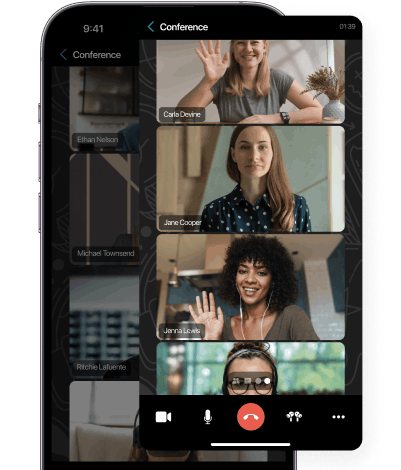
All Participants in Sight
Online meetings are not limited to the smartphone screen alone — simply scroll through the conference pages, which display the number of participants you have set!
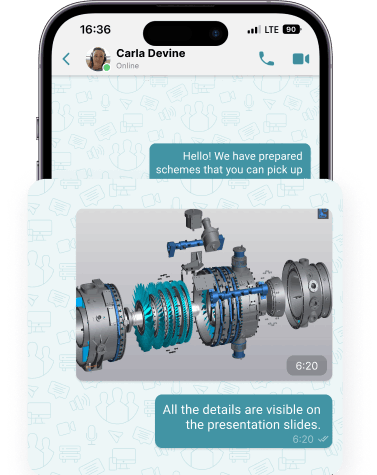
File Sharing
Send your colleagues images, documents and other files from your device’s memory, iCloud Drive cloud storage and third-party applications, and share your geolocation if necessary.
Speakers in Focus
Users who actively speak are always visible thanks to a special voice activation mechanism.

How to Choose a B2B Messaging Platform
Selecting the right B2B messaging platform requires a structured evaluation framework.
Use this decision checklist:
- Define Your Compliance Requirements: Identify industry regulations (GDPR, HIPAA, FSTEC) that dictate data handling, retention, and encryption standards.
- Map Integration Needs: List existing systems (CRM, ERP, ITSM) that must connect with your messaging platform via API, webhook, or native connector.
- Assess Deployment Flexibility: Determine whether cloud, hybrid, or on-premises deployment aligns with your IT strategy and risk tolerance.
- Evaluate Administrative Controls: Verify support for role-based access, audit logging, message retention policies, and external guest management.
- Test Scalability Scenarios: Request performance benchmarks for peak loads, concurrent meetings, and multi-region user distribution.
- Review Total Cost of Ownership: Factor in licensing, infrastructure, and maintenance. If you are integrating with back-office systems, perform a deep dive into how user licenses affect your NetSuite costs to avoid unexpected budget spikes during the scaling phase.
|
Evaluation Stage |
Key Questions |
Red Flags to Avoid |
|---|---|---|
|
Discovery |
What data types will be shared? Who are external vs. internal users? |
Vague answers about data residency or encryption standards |
|
Technical Validation |
Can we test SSO integration? Is there a sandbox environment? |
No API documentation or limited trial functionality |
|
Governance Review |
How are admin roles delegated? Can we export audit logs? |
Lack of granular permission controls or compliance reporting |
|
Pilot Deployment |
How long does onboarding take? What support is available? |
Poor documentation or slow response from vendor support |
Try TrueConf Server Free!
- 1,000 online users with the ability to chats and mske one-on-one video calls.
- 10 PRO users with the ability to participate in group video conferences.
- One SIP/H.323/RTSP connection for interoperability with corporate PBX and SIP/H.323 endpoints.
- One guest connection to invite a non-authenticated user via link to your meetings.

Insight #2: Governance Over Features
The most overlooked factor in B2B messaging selection isn’t feature count—it’s administrative governance.
Can you enforce message retention policies? Audit user activity? Restrict file types or external sharing?
Platforms that empower IT with granular policy controls reduce risk and simplify compliance reporting, even if their consumer-facing UI appears less “flashy.”
Best B2B Messaging Software for Companies
|
Platform |
Best For |
Deployment Options |
Key Strength |
Primary Limitation |
|---|---|---|---|---|
|
TrueConf |
Regulated enterprises, government, finance |
On-premises, private cloud, hybrid |
Full data sovereignty + video collaboration |
Requires internal infrastructure management |
|
Microsoft Teams |
Microsoft 365 ecosystems, mid-large enterprises |
Cloud, hybrid via ExpressRoute |
Deep Office integration, familiar UX |
Limited on-premises control, complex licensing |
|
Slack |
Tech startups, remote-first teams, agile workflows |
Cloud-only |
Rich app directory, intuitive interface |
No native on-premises, compliance gaps for sensitive data |
|
Mattermost |
DevOps teams, security-conscious orgs |
Self-hosted, cloud |
Open-source flexibility, GitLab integration |
Smaller ecosystem, steeper learning curve |
|
Rocket.Chat |
Customer-facing messaging, omnichannel support |
Self-hosted, cloud, hybrid |
White-label options, livechat integration |
Resource-intensive for large-scale deployments |
Secure B2B Messaging for Enterprises
Security in B2B messaging extends beyond basic encryption. Enterprise-grade protection requires a layered approach:
- Data Protection: End-to-end encryption for messages and files, with customer-managed keys where required.
- Access Control: Multi-factor authentication, SSO integration, and role-based permissions to limit data exposure.
- Audit & Compliance: Immutable logs, message retention policies, and export capabilities for regulatory reporting.
- Network Security: Support for private network deployment, firewall traversal, and zero-trust architecture principles. For distributed teams using company devices, secure remote access often depends on a VPN software for Mac to protect communication outside internal networks and reduce exposure risks.
- Threat Mitigation: Malware scanning for attachments, link protection, and anomaly detection for suspicious activity.
Insight #3: Integration Depth > Feature Breadth
A messaging platform with 50 superficial integrations is less valuable than one with 5 deep, bidirectional workflows.
Prioritize solutions that enable context-aware actions—like launching a video call from a CRM record with pre-loaded participant data—over those that merely push notifications.
TrueConf’s API and VideoSDK enable embedded collaboration directly within line-of-business applications, reducing context switching and improving adoption.
|
Security Feature |
Implementation Requirement |
Business Impact |
|---|---|---|
|
End-to-End Encryption |
Keys managed by customer or trusted HSM |
Prevents unauthorized access even if infrastructure is compromised |
|
Granular RBAC |
Custom roles with permission inheritance |
Reduces insider risk and simplifies onboarding/offboarding |
|
Audit Logging |
Real-time export to SIEM or external storage |
Enables forensic analysis and compliance evidence collection |
|
Data Residency Controls |
Configurable storage regions or on-premises only |
Meets legal requirements for cross-border data transfer |
|
Session Management |
Timeout policies, device trust verification |
Limits exposure from lost or compromised endpoints |
B2B Messaging Use Cases
Real-world scenarios where B2B messaging drives measurable business value:
- Cross-Organization Project Collaboration: Secure channels for joint ventures, enabling file sharing, task coordination, and video standups without exposing internal systems.
- Vendor & Supplier Coordination: Dedicated messaging spaces for procurement teams to negotiate contracts, share specifications, and track deliveries with external partners.
- Customer Success & Support Escalation: Integrated messaging for technical teams to collaborate on complex client issues, foster trust, and maintain audit trails.
- Regulatory & Compliance Workflows: Secure communication channels for legal, risk, and compliance teams to discuss sensitive matters with external counsel.
- Incident Response Coordination: Real-time messaging for security operations centers (SOCs) to coordinate threat response across internal teams and external CERTs.
- Executive & Board Communications: Encrypted, access-controlled channels for strategic discussions requiring confidentiality and non-repudiation.
Pro Tip: Map each use case to specific platform capabilities. For example, vendor coordination may require guest access controls and external domain whitelisting, while incident response demands high-availability architecture and mobile client support.
B2B Messaging Best Practices
Adopt these evidence-based practices to maximize ROI from your B2B messaging investment:
- Start with Governance, Not Features: Define policies for data classification, retention, and external sharing before configuring the platform.
- Phase Your Rollout: Begin with a pilot group, gather feedback, and refine configurations before organization-wide deployment.
- Invest in Change Management: Provide role-based training and clear usage guidelines to drive adoption and reduce shadow IT.
- Monitor & Optimize Continuously: Use built-in analytics to track engagement, identify bottlenecks, and adjust policies based on actual usage patterns.
- Document Integration Workflows: Maintain runbooks for key integrations (CRM, ITSM, HRIS) to simplify troubleshooting and onboarding.
- Plan for Business Continuity: Test failover procedures, backup restoration, and disaster recovery scenarios regularly, especially when coordinating with a fractional CMO or other external stakeholders.
|
Practice |
Implementation Tip |
Expected Outcome |
|---|---|---|
|
Policy-First Configuration |
Draft communication policies before platform setup |
Reduced compliance risk and clearer user expectations |
|
Role-Based Training |
Create tailored guides for admins, managers, end-users |
Faster adoption and fewer support tickets |
|
Usage Analytics Review |
Schedule monthly reviews of engagement metrics |
Data-driven optimization of channels and features |
|
Integration Health Checks |
Automate monitoring of API connectors and webhooks |
Proactive issue resolution before business impact |
B2B Messaging Metrics and Analytics
Measure what matters. Track these KPIs to evaluate messaging platform effectiveness:
- Adoption Rate: % of target users actively sending/receiving messages weekly.
- Engagement Depth: Average messages per user, file shares, and video call initiations.
- Response Time: Median time to first reply in critical channels (e.g., support, incident response).
- Compliance Adherence: % of messages retained per policy, audit log completeness.
- Integration Utilization: Frequency of CRM/ERP actions triggered from messaging workflows.
- Cost Per Active User: Total platform cost divided by engaged users (not just licensed seats).
|
Metric Category |
Key Indicators |
Benchmark Target |
|---|---|---|
|
Adoption |
DAU/MAU ratio, feature usage distribution |
>70% of licensed users active weekly |
|
Efficiency |
Reduced email volume, faster decision cycles |
20-30% decrease in internal email traffic |
|
Security |
Policy violations detected, audit log coverage |
Zero critical findings in compliance audits |
|
Business Impact |
Deal cycle time, support resolution time |
Measurable improvement in core workflows |
Analytics Implementation Checklist:
- Enable native platform reporting dashboards
- Export logs to centralized SIEM or BI tools for cross-system analysis
- Set up automated alerts for anomalous activity or policy breaches
- Review metrics quarterly with stakeholders to align platform evolution with business goals
Steps for Developing a Robust B2B Messaging Strategy
A robust B2B messaging strategy is essential for efficient communication, nurturing trust, and cultivating significant business connections. Here’s how to craft a strategy that delivers outcomes:
- Understand Your Audience. Recognize the pain points and priorities of your target customers. Engage thorough research to tailor your communications and meet their individual needs efficiently.
- Create ABM Strategy. Effective B2B messaging should also involve developing an effective ABM strategy that aligns communication with specific high-value accounts, significantly enhancing account engagement and achieving account-level revenue generation. Businesses can use targeted campaigns to generate b2b sales ready leads and drive conversions.
- Showcase Your Value Proposition. Showcase the reasons why businesses ought to select your services over the competition. Emphasize the distinct benefits of your offerings, how they address their pain points, and how you can provide leads to accelerate revenue growth. For example, in real estate marketing, clear messaging helps agencies differentiate themselves and attract qualified clients.
- Prioritize Clear and Cohesive Communication. Utilize simple language to convey your message. Avoid complicated terminology and ensure consistent messaging across all channels.
- Showcase Your Brand’s Character. Ensure that your communication style reflects the essence of your brand, whether it’s professional, friendly, or innovative. Consistent branding fosters trust and credibility. When teams use AI to draft outreach, support messages, or partner communications, an AI detector can help review content before publication and ensure messaging remains authentic, accurate, and aligned with the brand voice. Using B2B content marketing helps share your brand’s personality through blogs, social posts, and articles, building trust and credibility with your audience. To further strengthen professional credibility and attract decision-makers, businesses and individuals can also focus on Linkedin optimization to ensure their profiles and content effectively support broader brand-building efforts.
- Utilize Data for Valuable Insights. Examine metrics such as response rates and engagement levels to gain valuable insights. Utilize this data to enhance your messaging and achieve better results.
- Be Flexible. Adapt your messaging as business requirements evolve. Stay informed about industry trends and make necessary adjustments to stay relevant and effective.
Key Elements for a B2B Mobile Application
A successful B2B mobile application emphasizes functionality, user experience, and flexibility. Essential elements comprise:
- User-Friendly Interface: Guarantee effortless navigation through a sleek and intuitive design.
- Enhanced Security Measures: Protect confidential information through encryption and strong authentication protocols.
- Integration Features: Enable smooth interactions with platforms such as CRMs and ERPs.
- Scalability: Develop an application that can grow alongside your business requirements.
- Offline Functionality: Allow users to operate without internet access and synchronize data.
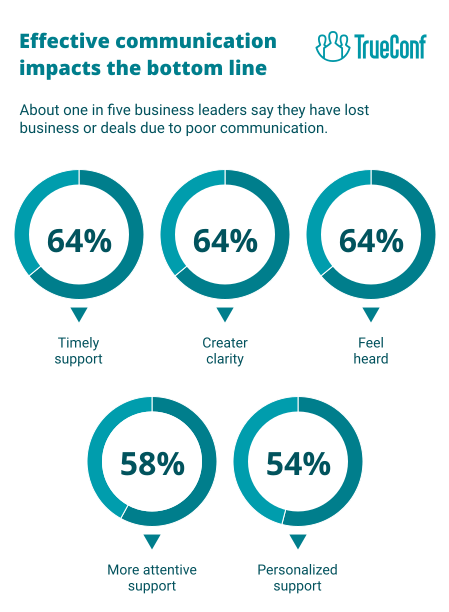
Leveraging Messenger Apps in B2B Sales
B2B messaging apps have become essential in B2B sales, providing efficient and tailored communication. Here are tips on maximizing their potential:
- Select the Appropriate Platform. Coose platforms where your target audience is active, such as WhatsApp or WhatsApp Business, LinkedIn Messenger, or Slack.
- Maintain a Polished Profile. Ensure your profile reflects your business identity. Include links to your business website or portfolio showcasing your design work.
- Engage in Meaningful Dialogues. Tailor your communications by addressing the recipient by name and acknowledging their specific business requirements. Provide immediate value by using a demo automation software to deliver interactive, personalized demos that resonate with each prospect’s unique needs, and keep messages concise.
- Strategically Monitor Follow-Ups. Send timely follow-ups or updates that offer value without overwhelming the recipient.
- Enhance Performance with Data Analysis. Monitor engagement metrics and adapt your messaging approach to enhance responses and results.
In Conclusion
B2B messaging is transforming the way businesses communicate, collaborate, and finalize transactions. By adopting effective tools and tactics, organizations can strengthen relationships and unlock new opportunities. Whether through mobile applications or messaging platforms, the key to success is to be transparent, reliable and focused on delivering value in every interaction.
For enterprises operating in regulated environments or requiring full control over communication infrastructure, platforms like TrueConf provide the necessary blend of security, scalability, and integration capability.
The strategic advantage lies not just in sending messages faster—but in ensuring every interaction is compliant, contextual, and connected to broader business workflows.
FAQ
What makes B2B messaging different from consumer chat apps?
B2B messaging requires enterprise-grade security, admin governance, compliance controls, and deep integration capabilities that consumer apps lack. TrueConf addresses these needs with on-premises deployment options, granular access policies, and APIs designed for business workflow integration.
Can B2B messaging platforms work without internet access?
Yes, but only if designed for on-premises or air-gapped deployment. TrueConf Server operates entirely within your private network, enabling secure messaging and video conferencing without external connectivity—critical for defense, utilities, and highly regulated sectors.
How do I evaluate messaging platforms for long-term scalability?
Assess architecture flexibility: can it scale from dozens to thousands of users without re-architecture? TrueConf supports modular scaling via TrueConf Enterprise and MCU components, allowing organizations to start small and expand without platform migration.
Why is on-premises deployment still relevant for messaging?
Data sovereignty, regulatory compliance, and risk mitigation drive continued demand for on-premises solutions. TrueConf enables full control over data location, encryption keys, and audit trails—requirements that public-cloud-only messengers cannot satisfy for many enterprises.
What integration capabilities should I prioritize?
Focus on bidirectional APIs, identity provider support (SSO), and compatibility with existing UC infrastructure like SIP endpoints. TrueConf offers REST APIs, VideoSDK, and SIP/H.323 gateway functionality to embed collaboration into CRM, ERP, and custom applications.
How does TrueConf support hybrid or remote teams securely?
TrueConf combines end-to-end encryption, MFA, and role-based access controls with flexible client support (desktop, mobile, web, VDI). Its architecture allows secure external guest access without compromising internal network policies, making it suitable for distributed enterprise teams.
Can I migrate from a public-cloud messenger to an enterprise platform like TrueConf?
Yes, with proper planning. TrueConf supports phased deployment, user provisioning via directory sync, and coexistence strategies during transition. Its admin tools simplify user onboarding and policy enforcement, reducing migration friction compared to consumer-grade alternatives.
About the Author
Olga Afonina is a technology writer and industry expert specializing in video conferencing solutions and collaboration software. At TrueConf, she focuses on exploring the latest trends in collaboration technologies and providing businesses with practical insights into effective workplace communication. Drawing on her background in content development and industry research, Olga writes articles and reviews that help readers better understand the benefits of enterprise-grade communication.


Follow us on social networks