
7 Remote Work Challenges You Can Easily Overcome with Video Conferencing Software
Updated April 2026
Remote and hybrid work have shifted from emergency measures to permanent workplace infrastructure. Today, roughly three out of four employees have some remote component in their week — and the technology they rely on has to match that scale. Video conferencing software sits at the center of that stack: it replaces the hallway conversation, the whiteboard session, the onboarding lunch, and the all-hands meeting — all at once.
This article walks through the seven most common remote work challenges and explains how purpose-built video conferencing software addresses each one.
Quick Reference: Challenges, Impact & Solutions
The table below captures the core of this article. If you’re evaluating video conferencing tools for a distributed team, start here.
|
Challenge |
Why It Hurts Remote Teams |
How Video Conferencing Helps |
Key TrueConf Feature |
|---|---|---|---|
|
Communication |
No face-to-face cues; messages misread |
Real-time video restores non-verbal context |
4K video calls, persistent team chat |
|
Collaboration |
Hard to co-create across locations |
Screen sharing, whiteboards, breakout rooms |
Collaborative whiteboard, content sharing |
|
Engagement |
Isolation, meeting fatigue, low motivation |
Regular video touchpoints, fun interaction tools |
Stand-up modes, reaction tools |
|
Scheduling |
Time zones, flexible hours, no single “overlap” |
Calendar integrations, AI scheduling |
Google Calendar / Outlook sync |
|
Training & Onboarding |
New hires feel lost without in-person context |
Live sessions + recorded on-demand content |
Meeting recording, AI transcription (TrueConf AI Server) |
|
Company Culture |
Physical separation erodes shared identity |
Virtual events, coffee chats, milestone celebrations |
Broadcast webinars, up to 1,500 participants |
|
Managing Remote Workers |
Invisible progress, harder feedback loops |
Structured check-ins, documented decisions |
One-click 1:1 video calls, meeting history |
State of remote work at a glance
About 27% of full-time employees worldwide now work fully remotely, and an additional 52% are in hybrid arrangements.
Hybrid job postings grew from 15% to 24% of all new postings between mid-2023 and mid-2025. The question for organizations is no longer whether to support remote work, but how well.
1. Communication
Effective business communication is the undeniable lifeblood of any organization. As they rely heavily on clear and efficient communication to thrive in the competitive landscape of today’s business world. In a virtual or loan-blend work environment, it becomes even more crucial. It’s easy to misunderstand communication within a remote team-up when you don’t have face-to-face interactions. This trouble can lead to confusion, mistakes, and decreased employee productivity.
Video conferencing apps address this challenge head-on by providing a platform for real-time communication. Video calls allow teams to pick up on non-verbal cues, ensuring clarity and understanding. Moreover, features like claver functions undefined current conversation and instant feedback. To maximize the benefits, establish regular video recording meetings for updates and advance employees to turn on their cameras to maintain the human element in communication.
What’s changed
The rise of AI-powered transcription has added a new communication layer. With tools like TrueConf AI Server, spoken meetings are automatically converted to searchable text, so team members in different time zones can catch up on what was said without sitting through a recording. The AI transcription market is projected to grow from $3.86 billion to nearly $30 billion by 2034 — a signal of how critical this capability has become for distributed teams.
Because remote teams lose the hallway conversations and body language that surface misunderstandings early, it pays to assess communication skills at the hiring stage — strong written and verbal communicators are the ones who keep distributed teams aligned without a shared office.
Practical tips:
- Establish a rhythm of short, focused video check-ins rather than long all-hands meetings
- Encourage cameras-on by default to restore human connection
- Use persistent team messaging (available in TrueConf’s built-in messenger) as an asynchronous layer between calls
2. Collaboration
In a remote control work setup, fostering collaboration tin be hard as well. You’ll need to find a way to brainstorm ideas, work on joint projects, work on undefined decisions, as well as set up tools for managing remote work since everyone is miles apart. Fortunately, many of the best video recording conference software package options have features that promote collaboration.
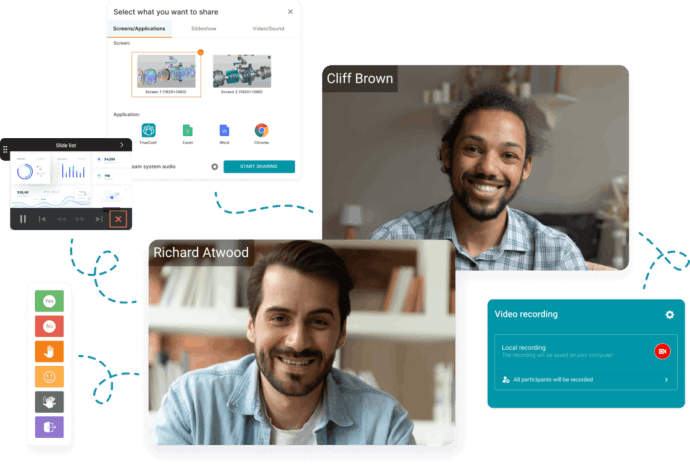
For instance, video conferencing apps volunteer screen-sharing capabilities, collaborative whiteboards, and breakout rooms for group discussions. Using these features, teams can co-create and make decisions together, almost like they were in the same room. Regularly, programming collaborative sessions and using these tools can maintain a high pull down of teamwork and creativity, which helps ensure employee productivity and eradicate chances of miscommunication that might occur in remote teams lacking face-to-face interaction.
What’s changed
Asynchronous collaboration is now a recognized discipline in its own right. Organizations with distributed teams across multiple time zones are increasingly adopting async-first workflows: fewer synchronous meetings, more documented decisions, and collaboration tools designed for time-shifted work. Video conferencing software that supports both live sessions and recorded async sharing covers both modes. TrueConf’s recording capabilities, combined with its built-in messenger, support exactly this kind of hybrid workflow.
Try TrueConf Server Free!
- 1,000 online users with the ability to chats and mske one-on-one video calls.
- 10 PRO users with the ability to participate in group video conferences.
- One SIP/H.323/RTSP connection for interoperability with corporate PBX and SIP/H.323 endpoints.
- One guest connection to invite a non-authenticated user via link to your meetings.

3. Engagement
50% of remote workers feel lonely at least one time per week. So keeping employees busy will be another vault to overwhelm when working remotely. Without the shared undergo of a physical workspace, employees can feel disconnected from their work on and colleagues. As a result, your team-up might have decreased motivation and performance.
Unique Insight — The Engagement Paradox
Conventional wisdom holds that remote workers are harder to engage. The data tells a different story. According to Gallup’s 2026 State of the Global Workplace report, fully remote workers have a 31% engagement rate — the highest of any work arrangement. Hybrid workers and on-site remote-capable workers both sit at 23%.
This suggests that autonomy itself is an engagement driver, and that video conferencing — when used to enable flexibility rather than just replicate office surveillance — supports rather than undermines motivation.
Video conferencing package plays a vital role in enhancing engagement, especially for companies operating in the B2B SaaS sector. Regular video check-ins, employees engagement programs, team-building activities, stand-up meetings, and town halls help maintain a semblance of community and connection. Furthermore, introducing fun elements like virtual backgrounds, filters, and emojis can make interactions more enjoyable and engaging. It’s also healthful to advance participation during video meetings, making for certain everyone has an opportunity to contribute and feel heard.
Practical tips:
- Run structured but short stand-up meetings (TrueConf supports dedicated stand-up conference modes)
- Schedule informal “coffee break” video calls that have no agenda
- Celebrate milestones visibly — anniversaries, project completions, personal wins — over video
4. Scheduling
Coordinating schedules across time zones, flexible hours, and varying personal constraints is one of the most persistent logistical challenges of remote work. Add global hiring and the complexity multiplies.
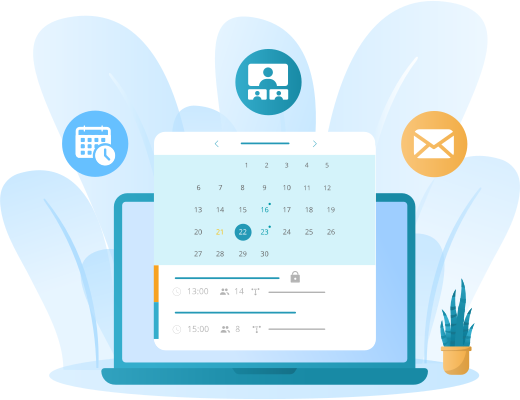
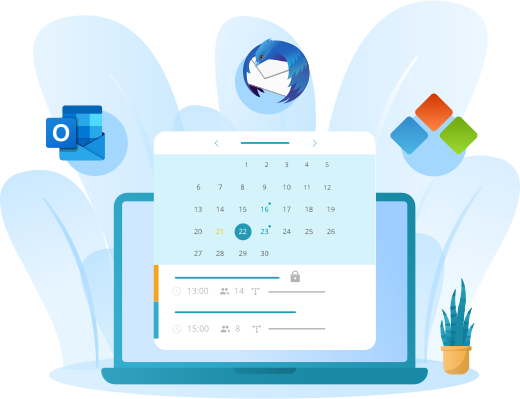
Most video conferencing software integrates with calendar apps like Google Calendar or Outlook. This integration allows for easy scheduling of meetings, complete with reminders and notifications.
What’s changed
AI-powered scheduling is now moving from novelty to standard feature. AI algorithms can analyze calendars, time zones, and participant preferences to automatically suggest the best meeting window — eliminating the back-and-forth that eats up time. TrueConf integrates with Microsoft Exchange via TrueConf Calendar Connector, enabling automated room booking and calendar-aware meeting management within enterprise environments.
Consider using scheduling tools to:
- Set availability windows that colleagues can self-serve book into
- Avoid reflexively scheduling meetings when an async update would do
- Protect focus time with buffer blocks around video calls
5. Training and Onboarding
With a virtual work arrangement, training new hires and integrating them into the team can be daunting. The absence of physical presence makes it harder to assess their progress and adapt training accordingly.
Virtual meet-and-greet sessions are a proven way to introduce new employees to their teams. When you give new hires a comprehensive and structured onboarding program via video conferencing, they feel welcomed, prepared, and aligned with the company. Live Q&A sessions, supplemented with an LMS, tools to track training, or recorded content, round out the experience.
Unique Insight — AI as Institutional Memory
One underrated use of AI transcription in video conferencing isn’t just live meetings — it’s knowledge preservation. Studies show employees forget roughly 50% of new information within an hour and up to 75% within a week.
When every training session, onboarding call, and team Q&A is automatically transcribed and indexed, that knowledge becomes searchable long after the meeting ends. TrueConf AI Server turns live video sessions into a living organizational knowledge base — new hires can search for any decision or explanation from past sessions rather than repeatedly asking colleagues to repeat themselves.
What’s changed
Security training has become a non-negotiable component of remote onboarding. Remote employees access company systems from varied networks and devices, and human error remains the leading cause of data breaches. Ensure your onboarding program includes a dedicated module on cybersecurity best practices.
6. Maintaining a Company Culture
Your team’s uncertain culture is critical to its success because it affects customer engagement, satisfaction, and retention. When working remotely, maintaining and developing this positive culture can be difficult, leading to a reduced sense of belonging and uncertainty about the company’s shared values.
To exert a formal company culture, it’s imperative that you witness shipway to keep employees connected and engaged, especially when working remotely. Video conferencing software can be an important tool in these scenarios. With these tools, you can easily organize virtual team-building activities, unplanned ‘coffee break’ video recording calls, and company-wide meetings. Additionally, you can also celebrate successes and milestones over video or VoIP calls, building a positive culture and holding everyone actuated and engaged.
7. Managing Remote Workers
Managing remote team outcomes and deliverables also comes with unique challenges. To help handle calendars, follow‑ups, and task coordination, many companies now rely on a remote executive assistant service to keep leaders and teams on track. It’s hard to monitor work progress, cater feedback, and ensure employee productivity when you can’t physically see your team. That miss of visibleness can top to misunderstandings, reduced productivity, and even burnout.
Video conferencing allows managers to maintain open lines of communication with their team members. Regular one-on-one video check-ins can be used to discuss work in progress, address issues, and provide positive feedback. “Open door” sessions — where team members can join freely to discuss anything with managers — replicate the informal access that makes in-office management effective.
Unique Insight — AI Meeting Summaries as a Management Tool
One of the most practical management applications of AI in video conferencing is the automatic meeting summary. Rather than relying on memory or informal notes, AI-generated summaries capture decisions, action items, and commitments from each call.
This creates lightweight accountability without surveillance — managers know what was agreed without micromanaging, and team members have a clear record of their own commitments. TrueConf AI Server provides this capability on-premises, meaning sensitive discussions stay within the organization’s own infrastructure rather than flowing through third-party cloud services.
Kudremukh Iron Ore Limited (KIOCL)|Case Study
KIOCL provided their employees with secure tools for collaboration, video calls, and team messaging by implementing TrueConf Server. An autonomous system unified more than 1,000 employees allowing to facilitate work meetings in hybrid and online modes from any location.

Considerations When Choosing Video Recording Conferencing Software
Choosing the correct video conferencing software is crucial for an efficient and productive remote work environment. Here are some factors to consider:
- User-Friendly Interface. It ensures that even team members with minimal technical skills can navigate the software easily.
- Quality of video recording and Audio. Ensure the software delivers high-quality video and audio for clear and operational communication.
- Number of Participants. Depending on the size up of your team, you power need a video recording conferencing solution that can suit a boastfully number of participants in ace call.
- Collaboration Features. search for features in its sheet that allow for easy collaboration, such as test sharing, document sharing, and synergistic whiteboards.
- Recording Capabilities. Recording meetings and video conferences can be material for those who can’t attend in real-time, for grooming purposes, or for record-keeping.
- Cost. Consider your budget and the cost-effectiveness of the software. Free versions can be limited, so assess if a paid plan offers value for your needs.
- Bandwidth Usage. You should also check how much net bandwidth the software system uses, which is especially probative for those with limited or slow internet connections.
While considering these factors, it’s worth noting that some comprehensive project management platforms offer built-in video conferencing capabilities alongside their other features. This integration can provide a seamless experience for teams that require both project management and communication tools, potentially simplifying their tech stack and improving overall workflow efficiency.
Best Video Conferencing Software to Deliver the Goods at Remote Work
In the ever-evolving landscape of work, remote and hybrid models are Here to stay. To voyage this newly normal and sweep over its unique challenges, you’ll require the best video recording conferencing software at your disposal. Your team or companion should embrace the transformative power of video conferencing tools if you haven’t yet. They turn to the challenges of remote work and unlock new possibilities and opportunities for companies and their teams worldwide.
Video Meetings in 4K with TrueConf!
Make Ultra HD video calls, hold online meetings, communicate with a built-in team messenger, share, record, stream your content, and more!
FAQ
What is the single biggest challenge of remote work?
Communication breakdown consistently ranks as the top challenge — the absence of spontaneous face-to-face interaction creates ambiguity that snowballs into mistakes and disengagement. TrueConf addresses this with persistent team messaging, always-on video presence, and 4K video calls that restore non-verbal communication cues in real time.
How does video conferencing actually improve remote team communication?
Video calls reinstate the visual and tonal cues that written messages strip out — making nuance, urgency, and intent far clearer. TrueConf adds AI transcription via TrueConf AI Server, so every spoken conversation becomes a searchable text record, helping teams across time zones stay aligned without requiring everyone on the same call.
Can video conferencing software fully replace in-person meetings?
For most operational meetings — standups, project reviews, 1:1s, and even large all-hands — video conferencing is functionally equivalent. For highly creative workshops, PwC research found VR showed a 58% improvement in felt closeness vs. video. That said, platforms like TrueConf that support large-scale broadcasts, breakout rooms, and interactive whiteboards come significantly closer to replicating the full in-person experience than basic video tools.
Is cloud-based or on-premises video conferencing better for enterprises?
It depends on data sensitivity and compliance requirements. Cloud solutions offer quick deployment; on-premises solutions give organizations complete control over where data lives. TrueConf Server deploys entirely within your corporate network, works without an internet connection, and requires no data to leave your infrastructure — making it the preferred choice for government, healthcare, defense, and regulated financial organizations.
How can remote teams maintain company culture without a shared office?
Intentionality is the key word: culture doesn’t happen by accident in remote settings. Regular video touchpoints — not just functional meetings but casual coffee chats, milestone celebrations, and visible recognition — sustain shared identity. TrueConf supports broadcast events for up to 1,500 participants, enabling company-wide culture moments that reach every employee regardless of location.
How does video conferencing help with remote employee onboarding?
Live video onboarding sessions, combined with recorded content for self-paced review, create a structured introduction that remote employees can revisit. TrueConf AI Server automatically transcribes these sessions, turning each onboarding call into a searchable knowledge resource — so new hires can find answers from past sessions rather than always needing to ask someone directly.
What should I look for in video conferencing software for a distributed global team?
Prioritize: multi-time-zone scheduling integration, high-quality audio even on low bandwidth, AI transcription for async access, strong security (end-to-end encryption, on-premises option), and SIP/H.323 compatibility for hardware room endpoints. TrueConf covers all of these natively — including a free tier (TrueConf Server Free) for teams of up to 1,000 users to test the platform before committing.
About the Author
Nikita Dymenko is a technology writer and business development professional with more than six years of experience in the unified communications industry. Drawing on his background in product management, strategic growth, and business development at TrueConf, Nikita creates insightful articles and reviews about video conferencing platforms, collaboration tools, and enterprise messaging solutions.


Follow us on social networks