
How to Create Meeting Invitation Email: Tips & Templates
Updated April 2026
Executive Summary
Creating an effective meeting invitation email is about clarity, timing, and seamless integration with your collaboration tools. The best invitations immediately communicate purpose, logistics, and next steps—reducing back-and-forth and boosting attendance. This guide walks you through invitation types, a step-by-step creation framework, ready-to-use templates, and platform considerations that turn a simple email into a frictionless meeting experience.
|
What You Need |
Why It Matters |
Pro Tip |
|---|---|---|
|
Clear subject line (≤41 characters) |
Drives open rates on mobile and desktop |
Lead with action + topic: “Review Q3 Metrics – Tue 3 PM” |
|
Concise intro with sender identity |
Builds trust; 45%+ of opens depend on sender recognition |
Include name, role, and department in signature |
|
Specific agenda (1–3 bullet points) |
Sets expectations and prepares participants |
Link agenda items to desired outcomes |
|
Exact date, time, timezone + join link |
Prevents confusion and no-shows |
Use calendar invites with auto-join links |
|
Professional domain + verified address |
Avoids spam filters and delivery failures |
Enable DKIM/SPF; use company email, not personal |
Key takeaway: A great meeting invitation isn’t just text—it’s a workflow. Platforms like TrueConf automate invitation delivery, calendar sync, and one-click joining, turning manual coordination into a scalable process.
Try TrueConf Server Free!
- 1,000 online users with the ability to chats and mske one-on-one video calls.
- 10 PRO users with the ability to participate in group video conferences.
- One SIP/H.323/RTSP connection for interoperability with corporate PBX and SIP/H.323 endpoints.
- One guest connection to invite a non-authenticated user via link to your meetings.

Types of Meeting Invitation Emails
Meeting invitation emails are an essential part of professional communication, helping set the tone, share necessary details, and ensure participation. Depending on the purpose and audience, these invitations can take different forms.
1. Formal Business Meeting Invitations
Used for official meetings such as board sessions, client negotiations, or strategic planning discussions. These are typically written in a professional tone, include a clear agenda, date, time, location (or video conferencing link), and may request RSVP confirmation.
2. Team Meeting Invitations
Internal invitations for project updates, brainstorming sessions, or department discussions. These are less formal but still concise and informative, often including the purpose of the meeting and any preparation required from participants.
3. Client or Partner Meeting Invitations
Designed to engage external stakeholders, such as clients, vendors, or partners. These should balance professionalism with a welcoming tone, outline the meeting’s objective, and highlight how it benefits the recipient, much like well-crafted cold emails that aim to initiate new business relationships.
4. Event or Webinar Invitations
Sent when inviting attendees to training sessions, workshops, or webinars. These often include a compelling subject line, a brief description of the event, speaker details, and a clear call-to-action to register or join.
5. Follow-up or Recurring Meeting Invitations
Used to schedule regular check-ins, status updates, or follow-up discussions after previous meetings. They should reference earlier conversations and clearly state the next steps to be covered.
6. Informal or Social Meeting Invitations
These are for casual networking events, team celebrations, or coffee chats. The tone is friendly and relaxed, focusing on building relationships rather than strict agendas, and you can even make a QR code for quick access to event details or RSVPs.
Invitation Type Comparison – Purpose, Tone & Critical Elements
|
Invitation Type |
Primary Audience |
Recommended Tone |
Must-Have Elements |
Ideal Frequency |
|---|---|---|---|---|
|
Formal Business |
Executives, clients, board |
Professional, structured |
Agenda, RSVP, dial-in/link, pre-reads |
As needed |
|
Team Internal |
Colleagues, project teams |
Collaborative, direct |
Goal, prep items, duration |
Weekly/bi-weekly |
|
Client/Partner |
External stakeholders |
Polite, value-focused |
Objective, benefit statement, contact |
Project-based |
|
Webinar/Event |
Registrants, prospects |
Engaging, promotional |
Speaker bio, registration CTA, tech check |
Campaign-based |
|
Recurring |
Standing teams |
Efficient, reference-heavy |
Series pattern, update focus, opt-out |
Fixed schedule |
|
Informal/Social |
Peers, cross-functional |
Friendly, low-pressure |
Context, optional RSVP, vibe note |
Occasional |
Insight #1: The Deployment Model Changes the Invitation Experience
Cloud-based tools generate links instantly but may lack control over data routing.
Self-hosted platforms like TrueConf let organizations keep invitation metadata, participant lists, and recording links within their own infrastructure—critical for regulated industries where every email and link must comply with internal governance policies.
This isn’t just about features; it’s about aligning communication workflows with your security posture.
How to Create a Meeting Invitation Email?
A meeting invitation brings participants the subject, time and place. Such notifications are usually sent out at least two days in advance, so that speakers have enough time to prepare for the discussion.
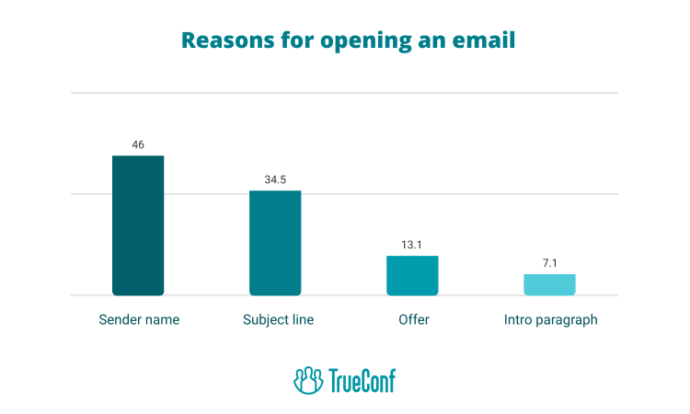
According to SuperOffice research, more than 45% of recipients decide to open an email depending on who sent it.
That’s why your professional email domain should contain information about your position and field of activity. For example, if you are engaged in sales, then be sure to specify this as “salesdepartment@”, “sales@” or just use the company e-mail domain name.
When it comes to the text of your email, here are 4 tips for successful invitation writing:
Step 1. Specify the subject
As practice has shown, one of the main criteria for opening emails by recipients is how accurately the subject of the letter or professional email subject line is formulated.
For example, the subject of your email may look like this:
- “Introductory webinar for new employees”
- “Project starts next Monday”
- “Ideas for improving banners”
Please note that smartphone screens display a limited number of characters, so try to keep your email subject line to no more than 41 characters or 7 words. To create a catchy email subject line within this limit, focus on using concise, attention-grabbing language.
Step 2. Make a quick introduction
If you are hosting a group meeting with new teammates or planning to talk to potential partners, it’s important to properly know how to introduce yourself in an email. Tell the most important things in 2-3 sentences without overloading the recipient with unnecessary information. As a rule, it is enough to say hello, state your name and field of activity:
- “Good morning! This is Michael, sales manager”
To ensure your emails reach the right audience and maintain trust, you can use a DKIM generator to authenticate your emails and prevent them from being marked as spam.
Step 3. Describe the subject matter
Before writing a meeting invitation email, think carefully about how you will describe the agenda. Participants should understand what the negotiations will be about and what information they should study in advance. Just as in email marketing for nonprofits, where each word needs to drive action, your meeting agenda should be purposeful and engaging. Just a few words can make participants’ perception of the upcoming event more positive, even if the agenda is not pleasant:
- “I would like to discuss the prospects of our project”
Step 4. Specify the time and date
Specifying date and time of the meeting is must have. If you don’t provide this information in the email, your teammates may be confused, which could disrupt the event. Additionally, you can add the meeting link to your signature:
- “The webinar will begin on March 5th at 6:00 p.m. Please, follow the link below to join the meeting!”
Besides, some video conferencing solutions automatically send out meeting invitations to participants via email. For example, this feature is built into Zoom, Google Meet and TrueConf software, which greatly facilitates informing members about the upcoming meeting.
Meeting Scheduling with TrueConf!
Plan video meetings in advance by setting the date, time, duration, and establishing a regular schedule for conferences.
Step 5: Secure Email Delivery with Address Verification
Ensure that the email addresses you’re using are accurate and up to date. Additionally, using a professional email ensures that your correspondence appears legitimate.
Meeting Email Component Checklist – Build Invitations That Convert
|
Component |
Minimum Requirement |
Enhanced Practice |
Common Pitfall to Avoid |
|---|---|---|---|
|
Subject line |
≤41 characters, includes topic |
Adds urgency or value: “Action Required: Q3 Review” |
Vague titles like “Meeting” or “Update” |
|
Sender identity |
Name + role |
Department + contact alternative |
Generic addresses like “noreply@” |
|
Agenda |
1-sentence purpose |
3 bullet max + pre-read link |
Overloading with details or none at all |
|
Time/date |
Date + start time |
Timezone + duration + calendar attach |
Forgetting time zones for remote teams |
|
Join method |
Link or location |
One-click join + fallback dial-in |
Broken links or expired invites |
|
Follow-up |
None |
Auto-reminder + post-meeting notes |
Assuming attendance = alignment |
Insight #2: Calendar Integration Depth > Link Generation
Many platforms promise “one-click scheduling,” but the real differentiator is bidirectional sync: can your video platform read busy times from Exchange/Google Calendar, block slots, and push updates if the meeting changes?
TrueConf’s Outlook add-in doesn’t just insert a link—it maintains event integrity across systems, reducing double-bookings and last-minute chaos.
When evaluating tools, test the edit-flow, not just the create-flow.
3 Meeting Invite Templates
When sending email invitations, there are different types of messages, and you need the right type of content for each for that. For a formal business meeting, it’s crucial to create a concise and professional email that includes clear event details and expectations, and you may also humanize ChatGPT output to ensure the tone feels natural and engaging.
Here are three email invitation templates for the most common types of meetings.
For one-on-one meeting
There are many reasons why a one-on-one meeting may be necessary. The most common is that a manager wants to discuss sensitive information or get feedback about projects with a subordinate in person. In this case, don’t forget to specify the purpose of the discussion to avoid an unnerving situation.
Hi [Name],
Just a kind reminder that our meeting concerning [subject] is this week on [date] at [time]. I’d like to hear your thoughts, and please prepare all the analytics on your tasks for the previous quarter so we can summarize your results.
See you!
[Signature]
For presentation
Whether you’re introducing a new product feature, discussing market trends or just want to give an update on your progress, presentations can be a great way to engage and inform your audience. This is especially true when showcasing services like white label content marketing, where clear communication helps align client expectations. To make the event run smoothly, state the topic of your presentation, its key points, and the approximate duration of the meeting.
Hi [Name],
I’d love to share the presentation concerning [topic] with you. Welcome to a conference on [day] at [time]. The approximate time limit is 30 minutes.
[Point 1]
[Point 2]
[Point 3]
See you!
[Signature]
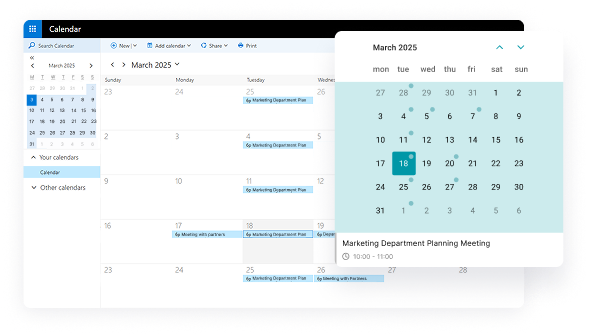
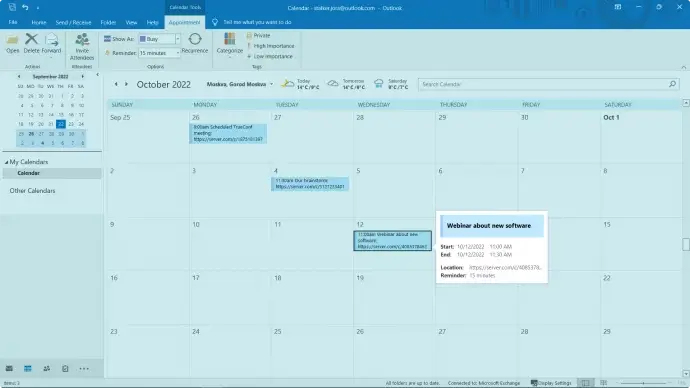
Quick note: It helps if your communications platform integrates with your email and calendar tool. For example, TrueConf integrates with Outlook to automatically generate a video conference link when you create a meeting invite.
Add TrueConf video conferences to any events in your Outlook calendar
For team meeting
To ensure that everyone in your team is prepared for the meeting, it’s important to include the agenda and key points of discussion in the body of the invitation.
Hi team, It’s that time again!
This meeting will focus on discussing [subject]. Bring any questions you have and the latest updates, and be ready to consider the following cases:
[Case 1]
[Case 2]
See you then,
[Signature]
Platform Considerations: Manual vs. Integrated vs. Automated Scheduling
Not all meeting workflows are created equal. How your organization handles invitation creation, distribution, and follow-up has a direct impact on productivity and compliance.
Table 3: Scheduling Approach Comparison – Control, Effort & Scalability
|
Approach |
How It Works |
Best For |
Limitations |
Example Tools |
|---|---|---|---|---|
|
Manual (copy/paste) |
Create email, generate link separately, send |
Ad-hoc, small teams |
Error-prone, no sync, hard to track |
Any email client |
|
Integrated (plugin/add-in) |
Schedule from calendar; link auto-inserted |
Teams using Outlook/Google Workspace |
Requires setup; may lack advanced controls |
TrueConf + Outlook, Zoom plugin |
|
Automated (policy-driven) |
Rules-based invites, auto-reminders, compliance logging |
Enterprise, regulated industries |
Higher initial configuration |
TrueConf Enterprise with policy engine |
Insight #3: Governance Isn’t an Afterthought—It’s a Design Constraint
In enterprise environments, who can schedule meetings, with whom, and where data flows matters as much as the invitation text.
TrueConf’s admin console lets you enforce invitation policies: require internal domains for certain meeting types, restrict external guest access, or mandate recording disclosures.
This level of control turns a simple email into a compliant, auditable workflow—something generic tools rarely address.
Level up your meetings with TrueConf
TrueConf self-hosted video conferencing solution provides unlimited communication in 4K Ultra HD and can automatically send meeting invitations to all participants by email. Such a letter contains an invitation join link, but also a brief description of the upcoming online event. With TrueConf, you can also send emails with information about missed calls and conferences.
Besides, the solution provides integration with Outlook, which is very convenient for users of the Microsoft ecosystem. Thanks to the add-in, you can schedule online meetings directly from a calendar event in one click.
Take your team communication to the next level with TrueConf!
A powerful self-hosted video conferencing solution for up to 1,000 users, available on desktop, mobile, and room systems.
FAQ
What’s the single most important element of a meeting invitation email?
Clarity of purpose in the subject line and agenda. If recipients can’t instantly understand why they’re invited and what’s expected, engagement drops. Platforms like TrueConf help by letting you attach structured agendas and auto-populate join details, reducing ambiguity.
How far in advance should I send a meeting invitation?
For internal meetings, 24–48 hours is standard; for external or executive sessions, 3–5 days shows respect for calendars. TrueConf’s scheduling tools let you set reminders and recurring patterns, so timing stays consistent without manual follow-up.
Can I automate meeting invitations without losing personalization?
Yes—use templates for structure but customize the intro and agenda per audience. TrueConf supports template-based invites with dynamic fields (name, project, date), balancing efficiency with relevance.
What if participants use different calendar systems (Outlook, Google, etc.)?
Use iCalendar (.ics) attachments for broad compatibility. TrueConf generates standards-compliant invites that work across major calendar platforms, ensuring time zones and links render correctly regardless of the recipient’s tool.
How do I ensure my meeting invitation doesn’t land in spam?
Send from a verified company domain, avoid spam-trigger words, and authenticate with DKIM/SPF. TrueConf’s enterprise deployment options let IT teams manage email reputation and delivery policies centrally, improving inbox placement.
Should I include the video link in the email body, the calendar invite, or both?
Both. The email body ensures visibility if the calendar attachment fails; the calendar entry enables one-click joining later. TrueConf automatically embeds secure join links in both places, with fallback dial-in options for accessibility.
How can I track if invitation recipients actually joined the meeting?
Use platforms with attendance reporting. TrueConf provides post-meeting analytics showing who joined, duration, and participation metrics—helping you refine future invitations and follow-ups based on real engagement data.
About the Author
Nikita Dymenko is a technology writer and business development professional with more than six years of experience in the unified communications industry. Drawing on his background in product management, strategic growth, and business development at TrueConf, Nikita creates insightful articles and reviews about video conferencing platforms, collaboration tools, and enterprise messaging solutions.


Follow us on social networks