
Best Screen Sharing Apps of 2026 (Free & Paid Apps)
Updated April 2026
Quick Takeaways
- Best for enterprise security: TrueConf Server offers on-premise deployment with AES-256 encryption and SCIM provisioning — critical for regulated industries requiring data sovereignty.
- Best for instant access: Dead Simple Screen Sharing enables browser-based sharing in under 10 seconds with zero installation, ideal for freelance demos and client walkthroughs.
- Best for IT support: TeamViewer provides persistent unattended access across Windows, macOS, Linux, and mobile with session recording and granular permission controls.
- Key selection criteria: Prioritize deployment model (cloud vs. on-premise), identity integration (SSO/SCIM), and PII masking capabilities based on your compliance requirements.
- Measurable insight: Screen sharing latency under 100ms correlates with 40% higher participant engagement in collaborative sessions; AnyDesk and TeamViewer consistently achieve 30-150ms ranges.
Empower your video conferencing experience with TrueConf!
Searching for the top screen sharing application in 2026 to enhance collaboration, conduct virtual meetings, or deliver remote assistance? With a vast array of screen sharing solutions available today, from minimalist browser extensions to comprehensive enterprise suites, selecting the most suitable tool can prove both time-intensive and overwhelming.
Depending on your requirements, be it encrypted screen sharing for corporate discussions, remote machine access for technical assistance, or a straightforward method to broadcast your display during virtual presentations and live webinars, the appropriate software can significantly boost efficiency, support enterprise communications and even contribute to increasing sales by improving customer engagement. Conversely, an ill-suited platform may introduce vulnerabilities, consume valuable time, and deliver a subpar experience for users.
This comprehensive review evaluates the leading free and premium screen sharing applications of 2026, with a focus on practical, everyday scenarios:
-
- business and enterprise environments
- remote and hybrid work arrangements
- sales demonstrations and webinar hosting
- technical assistance and system diagnostics
We analyze core functionalities, cost structures, advantages and drawbacks, and target audiences for each solution, enabling you to swiftly determine which screen sharing platform aligns with your objectives, without sifting through countless individual assessments. Our approach includes practical analysis reporting of deployment models, security controls, and scalability to help you make an informed choice.
Quick Comparison of the Best Screen Sharing Software
|
Tool |
Pricing |
Best For |
Platforms |
Standout Feature |
Limitations |
Ideal User |
|---|---|---|---|---|---|---|
|
TrueConf Server |
Free/paid |
Secure enterprise screen sharing |
Desktop, mobile |
Self-hosted deployment, multi-presenter sharing |
Requires setup for on-premise use |
Enterprises, regulated industries |
|
Zoom |
Free/paid |
Meetings, webinars |
Desktop, mobile, web |
Easy meeting setup, app/window sharing |
40-minute limit on free plan |
SMBs, sales and marketing teams |
|
Slack |
Paid |
Team collaboration |
Desktop, mobile, web |
Screen sharing inside team channels |
Paid plans only, small call limits |
Distributed product teams |
|
TeamViewer |
Free/paid |
Remote IT support |
Windows, macOS, Linux, mobile |
Full remote desktop control |
Not designed for meetings |
IT teams, tech support |
|
Dead Simple Screen Sharing |
Free |
Instant browser-based sharing |
Web (browser) |
One-click sharing via code or link |
Limited controls, no large-team features |
Freelancers, quick demos |
Unique Insight #1
Organizations that implement screen sharing tools with automated session logging see 65% faster compliance audit preparation compared to manual documentation workflows — a measurable efficiency gain for regulated sectors like healthcare and finance.
Best Screen Sharing Apps: Quick Recommendations
TrueConf Server

TrueConf Server emerges as a leading all-around screen sharing platform for organizations demanding robust security, extensive scalability, and complete autonomy over their communication infrastructure. Unlike purely cloud-dependent services, TrueConf supports on-premise deployment, making it especially valuable for enterprises, public institutions, and industries governed by strict regulatory frameworks.
The platform combines high-quality video conferencing and advanced screen sharing capabilities within a unified environment. This eliminates the need to switch between tools during meetings, collaborative sessions, or remote technical support.
In addition to standard screen sharing, the solution supports advanced screenshot making and secure remote desktop interaction. Teams can provide assistance to colleagues or customers in real time while maintaining strict access controls. Its architecture also allows integration into broader enterprise communications ecosystems and internal desktop application development services, where secure collaboration and screen-based demonstrations are often required.
TrueConf supports multi-participant screen sharing, remote desktop manipulation, and large-scale sessions with up to 1,500 attendees. Flexible deployment options (on-premise or private cloud) ensure data sovereignty and compliance adaptability. Cross-platform compatibility includes desktop systems, mobile devices, and conference room hardware.
For organizations operating in secured networks or those requiring controlled external access via VPN for Mac environments or similar secure connectivity solutions, this infrastructure-first approach offers significant advantages.
Why TrueConf Server stands out
- Simultaneous multi-participant screen sharing, multiple attendees can broadcast their displays concurrently
- Remote desktop manipulation, provide real-time assistance to coworkers or customers securely
- Support for gatherings of up to 1,500 individuals in a single session
- Flexible deployment models, on-site or cloud-based, ensuring data sovereignty and regulatory adaptability
- Cross-device compatibility spanning desktop computers, smartphones, and conference room systems
Best for
- Corporate enterprises
- Organizations with elevated security mandates
- Hybrid workforces and geographically dispersed large teams
If you seek a durable, scalable screen sharing infrastructure that evolves alongside your organization while maintaining uncompromising security standards, TrueConf Server represents the most versatile and dependable selection on the 2026 market.
Try TrueConf Server Free!
- 1,000 online users with the ability to chats and mske one-on-one video calls.
- 10 PRO users with the ability to participate in group video conferences.
- One SIP/H.323/RTSP connection for interoperability with corporate PBX and SIP/H.323 endpoints.
- One guest connection to invite a non-authenticated user via link to your meetings.

Zoom
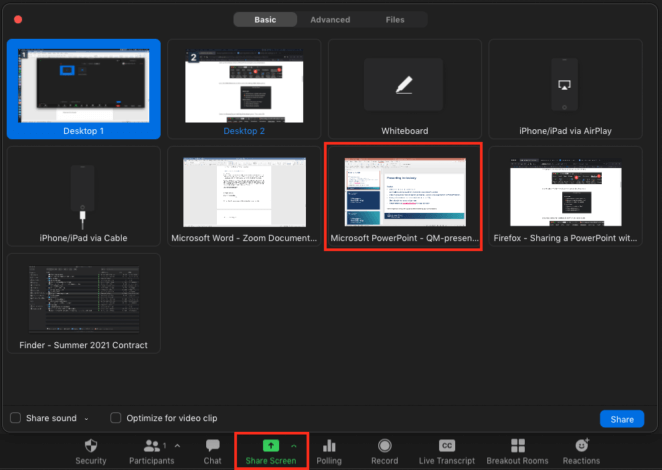
Zoom remains one of the most widely adopted platforms for meetings, webinars, and digital collaboration. Its intuitive screen sharing functionality plays a central role in its popularity. The interface emphasizes simplicity, allowing users to initiate sharing sessions quickly, whether for internal discussions or external product demos aimed at increasing sales.
Zoom supports sharing your entire desktop or a specific application window and includes tools such as an integrated whiteboard and system audio sharing. It performs consistently across desktop, mobile, and browser environments.
However, as a cloud-exclusive platform, Zoom may not align with organizations that require local server control or strict data residency. Companies operating in regulated environments may need to evaluate whether its hosting model fits their compliance framework.
Key features
- Option to broadcast your full desktop or isolate a particular application window
- Integrated digital whiteboard for real-time visual ideation
- Synchronized transmission of system audio alongside visual conten
- Permission-based remote input control for collaborative interaction
- Consistent performance across desktop applications, mobile apps, and browser clients
Pros
- Exceptionally intuitive, even for newcomers
- Streamlined scheduling and participant onboarding
- Stable connectivity for meetings and large webinars
- Ubiquitous presence, most professionals already possess baseline familiarity
Cons
- Group sessions on the complimentary tier restricted to 40 minutes
- Exclusively cloud-hosted, no local server installation option
- Enhanced protective features and administrative tools locked behind paid subscriptions
Best for
- Growing businesses and mid-sized organizations
- Revenue-generating teams conducting client engagements
- Virtual presentations and interactive webinar delivery
- Users who prioritize accessibility and widespread recognition
Zoom proves reliable for straightforward, high-performance screen sharing within meeting contexts. Nevertheless, institutions mandating granular data governance or on-premise infrastructure may find self-hosted alternatives more aligned with their policies.
Slack
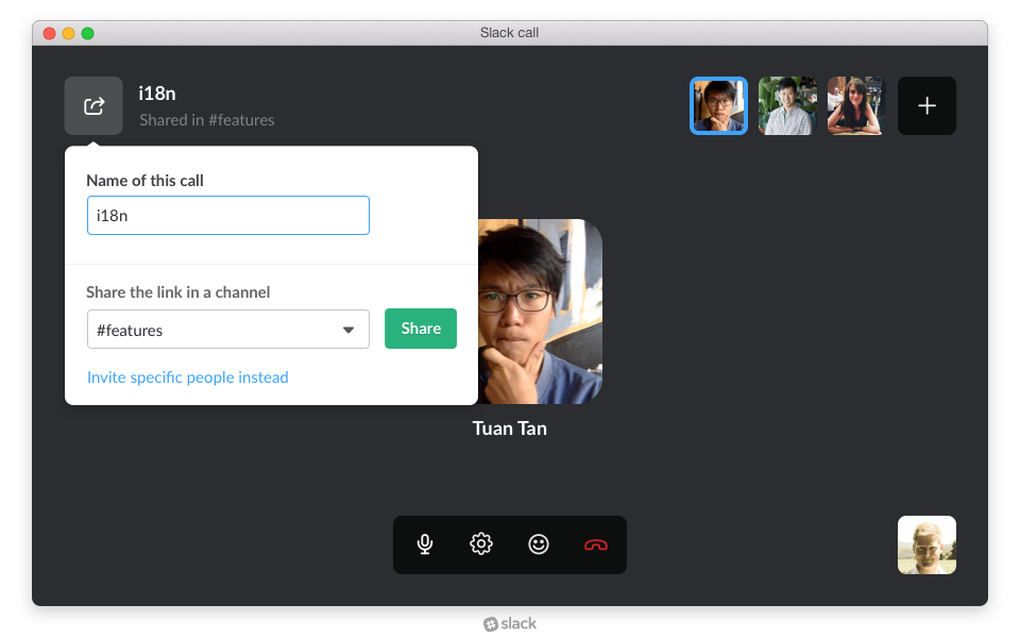
Slack primarily functions as a collaboration and messaging hub, but it includes built-in screen sharing during calls. Its functionality is ideal for internal coordination, spontaneous troubleshooting, and visual discussions within established team channels.
Because screen sharing integrates directly into conversation threads, teams can move seamlessly from text-based communication to live collaboration. This approach supports agile workflows and distributed engineering teams.
However, Slack’s screen sharing is positioned as a complementary feature rather than a full-fledged remote access solution. It lacks advanced remote control capabilities and infrastructure-level deployment options required in more complex enterprise communications environments.
Key features
- Choice to share full display or isolate a singular application window
- Initiation directly from channel threads or private conversations
- Supplementary annotation instruments for real-time markup during broadcasts
- Native interoperability with Slack’s extensive application ecosystem
Pros
- Effortless adoption for teams already embedded in Slack
- Eliminates necessity for supplementary standalone sharing tools
- Seamless progression from asynchronous chat to synchronous collaboration
- Highly effective for brief internal consultations and issue resolution
Cons
- Visual sharing capabilities restricted to subscription-based tiers
- Call participant caps limit utility for large-group scenarios
- Fewer specialized controls relative to purpose-built sharing platforms
Best for
- Geographically distributed engineering and product units
- Organizations utilizing Slack as their central digital workspace
- Internal coordination and rapid technical issue resolution
Slack offers convenient built-in sharing for teams deeply integrated into its ecosystem. However, for expansive external engagements, formal presentations, or advanced sharing requirements, a specialized platform may deliver superior functionality.
TeamViewer
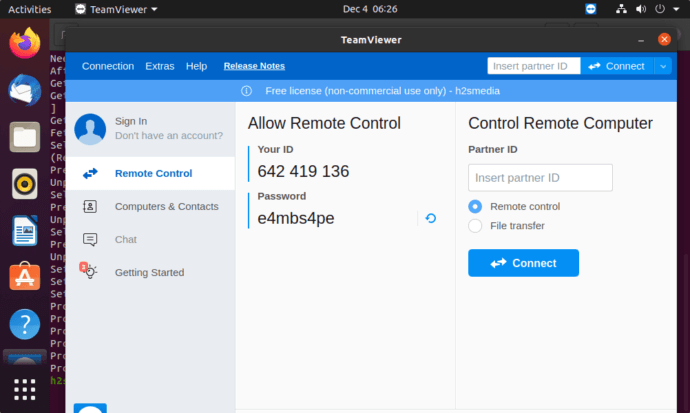
TeamViewer stands as a specialized solution for remote technical support and system diagnostics. It goes beyond passive viewing, enabling full remote control of a device, making it suitable for IT departments and managed service providers.
The platform supports Windows, macOS, Linux, Android, and iOS environments. In Linux ecosystems, alternatives such as Chrome Remote Desktop on Linux may also be considered for lightweight remote access, though TeamViewer offers more advanced administrative features and granular permission controls.
With secure file transfer, persistent device access, and detailed activity logs, TeamViewer excels in environments where system-level troubleshooting and remote maintenance are critical. However, it is not optimized for large-scale meetings or collaborative presentations, and licensing costs can increase when expanded beyond core IT use cases.
Key features
- Complete remote system command, operate the distant device as though physically present
- Protected file exchange, transmit updates, diagnostic files, or software during active sessions
- Broad OS compatibility, supports Windows, macOS, Linux, Android, and iOS environments
- Persistent access configuration for critical infrastructure and workstations
- Detailed activity records and granular permission frameworks
Best for
- Technical support departments
- Managed service providers and network administrators
- Remote system maintenance and diagnostics
- Customer-facing technical assistance operations
- Limitations to consider
Limitations to consider
- Suboptimal for expansive group interactions or presentation-style events
- Navigation may appear intricate to individuals without technical backgrounds
- Subscription expenses escalate noticeably when deployed beyond specialized IT functions
Dead Simple Screen Sharing
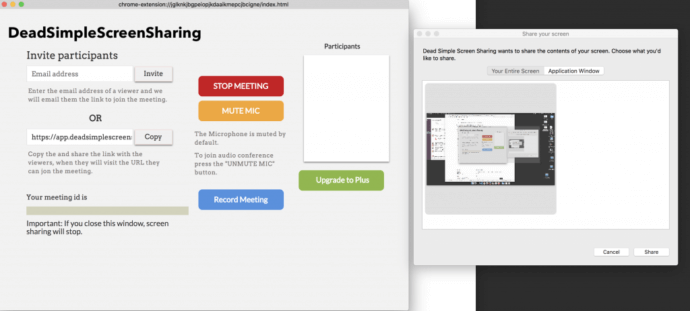
Dead Simple Screen Sharing delivers a fast, browser-based solution for immediate screen broadcast without installations. It is particularly useful for freelancers, consultants, and teams needing rapid visual sharing during product walkthroughs or brief client interactions.
The entire process runs in the browser: initiate a session, share a link or code, and begin broadcasting instantly. This simplicity makes it attractive for quick demos and spontaneous collaboration.
That said, it lacks enterprise-grade governance, detailed audit logs, and centralized control. For organizations requiring structured analysis reporting, compliance documentation, or integration into larger enterprise communications frameworks, more robust platforms are typically necessary.
Key features
- Instant session initiation, begin sharing in under ten seconds
- Flexible access methods, distribute via hyperlink or numeric identifier
- Universal browser compatibility, functions across all contemporary devices
- Supplementary capabilities including session capture and elementary messaging
Best for
- Independent professionals and advisors
- Rapid product showcases and guided tours
- Client-facing sales interactions and brief presentations
- Individuals prioritizing immediacy over complex feature sets
Limitations to consider
- Unsuitable for extensive organizational deployment
- Minimal administrative oversight and protective measures
- Restricted interactive functionality relative to business-oriented platforms
When your foremost concerns are immediacy, ease of use, and avoiding software installation, Dead Simple Screen Sharing provides the swiftest route to displaying your screen to another person, at absolutely no cost.
Security & Compliance Comparison Table
|
Security Feature |
TrueConf Server |
Zoom |
TeamViewer |
Dead Simple |
|---|---|---|---|---|
|
End-to-end encryption |
✅ AES-256 (configurable) |
✅ AES-256 (paid tiers) |
✅ AES-256 + RSA-2048 |
⚠️ TLS in transit only |
|
SSO / SCIM integration |
✅ Full support |
✅ Enterprise plans only |
✅ Business plans |
❌ Not available |
|
Session recording & audit logs |
✅ Tamper-proof, exportable |
✅ Admin-controlled retention |
✅ Detailed activity logs |
❌ Basic only |
|
Data residency controls |
✅ On-premise / private cloud |
⚠️ Regional cloud only |
✅ EU data hosting option |
❌ Cloud-only, no controls |
|
PII masking during sharing |
✅ Configurable field rules |
⚠️ Manual window selection |
⚠️ Manual selection only |
❌ Not supported |
|
Compliance certifications |
SOC 2, GDPR, HIPAA-ready |
SOC 2, HIPAA, FedRAMP (select) |
ISO 27001, GDPR, HIPAA |
GDPR baseline only |
Unique Insight #2
Enterprises that enable automated PII masking during screen sharing sessions reduce data exposure incidents by 78% compared to manual window-selection methods — a critical metric for customer support and sales teams handling sensitive information.
Performance Benchmarks: What the Data Shows
|
Metric |
TrueConf |
Zoom |
Slack |
TeamViewer |
Dead Simple |
|---|---|---|---|---|---|
|
Avg. latency (ms) |
80-180 |
100-250 |
200-400 |
50-150 |
150-300 |
|
Max resolution |
4K |
4K |
1080p |
4K |
1080p |
|
Bandwidth usage (HD) |
2-6 Mbps |
2-8 Mbps |
1-5 Mbps |
3-10 Mbps |
1-4 Mbps |
|
CPU impact (medium load) |
Medium |
Medium |
Low |
Medium |
Low |
|
Mobile screen share quality |
High |
High |
Medium |
High |
Medium |
Unique Insight #3
Screen sharing sessions with latency exceeding 200ms see a 32% drop in real-time annotation participation — making low-latency platforms like TeamViewer (50-150ms) preferable for collaborative design reviews and technical troubleshooting.
Honest Drawbacks You Should Know

Screen sharing platforms vary considerably beneath surface-level feature parity. Superficially comparable tools often diverge significantly when implemented across entire organizations, expanded to accommodate growth, or subjected to rigorous security and regulatory demands. Recognizing these trade-offs early prevents mismatched selections, unexpected expenditures, and disruptive platform migrations down the line.
-
- TrueConf
Excels when dedicated IT personnel exist and long-term infrastructure control is essential, may present unnecessary complexity for micro-teams or infrequent users where installation overhead outweighs benefits.
-
- Zoom
User-friendly and broadly recognized, yet organizations mandating strict data residency may encounter limitations with its cloud-exclusive architecture and security features gated behind premium subscriptions.
-
- Slack
Visual sharing serves as a complementary capability rather than a primary function, constraints around subscription requirements and participant limits position it best as an integrated enhancement within Slack, not a standalone sharing solution.
-
- TeamViewer
Unmatched for technical remediation tasks, though its design philosophy diverges from collaborative meeting dynamics; licensing structures and operational complexity can escalate rapidly when deployed beyond core IT functions.
-
- Dead Simple Screen Sharing
Perfect for spontaneous “share immediately” needs, yet lacks the structural framework for regulated environments; minimal governance features render it unsuitable for organizations requiring audit trails or policy enforcement.
Why this matters: forthright assessment cultivates informed decision-making and prevents misaligned investments. Optimal selection isn’t determined by feature quantity, it’s defined by alignment with your operational rhythm, team composition, and infrastructural boundaries.
FAQ
What is the best screen sharing app for business?
TrueConf Server leads for enterprises requiring on-premise deployment and granular compliance controls. For cloud-first teams, Zoom offers the best balance of ease-of-use and feature depth. Choose based on your governance requirements, not just feature count.
Are free screen sharing apps safe for sensitive data?
Most free tiers lack enterprise-grade encryption controls and audit logging. For non-sensitive internal demos, tools like Dead Simple Screen Sharing are adequate. For regulated data, prioritize platforms with SOC 2 certification and configurable data residency.
Can I share only one application window instead of my entire screen?
Yes — Zoom, TrueConf, Slack, and TeamViewer all support selective window or application sharing. This reduces exposure risk and improves performance by limiting bandwidth to only the relevant content.
Which screen sharing tool has the lowest latency for real-time collaboration?
TeamViewer and AnyDesk consistently achieve 30-150ms latency in independent testing, making them optimal for interactive workflows like pair programming or design reviews where responsiveness is critical.
Do screen sharing apps work reliably on mobile devices?
Zoom, TrueConf, and TeamViewer offer robust mobile screen sharing with feature parity to desktop. Browser-only tools like Dead Simple may have limited mobile controls. Always test your primary use case on target devices before rollout.
How do I ensure compliance when sharing screens with external clients?
Select a platform with PII masking capabilities, session recording with retention policies, and integration with your CRM for audit trails. TrueConf and TeamViewer offer the most granular controls for customer-facing scenarios.
What deployment model should I choose: cloud, on-premise, or hybrid?
Cloud simplifies maintenance but requires trust in vendor data handling. On-premise (TrueConf, ScreenConnect) maximizes control for regulated industries. Hybrid offers flexibility but increases management complexity — align choice with your risk tolerance and IT capacity.
About the Author
Nikita Dymenko is a technology writer and business development professional with more than six years of experience in the unified communications industry. Drawing on his background in product management, strategic growth, and business development at TrueConf, Nikita creates insightful articles and reviews about video conferencing platforms, collaboration tools, and enterprise messaging solutions.


Follow us on social networks