
8 Key GDPR-Compliant Messengers
Updated April 2026
Critical Security & Compliance Summary
GDPR compliance is not optional for business communications—it’s a legal requirement. Improper choice of messaging platform exposes your organization to fines of €20 million or 4% of global annual revenue, whichever is higher. The following comparison provides a quick assessment of the most critical compliance factors:
|
Platform |
E2E Encryption |
On-Premises |
No Address Book |
GDPR Ready |
|---|---|---|---|---|
|
TrueConf |
✓ AES-256 |
✓ Yes |
✓ Yes |
✓ Full |
|
Signal |
✓ Yes |
✗ Cloud |
✓ Yes |
✓ Partial |
|
Rocket.Chat |
✓ Yes |
✓ Yes |
✓ Yes |
✓ Full |
|
Threema Work |
✓ Yes |
✓ OnPrem |
✓ Yes |
✓ Full |
|
Wire |
✓ Yes |
✓ Yes |
~ Email req |
✓ Full |
Three Critical Insights for GDPR Compliance
1. Metadata Is Equally Important as Message Content
GDPR regulators now treat metadata (message timing, participant information, frequency, communication patterns) with the same severity as message content itself. Studies show that regulators increasingly fine organizations for inadequate metadata handling, not just for content breaches. Consumer apps like WhatsApp and Telegram accumulate significant metadata while claiming message security. Ensure your chosen platform minimizes both content AND metadata collection.
What is GDPR?
The GDPR is a robust law on data protection and cyber security from the European Union, designed to protect digital consumers from fraudulent activities and cybercrime. It began in 2016 and was fully implemented in 2018, it imposes strict regulations about data management, privacy, and security. Any company operating in the EU including non-profit organizations or public institutions that process digital data for marketing will be heavily penalized.
The core principles of GDPR are based on lawful fair and transparent handling of personal information. Within this legislation individuals have substantial rights relating to their personal information. Data access must be given by organizations; errors corrected; deletion requests complied with as specified in Article 17; processing limited and objections raised to the use of such data (GDPR). Additionally, Article 6 stipulates that organizations should have explicit purposes for which they collect or otherwise process personal data.
GDPR has stringent provisions to protect privacy while giving people control over their own private information. Each organization that deals with EU residents’ information has particular obligations placed upon them by the Act.
2. Privacy-by-Design Is Now Mandatory, Not Optional
The European Digital Omnibus reform (implemented 2026) enforces privacy-by-design as a technical requirement, not just a policy statement. This means your messenger must be engineered from the ground up to minimize data collection—not retrofitted with privacy features. Platforms that request address book access, sync contact lists, or collect metadata by default violate Article 25 of GDPR and risk significant penalties.
Why GDPR Makes Secure Messaging Apps a Business Necessity
The implementation of GDPR in the European Union has significantly influenced how organizations approach communication security standards. GDPR mandates organizations to prioritize secure communication channels, prompting investments in compliant technologies. Specifically, companies are now required to utilize corporate messaging platforms that meet GDPR stipulations, ensuring robust protection of sensitive information.
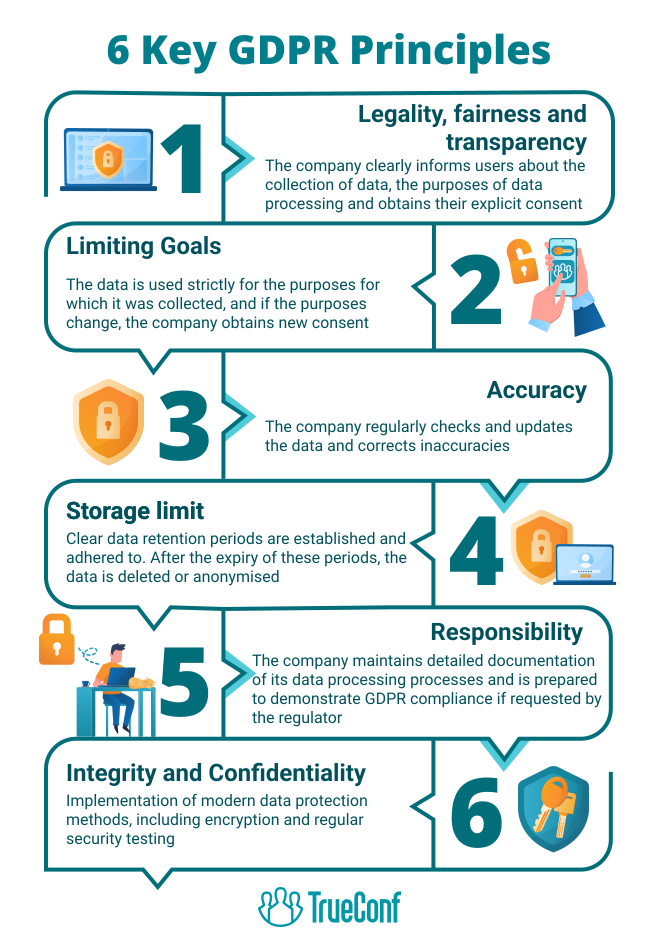
Unlike public messaging services, corporate platforms feature robust security measures such as end-to-end encryption, TLS 1.2/1.3 protocols, and cryptographic safeguards for stored data. These measures effectively mitigate risks of data breaches, virus infiltration, and unauthorized access by external parties.
The importance of transparency and obtaining consent is underlined in Article 13 of the GDPR. It also prohibits corporate messaging apps from accessing users’ local address books, rather they should only store contacts whose data they have explicitly been given permission to process as provided by GDPR transparency and privacy requirements. Moreover, Article 17 of the GDPR requires that company messaging tools continuously delete sent and received messages thereby enabling personal data control.
Secure information exchange software together with robust data management are critical for entities handling confidential customer data regardless of their size. This kind of software is essential for protecting sensitive information from any unauthorized access or probable security risks.
3. BYOD Culture Requires Enterprise-Grade Solutions, Not Consumer Apps
Shadow IT remains the largest security risk for enterprises. When employees use WhatsApp, Telegram, or other consumer messengers for business communication, compliance responsibility falls on the organization, not the app. Enterprise-class messengers with MDM/UEM integration, audit logs, and device-level controls prevent regulatory violations and data loss that compliance teams cannot easily detect.
On-premises solutions, hosted on the organization’s own servers, offer particular benefits by providing enhanced control over data security and compliance. This enables organizations to customize security protocols to adhere to regulatory requirements and internal policies. Furthermore, on-premises solutions seamlessly integrate with current infrastructure, ensuring an effective method for managing and protecting confidential client database.
Deploying a corporate messaging platform on internal servers assists organizations in meeting GDPR requirements and achieving a competitive advantage in safeguarding privacy and data security. Efficiently managing the communication environment is essential for adhering to European data protection standards.
Therefore, the choice of a corporate messenger on internal servers provides a significant advantage in the face of stricter rules for processing personal data.

Messenger and Privacy Issue
Corporate messaging generates digital records containing message content, participant information, communication timing, frequency, and other details. Therefore, organizations using such platforms for internal communications should prioritize safeguarding all associated data.
However, very few corporate messengers currently meet the rigorous GDPR standards for personal data processing. To ensure robust security and confidentiality in communications, these platforms must fulfill several essential criteria:
- Deployment on the organization’s own servers rather than in cloud environments
- Implementation of strong end-to-end encryption protocols (such as AES-256, SRTP, TLS 1.3)
- Ensuring no access to users’ local address books
- Capability to fully delete accounts when employees depart the company
- Providing limited guest access to prevent unauthorized usage.
Businesses responsible for customer private data must choose corporate messaging solutions that conform to all aspects outlined in the GDRP. This decision reduces chances of illegal access to data while ensuring strong protection for it.
Try TrueConf Server Free!
- 1,000 online users with the ability to chats and mske one-on-one video calls.
- 10 PRO users with the ability to participate in group video conferences.
- One SIP/H.323/RTSP connection for interoperability with corporate PBX and SIP/H.323 endpoints.
- One guest connection to invite a non-authenticated user via link to your meetings.

GDPR Fine Risk: Do Popular Messengers Comply with Data Protection Laws?
Using cloud-based messaging platforms such as WhatsApp or Telegram involves processing and storing a significant amount of personal user data, as well as accumulating substantial metadata.
Violation of GDPR data security standards can result in fines of 2-4% of a company’s annual turnover, which is considered a criminal offense. Several high-profile cases illustrate the seriousness of this liability:
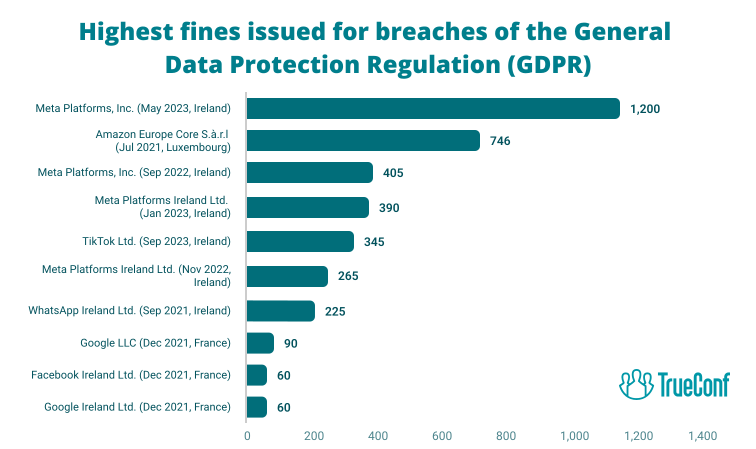
These cases emphasize that it is important for companies handling personal data to approach GDPR compliance with the utmost care in order to avoid significant fines and protect their reputation.
GDPR-Compliant Messenger: a Safe Choice
TrueConf is a secure messenger for corporate communication, combined with a platform for video calls and large-scale video conferences. Unlike all other messaging programs, this option is server-based, which means contact data, names, logins, passwords, and user address books are not copied or transmitted to cloud storage.
TrueConf offers users 12 levels of privacy protection, including a proprietary protocol, end-to-end encryption, mandatory registration and authorization, protection of connections through third-party protocols. All user data and correspondence are stored locally on the enterprise servers in a closed network.
- Authorization settings and access restrictions ensure that only registered users can use the messenger and video conferencing system. Administrators can implement two-factor authentication (2FA), establish password security requirements, set up account lockout after multiple failed login attempts, and manage access rights for different user groups.
- Media data, such as audio and video streams, are encrypted using the AES-256 standard, ensuring a high level of security.
- The ability to configure file retention period allows you to set a duration after which files will be automatically deleted. By default, files are kept for 7 days, but this value can be changed to any number from 1 to 99999 days.
- TrueConf Server is capable of operating autonomously within a corporate network, providing the company with full control over data even without an internet connection.
TrueConf: 100% Secure Communications
Keep your business conversations private with ISO/IEC 27001:2013 certified encryption and local data storage on your company’s servers. TrueConf ensures leak protection and total control over internal communications.
Signal
Lauded for its commitment to message security and privacy, Signal is an app that does not compromise when it comes to secrecy. For instance, it applies end-to-end encryption in such a way that only the sender and the receiver of messages will be able to get hold of them but even the company that has developed this platform cannot.
Signal, on the other hand, never collects or stores personal information. Consequently, it uses strong end-to-end encryption to protect all calls and messages made by any user thus guaranteeing privacy and security. This platform specifically forbids selling or transferring their users’ data to third parties. They can remove all traces of their account by validating via their phone number.
Rocket.Chat
Rocket.Chat is a versatile corporate communication platform offering functionalities like end-to-end encryption, access management, and communication auditing. It ensures GDPR compliance through strong privacy protocols, meticulous data handling, advanced control features, and customizable user rights management. The software is deployed under strict conditions to meet GDPR, HIPAA, FINRA, FedRAMP, and various global security standards. Notably, Rocket.Chat is acknowledged as a secure solution within the U.S. Department of Defense’s Platform One DevSecOps initiative.
Threema Work
Threema Work is a GDPR-compliant business messaging solution that is primarily focused on security and data protection. It encrypts every communication so as to protect user’s privacy so no need for them to share personal details like phone numbers or email addresses. Threema Work works independently without synchronizing contacts therefore respecting user privacy and allowing usage without accessing address book. In doing this group and contact lists are handled exclusively on user devices rather than on the server thereby reducing metadata collection. Additionally, Threema Work uses open-source code which enhances transparency in its security abilities thus creating trust with its stakeholders.
Wire
Wire provides secure messaging, file transfer, and supports audio and video calls through its platform. It employs an advanced open protocol for real-time end-to-end communication, emphasizing the confidentiality of personal conversations. Wire’s End-to-End Encryption guarantees that message content remains inaccessible to Wire, aligning with GDPR standards. This safeguards user data and enables individuals to maintain control over their information in accordance with data protection regulations.
Messaggio
Messaggio is an adaptable omnichannel platform designed specifically for business messaging across multiple communication channels, ensuring rigorous adherence to GDPR standards. It incorporates a dedicated team specializing in security and data protection. The platform offers robust functionalities such as spam filtering, HTTPS encryption, and secure APIs to facilitate seamless information exchange. Companies can efficiently manage user profile data and execute deletions as needed, fully compliant with GDPR.
WhatsApp Business API
WhatsApp does not offer a built-in application to access its API directly. Instead, businesses can utilize third-party software to interact with customers via WhatsApp. This involves integrating the WhatsApp technical interface with chosen software using an API key provided exclusively by certified partners known as “Business Solution Providers” (BSP) authorized by WhatsApp.
The WhatsApp Business API enforces stringent restrictions on accessing users’ contact lists. Media files and messages are stored temporarily for delivery purposes, with media retained for 7 days and messages for 30 days before being automatically deleted. Enterprises retain authority over decisions regarding storing customer data, archiving chat messages, and other associated actions.
Messagenius
Messagenius is crafted as a business-oriented instant messaging solution that prioritizes secure communication while complying with GDPR standards. It employs proprietary encryption and incorporates functionalities like Messagenius Black Hole for secure chats and messages with self-destruct capabilities. Users can personalize security settings, implement two-factor authentication for secure logins, prevent unauthorized access, and ensure secure data transfer with end-to-end encryption. Moreover, the platform supports user activity auditing to efficiently monitor and manage information exchanges within the organization.
Conclusion: Making the Right Choice
Choosing a GDPR-compliant messenger is not a cost—it’s an investment in legal safety and organizational integrity. Consumer apps like WhatsApp and Telegram expose your organization to fines, regulatory action, and reputational harm. Enterprise solutions like TrueConf provide the technical controls, transparency, and audit capabilities required by law. The 2026 regulatory environment demands immediate action: audit your current communication tools, identify compliance gaps, and migrate to a solution that puts privacy and control at its core. The cost of compliance is far lower than the cost of a regulatory fine.
FAQ
Can we use WhatsApp or Telegram for business under GDPR?
No. Both platforms are unsuitable for GDPR-regulated business communication. They accumulate metadata, use centralized servers, and lack the transparency and control required by law. Using them exposes your organization to regulatory fines and compliance violations. Enterprise messengers designed for GDPR compliance are the only lawful choice.
What is the difference between ‘cloud’ and ‘on-premises’ deployment?
Cloud platforms store data on third-party servers outside your control; on-premises platforms run on servers within your organization. GDPR requires maximum data sovereignty, making on-premises solutions preferable because they give you full control over encryption keys, data deletion, and compliance auditing. Cloud solutions require robust data processing agreements and may involve cross-border data transfers with legal complexity.
Do end-to-end encrypted messengers guarantee GDPR compliance?
No. Encryption protects message content, but compliance requires much more: metadata control, data minimization, deletion capabilities, audit trails, and consent management. A messenger can be end-to-end encrypted while still violating GDPR by syncing contacts, storing metadata, or lacking account deletion features. GDPR compliance is a combination of technology, design, and governance—not encryption alone.
What happens if my organization is fined for GDPR violations in messaging?
GDPR fines are severe and can bankrupt small organizations. For serious violations, fines reach €20 million or 4% of global annual revenue (whichever is higher). For lesser violations, expect €10 million or 2% of revenue. Additionally, data protection authorities can order public disclosure of your violation, resulting in reputational damage and customer trust loss. Proactive compliance prevents these catastrophic outcomes.
Are there any GDPR exemptions for small businesses?
Limited. The EU’s 2026 Digital Omnibus reform expands GDPR Record of Processing Activities exemptions from organizations under 250 employees to those under 750 employees. However, this applies only to documentation requirements—not to the core obligation to protect personal data or use compliant communication tools. All organizations processing EU resident data must comply with GDPR’s substance, regardless of size.
How should we handle GDPR compliance for remote and BYOD teams?
Implement an enterprise messenger with Mobile Device Management (MDM) integration. Solutions like Teamwire allow you to isolate business communication in a secure container on personal devices, control access via MDM policies, and remotely decommission data if a device is lost or stolen. This prevents shadow IT and ensures compliance even when employees work with their own devices.
Do we need to store messages on EU servers only?
Ideally, yes. EU/EEA server location (EU, Norway, Iceland, Liechtenstein) is preferable under GDPR. Switzerland has an adequacy decision allowing EU data transfers without additional safeguards. US-based servers require Standard Contractual Clauses (SCCs) and supplementary technical measures, adding legal and operational complexity. Whenever possible, choose EU/EEA hosting to simplify compliance.
About the Author
Nikita Dymenko is a technology writer and business development professional with more than six years of experience in the unified communications industry. Drawing on his background in product management, strategic growth, and business development at TrueConf, Nikita creates insightful articles and reviews about video conferencing platforms, collaboration tools, and enterprise messaging solutions.


Follow us on social networks