
What is Team Dynamics? Definition, Examples, and How to Improve It at Work
Updated April 2026
Team dynamics is the pattern of interactions, behaviors, and relationships that emerge when people work together toward shared goals. It determines whether a group operates as a high-performing unit or struggles with misalignment and conflict. This guide covers the core elements that shape team dynamics, warning signs to watch for, a practical diagnostic tool, and specific fixes for common problems.
Team Dynamics Definition
Team dynamics refers to the behavioral relationships and psychological forces that influence how team members interact, make decisions, and perform together. It encompasses communication patterns, trust levels, power structures, and the unwritten rules that govern collaboration.
Strong team dynamics directly affect performance outcomes. Teams with healthy dynamics resolve conflicts faster, adapt to change more effectively, and deliver higher-quality work. When dynamics break down, even talented individuals produce mediocre results because energy goes into managing interpersonal friction instead of solving problems.
Team Dynamics vs. Group Dynamics
People often use these terms interchangeably, but there’s a meaningful distinction:
|
Aspect |
Group Dynamics |
Team Dynamics |
|---|---|---|
|
Goal structure |
Individual or loosely connected goals |
Shared, interdependent objectives |
|
Accountability |
Personal responsibility only |
Mutual accountability for outcomes |
|
Success measure |
Sum of individual contributions |
Collective results that require coordination |
|
Example |
Department staff meeting |
Product launch task force |
Rule of thumb: If failure or success of one person directly affects everyone else’s outcomes, and members depend on each other’s work to succeed, you’re dealing with a team. A marketing department is a group; the four people building next quarter’s campaign are a team.
This matters because teams require different management. Groups need clear individual goals and fair resource distribution. Teams need role clarity, communication protocols, and mechanisms to handle interdependencies.
The 7 Core Elements of Healthy Team Dynamics
1. Communication
What it is: The flow of information, feedback, and context between team members, both formal and informal channels.
What it looks like in practice: Engineers post morning updates in Slack before standup. A designer asks “dumb questions” without hesitation. When priorities shift, someone calls an impromptu video huddle instead of letting confusion fester. People share not just what they’re doing, but why it matters and what they need from others. With AI tools increasingly handling routine communication tasks, maintaining authentic team voice becomes critical Undetectable AI ensures automated messages retain natural human tone rather than sounding robotic.
What breaks it:
- Remote teams that rely only on async messages
- Leaders who punish bearers of bad news
- Meetings without clear purposes or follow-up
- Technical jargon that excludes non-specialists.
Fixes:
- Establish communication norms (response time expectations, which channel for what, when to escalate to synchronous)
- Run “communication audits” where team members map who they need info from and assess whether they’re getting it
- Create a “stupid questions” channel where any ask is welcome.
Take your team communication to the next level with TrueConf!
A powerful self-hosted video conferencing solution for up to 1,000 users, available on desktop, mobile, and room systems.
2. Trust & Psychological Safety
What it is: The belief that you can take interpersonal risks, admitting mistakes, asking for help, challenging ideas, without fear of embarrassment or punishment.
What it looks like in practice: A junior developer points out a flaw in the tech lead’s architecture proposal during design review. The lead responds with “Good catch, let’s explore that.” A project manager tells the team “I dropped the ball on that client email” in standup. Someone says “I don’t understand this strategy” in an executive meeting and others nod in agreement.
What breaks it:
- Blame culture where mistakes become witch hunts
- Leaders who say they want honesty but react defensively
- Public criticism without private coaching first
- Uneven standards (some people can challenge ideas, others can’t)
Fixes:
- Leaders model vulnerability first (share a mistake you made this week)
- Implement “blameless retrospectives” with focus on systems, not people
- When someone takes a risk (admits error, challenges consensus), explicitly thank them
- Track whether quieter members speak up — if not, create structured turn-taking.
3. Role Clarity & Decision Rights
What it is: Clear understanding of who does what, who decides what, and how decisions get made when responsibilities overlap.
What it looks like in practice: Before a project starts, the team documents who’s Responsible, Accountable, Consulted, and Informed (RACI) for major decisions. When two people disagree about approach, they both know who makes the final call. An engineer doesn’t wait for permission to refactor code in their domain, but checks in before changing shared infrastructure.
What breaks it:
- Job titles that sound senior but have no real authority
- “Collaborative” cultures where every decision needs full consensus
- Leaders who override team decisions without explanation
- Scope creep where everyone’s “helping” but no one owns the outcome.
Fixes:
- Use DACI framework (Driver, Approver, Contributors, Informed) for important decisions
- Write one-pagers for projects that include decision authority
- When roles blur, ask “Who has regret rights on this decision?” and document it
- Review role boundaries quarterly as team structure evolves.
What it is: Genuine alignment on what success looks like and what matters most, not just stated agreement.
What it looks like in practice: When an urgent request comes in, team members independently make similar trade-off decisions because they understand priorities. If you ask three people “What’s our top goal this quarter?” you get the same answer. Resources and time allocation match stated priorities, if quality is the goal, there’s time for testing.
What breaks it:
- Leadership announces goals but doesn’t change what gets measured
- Competing metrics that incentivize different behaviors
- No clear priority order (everything is “high priority”)
- Individual bonuses tied to goals that conflict with team objectives.
Fixes:
- Force-rank priorities (only one thing can be #1)
- Connect daily work to goals explicitly (“This sprint supports Q2 Goal #1”)
- Review resource allocation against stated priorities – if they don’t match, change one or the other
- Create a “stop doing” list alongside the goal list.
Read also: What is a Team Leader?
5. Accountability & Follow-Through
What it is: Reliable delivery on commitments and peer-driven pressure to maintain standards, not just top-down enforcement.
What it looks like in practice: Team members ask each other “Did you finish that thing you committed to?” without awkwardness. When someone consistently misses deadlines, their peers address it before a manager needs to. People under-promise and over-deliver more often than the reverse. If circumstances change and a commitment can’t be met, the person signals early and proposes solutions.
What breaks it:
- No consequences for repeated non-delivery
- Vague commitments (“I’ll try to get to it”)
- Hero culture that rewards last-minute saves over consistent delivery
- Leaders who don’t follow through, modeling that commitments are optional.
Fixes:
- Use DRI (Directly Responsible Individual) for every deliverable
- In meetings, end with explicit commitments: “By when?” and “Who?”
- Implement weekly commitment reviews (public board showing status)
- Address accountability breakdowns within 48 hours, not quarterly reviews.
6. Conflict Norms (Healthy Debate)
What it is: Established ways to disagree productively, separating idea battles from personal attacks.
What it looks like in practice: Meetings have vigorous debates about approach, then everyone commits to the chosen path. When tensions rise, someone can say “Let’s take this offline” without it being awkward. The team has scripts for disagreement: “I see it differently because…” rather than “That won’t work.” After heated discussions, people grab coffee together.
What breaks it:
- rtificial harmony where no one ever disagrees
- Conflicts that go underground into gossip and passive resistance
- Personality-based arguments (“You always…” or “That’s just how they are”)
- Winner-take-all culture where losing an argument means losing status.
Fixes:
- Create explicit debate rules (attack ideas, not people; bring data; time-box arguments)
- Assign a “devil’s advocate” role in important decisions
- Teach escalation paths: peer discussion → mediated conversation → leader decision
- Normalize “disagree and commit”—model publicly supporting decisions you argued against.
7. Inclusion & Leveraging Differences
What it is: Actively using the diverse perspectives, backgrounds, and skills in the room rather than defaulting to the loudest or most senior voice.
What it looks like in practice: Before finalizing a go-to-market strategy, the team explicitly asks the newest member what they notice that veterans might miss. Meeting agendas include “round-robin” segments where everyone speaks. When hiring, the team discusses what perspective is missing, not just who’s most impressive. Different working styles (deep focus vs. collaborative energy) get accommodated rather than judged.
What breaks it:
- Homogeneous teams where “culture fit” means “thinks like us”
- Meeting dynamics where the same three people speak 80% of the time
- Promotion criteria that reward self-promotion over quiet competence
- Unexamined assumptions about “professional communication” that exclude valid styles.
Fixes:
- Use structured brainstorming where everyone writes ideas before discussion
- Track speaking time in meetings and address imbalances
- Create explicit space for different work preferences (async vs. sync, morning vs. evening)
- Ask “Who haven’t we heard from?” before making decisions.
Teams using an inclusive process made decisions 2× faster with half the meetings.
Signs of Strong vs. Poor Team Dynamics
✅Green flags (healthy dynamics):
- People volunteer information before being asked
- Conflicts get addressed in real-time, not avoided
- Laughter and casual conversation happen naturally
- Members defend each other’s work to outsiders
- New people get up to speed quickly
- Meeting time decreases as trust increases
- The team self-corrects problems without management intervention
- People take vacations without the team falling apart.
❌Red flags (poor dynamics):
- Passive-aggressive communication (sarcasm, eye rolls, vague complaints)
- Information hoarding or surprise reveals
- The same issues resurface in every retrospective
- High performers want to leave or go silent
- Decisions get relitigated after meetings end
- Constant escalations to leadership for minor issues
- Tribal knowledge that exists only in certain people’s heads
- Sick day patterns that correlate with certain meetings or projects.
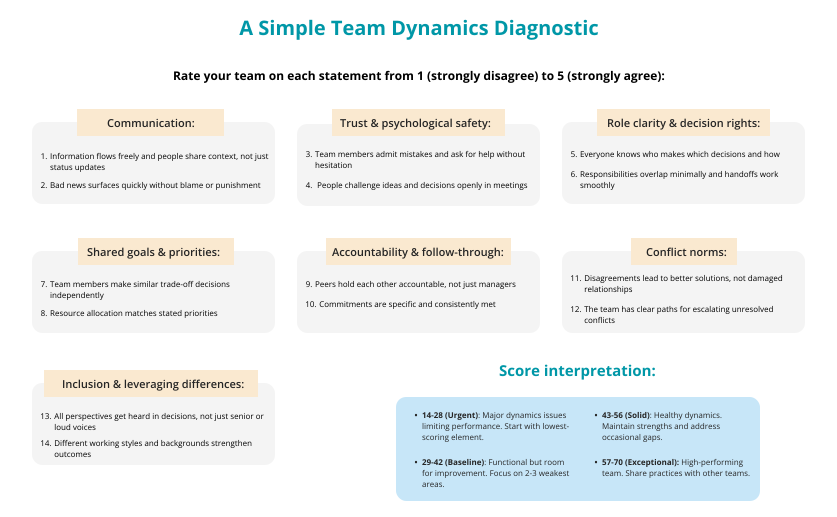
Prioritization guide:
- If psychological safety scores lowest (questions 3-4), start there – it enables all other improvements
- If role clarity scores lowest (5-6), fix that before addressing communication
- If multiple elements score poorly, begin with whichever problem shows up most frequently in daily work.
How to Improve Team Dynamics
|
Symptom |
Root Cause |
Intervention |
|---|---|---|
|
Meetings end with confusion about next steps |
Unclear decision rights |
Implement DACI for decisions; end every meeting with explicit commitments (who/what/when) |
|
Silence in retrospectives or design reviews |
Low psychological safety |
Run “no-interruption rounds” where everyone speaks; leader shares vulnerability first |
|
Repeated rework and missed deadlines |
Weak accountability |
Assign explicit DRI for each deliverable; weekly public commitment review |
|
Conflict becomes personal or goes underground |
Missing conflict norms |
Establish debate rules; create escalation path; teach “disagree and commit” |
|
Important context lives in one person’s head |
Information hoarding |
Create documentation expectations; rotate “expert” roles; cross-training sessions |
|
Same people dominate all discussions |
Inclusion gaps |
Track and balance speaking time; structured brainstorming before open discussion |
|
Urgent requests always derail plans |
No clear priorities |
Force-rank goals; create “protected time” blocks; decision criteria for trade-offs. |
Example fix in action:
A software team struggled with rework because developers and QA had different assumptions about “done.” They tried better documentation, but the problem persisted. The real issue was weak accountability — no single person owned the handoff.
The fix: They assigned a DRI for each feature who was responsible for the full cycle, not just their piece. That person had to explicitly confirm acceptance criteria with QA before coding started. Rework dropped 60% in one sprint because one person now had skin in the game for the entire outcome.
Conclusion
Team dynamics isn’t about mandatory trust falls or personality tests — it’s about the operational realities of how people work together. Communication patterns, decision rights, accountability mechanisms, and conflict protocols determine whether teams perform or struggle.
The diagnostic above gives you a starting point to measure your team’s health across the seven core elements. If you scored below 3 on psychological safety or role clarity, those should be your first priorities — they enable improvements in other areas.
Most teams don’t fail because of lack of talent or effort. They fail because the invisible systems governing collaboration are broken. The good news is that team dynamics can be diagnosed and improved systematically. Start with your lowest score, implement one specific fix from the playbook, and measure whether things improve in two weeks. Small changes to how teams operate compound into dramatically better outcomes over time.
FAQ
How can leaders effectively monitor and improve team dynamics in a fully remote or hybrid work environment?
In remote settings, the lack of informal interactions can quickly lead to silos and poor communication, making intentional connection crucial. Leaders should establish regular video check-ins and use structured collaboration routines to maintain visibility and trust. Utilizing a reliable, high-quality platform like TrueConf ensures that virtual face-to-face interactions remain engaging, helping remote teams build the psychological safety needed for healthy dynamics.
What is the most effective way to build psychological safety in a team that currently struggles with a blame culture?
The fastest way to shift a blame culture is for leaders to model vulnerability first by openly sharing their own mistakes and what they learned from them. Additionally, implementing “blameless retrospectives” shifts the focus from punishing individuals to fixing broken systems and processes. When team members feel safe to speak up during these sessions — perhaps facilitated through secure, private video meetings in TrueConf — they are more likely to share innovative ideas and flag risks early.
How can we prevent a few dominant personalities from taking over meetings and ensure inclusive participation?
To fix meeting imbalances, leaders should implement structured brainstorming where everyone writes down ideas before any open discussion begins. You can also use round-robin formats or explicitly track speaking time to ensure quieter members are given the floor. Integrating interactive features like live polling and screen sharing via TrueConf can further democratize the conversation, allowing all team members to contribute their perspectives equally regardless of their location.
How long does it typically take to see measurable improvements after applying these team dynamics fixes?
While deep-rooted cultural issues can take months to fully resolve, you should start seeing positive shifts in daily interactions within two to four weeks of implementing targeted interventions. The key is to focus on just one or two low-scoring areas from the diagnostic, such as clarifying decision rights or establishing communication norms. Tracking these improvements during regular video syncs using TrueConf helps leaders celebrate small wins and keep the team motivated throughout the transition.
What role does communication technology play in resolving poor team dynamics and reducing interpersonal friction?
The right technology removes technical frustrations and provides the rich, non-verbal cues necessary for building trust and resolving conflicts effectively. When teams rely solely on text-based chats, misunderstandings multiply, but face-to-face video interactions foster empathy and clearer alignment. Deploying an enterprise-grade solution like TrueConf guarantees secure, high-definition communication, which is especially critical for hybrid teams needing to maintain strong, frictionless relationships across different offices.
How can we improve accountability and follow-through without micromanaging the team?
Improving accountability requires shifting from top-down enforcement to peer-driven ownership by assigning a Directly Responsible Individual (DRI) for every key deliverable. Teams should end every meeting with explicit commitments regarding who is doing what and by when, tracked on a visible public board. Reviewing these commitments together during weekly video stand-ups in TrueConf keeps everyone aligned and allows the team to self-correct delays before they become major roadblocks.
About the Author
Olga Afonina is a technology writer and industry expert specializing in video conferencing solutions and collaboration software. At TrueConf, she focuses on exploring the latest trends in collaboration technologies and providing businesses with practical insights into effective workplace communication. Drawing on her background in content development and industry research, Olga writes articles and reviews that help readers better understand the benefits of enterprise-grade communication.

Follow us on social networks