
Threema vs. Signal vs. TrueConf: Comprehensive Comparison for Secure Business Communication
Choosing the right secure messaging platform for your organization requires careful evaluation of privacy features, usability, and deployment options. This detailed comparison examines three distinct approaches to secure communication: Threema’s paid Swiss privacy model, Signal’s free nonprofit approach, and TrueConf’s enterprise self-hosted solution. Each platform serves different organizational needs, from individual privacy advocates to large corporations requiring complete data sovereignty.
Modern organizations face an unprecedented challenge: how to maintain secure, private communications while managing compliance requirements and operational efficiency.
Data breaches cost companies an average of $4.9 million per incident, while cyber attacks on businesses increased by 30% in 2024, reaching over 1,000 attacks per week per company. These statistics make selecting the right secure messaging platform a business-critical decision.
Three messaging platforms have emerged as serious contenders for organizations prioritizing security:
- Threema, with over 12 million users globally and adoption by the Swiss government and military;
- Signal, trusted by 70 million active users including privacy advocates and journalists;
- TrueConf, deployed by more than 8,000 organizations requiring on-premises control.
Each represents a different philosophy toward secure communication.
While Threema offers true anonymity through its Swiss-based infrastructure and no-phone-number registration, and Signal provides free, donation-funded end-to-end encryption for the masses, TrueConf takes a fundamentally different approach. Rather than trusting external servers, whether in Switzerland or the United States, TrueConf deploys entirely on your infrastructure, giving organizations complete control over their communication data. For security-conscious enterprises, government agencies, and defense contractors, this architectural difference isn’t just a feature; it’s a requirement.
Your Messages Are Secure with TrueConf!
A powerful self-hosted video conferencing solution for up to 1,000 users, available on desktop, mobile, and room systems. Your confidential information is protected by 12 levels of security.
How Did We Compare Signal, Threema and TrueConf?
Our comparison methodology evaluates each platform across three critical dimensions that matter most to organizations: security and privacy capabilities, practical usability for daily operations, and total cost of ownership. We examined official documentation from Threema GmbH, Signal Foundation, and TrueConf, reviewed independent security audits, and analyzed real-world deployment scenarios.
For security assessment, we examined encryption protocols, server architecture, metadata handling, and compliance certifications. We reviewed the 2022 ETH Zurich security analysis of Threema, the 2016 formal cryptographic verification of the Signal Protocol, and TrueConf’s ISO 27001-certified deployment options. Privacy evaluation focused on data minimization practices, anonymity options, and jurisdictional protections – from Swiss data protection laws to GDPR compliance.
Usability testing covered installation complexity, learning curves for non-technical users, mobile and desktop experience, and administrative management tools. We tested file sharing limits, video call quality, and group chat functionality across different network conditions. Finally, our pricing analysis calculated not just license costs, but deployment resources, maintenance overhead, and scalability expenses – recognizing that the cheapest upfront option often carries hidden long-term costs.
Threema vs Signal vs TrueConf: A Quick Overview
Threema represents the premium Swiss approach to secure messaging. Founded in 2012 by Threema GmbH in Pfäffikon, Switzerland, it charges a one-time fee of approximately $2.99 per user for its mobile app, positioning itself as the messenger for users who refuse to provide phone numbers or email addresses. Its randomly generated user ID system allows complete anonymity. The Swiss Armed Forces recommended Threema to its troops in 2022, explicitly noting its Swiss jurisdiction protects it from the US CLOUD Act. With servers physically located in two ISO 27001-certified data centers in Zurich, Threema processed messages for over 12 million individual users and 7,000 enterprise customers by 2026.
Signal operates as a free, nonprofit alternative developed by the Signal Foundation. Launched in 2014 by Moxie Marlinspike and funded by a $50 million donation from WhatsApp co-founder Brian Acton, Signal relies on donations and grants rather than commercial revenue. The Signal Protocol it developed became the industry standard, adopted by WhatsApp, Facebook Messenger, and Google Messages. Signal requires a phone number for registration but added optional usernames in 2024 to improve privacy. With 70 million active users, Signal earned endorsements from Edward Snowden and cryptography experts worldwide. However, its servers operate in the United States, subject to different legal frameworks than European alternatives.
TrueConf takes a fundamentally different approach: rather than asking organizations to trust any external provider, it deploys entirely on-premises within your corporate network. Developed as a comprehensive unified communications platform, TrueConf combines secure messaging with 4K video conferencing for up to 2,000 participants, screen sharing, and enterprise collaboration tools. More than 8,000 organizations worldwide, including government agencies, defense contractors, banks, and manufacturers, chose TrueConf specifically because their data never leaves their infrastructure. The platform offers a free tier supporting up to 1,000 users permanently, making it accessible to small businesses while scaling to enterprise deployments. Unlike cloud-based competitors, TrueConf can operate completely offline within closed networks, meeting the strictest security requirements for classified communications.
Threema vs Signal vs TrueConf: Advanced Messaging Features
All three platforms provide the baseline features users expect: text messaging, voice and video calls, file sharing, and group chats. However, their implementations reveal different priorities and capabilities that become critical in professional environments.
Group Communication and File Sharing
Threema supports group chats with up to 256 participants and limits individual file transfers to 50 MB. For professional teams, it offers polls and agree/disagree voting tools, though these remain relatively basic compared to dedicated collaboration platforms. Groups are managed in a strictly decentralized manner—not even Threema itself knows group membership, protecting organizational structure from external observation.
Signal also accommodates large group chats and provides file sharing, though without published size limits in official documentation. Its recent updates added message editing, reactions with emojis, and disappearing messages with customizable timers. The Stories feature allows broadcasting updates to contacts. Signal’s group calls support up to several dozen participants, though exact limits aren’t prominently documented. Screen sharing works in desktop calls but with occasional quality issues reported by users.
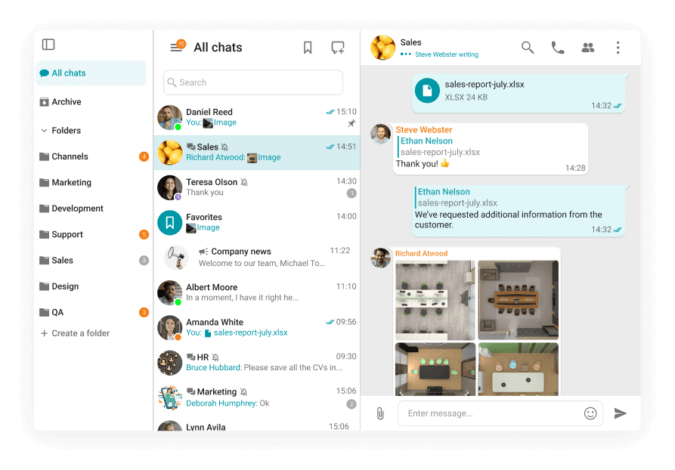
TrueConf dramatically expands these capabilities for enterprise use. Group chats support up to 1,000 participants with organized folder systems for managing multiple projects. File sharing has no arbitrary size limits – you can transfer gigabytes of CAD models, presentations, or datasets directly through the platform. Built-in viewers let recipients preview PDFs, images, and videos without downloading. The platform includes corporate channels for broadcasting announcements, chatbots for automating workflows, and spell-check in multiple languages.
Video Conferencing Quality and Scale
For video calling, the three platforms operate at vastly different scales. Threema and Signal provide basic video calling for one-on-one conversations and small group calls. Threema’s video conferencing supports standard definition quality suitable for casual communication. Signal offers crystal-clear video calls according to user reviews, though performance depends heavily on network conditions.
TrueConf delivers professional video conferencing in 4K Ultra HD quality for point-to-point calls, with conferences supporting up to 2,000 participants distributed across multiple servers. The platform automatically adjusts quality based on network conditions and device capabilities, ensuring stable performance even on weak connections. During conferences, you can display up to 49 participants simultaneously on screen, share multiple content streams, and record meetings for later review. For organizations conducting customer presentations, board meetings, or technical trainings, this isn’t just a nice-to-have feature – it’s the core use case.
Advanced Collaboration Tools
Neither Threema nor Signal focuses heavily on workplace collaboration beyond basic messaging. They don’t offer screen annotation, remote desktop control, or whiteboard functionality. Both platforms excel at secure person-to-person communication but weren’t designed to replace workplace collaboration suites.
TrueConf integrates these tools natively: annotate shared screens during presentations to highlight important points, take control of remote desktops for technical support scenarios, use AI-powered whiteboards that can recognize handwritten content, access built-in survey tools for collecting feedback during meetings, and stream conferences to YouTube or other platforms for broader audiences. The platform also includes an AI server for meeting transcription and summarization, helping teams capture action items from lengthy discussions. These features transform TrueConf from a messaging app into a complete unified communications platform.
Threema vs Signal vs TrueConf: Which is Best for Privacy?
Encryption Standards and Protocols
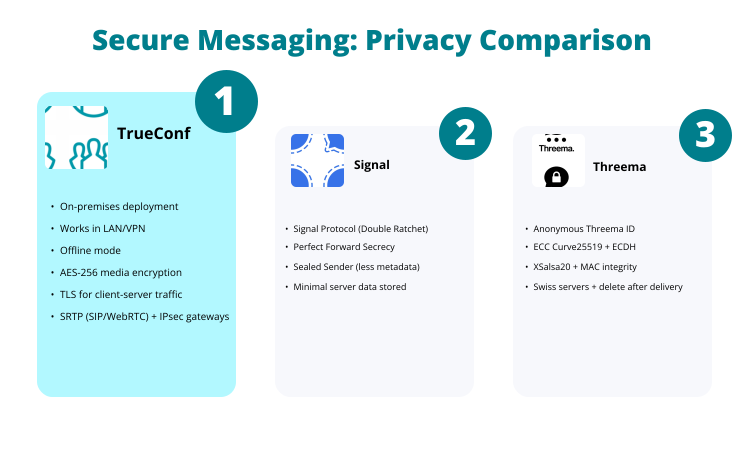
Threema employs asymmetric ECC-based encryption with 256-bit strength using the NaCl (Networking and Cryptography library) for all communications. The platform uses ECDH on Curve25519 combined with hash functions and random nonces to derive unique 256-bit symmetric keys for each message, then encrypts content with the XSalsa20 stream cipher. According to NIST estimates, this corresponds to at least 2048-bit RSA strength. Threema adds 128-bit message authentication codes to detect tampering. Independent security audits by Cure53 in 2020 confirmed the implementation was solid, though ETH Zurich researchers identified theoretical vulnerabilities in 2022 that were subsequently patched.
Signal developed and maintains the Signal Protocol, widely considered the gold standard for secure messaging. The protocol combines the Double Ratchet algorithm, prekeys, and Extended Triple Diffie-Hellman (X3DH) handshake to provide Perfect Forward Secrecy—meaning compromise of current encryption keys doesn’t expose past or future messages. Formal security analysis by researchers from multiple universities in 2016 confirmed the protocol’s cryptographic soundness. The protocol’s reputation led to adoption by WhatsApp, Facebook Messenger, Google Messages, and Skype. Signal also implemented sealed sender technology in 2018, which conceals sender identifiers from servers, reducing metadata exposure.
TrueConf uses military-grade AES-256 encryption for all media streams transmitted via its proprietary protocol. Traffic between applications and servers is encrypted with TLS (Transport Layer Security), while connections via SIP and WebRTC use SRTP (Secure Real-time Transport Protocol). The platform also employs a modified VP8 codec with SVC support for video encoding, making streams harder to decrypt using standard methods. For organizations requiring additional protection between network segments, TrueConf supports VPN gateways with end-to-end encryption via the IPsec protocol family. Modern processors’ hardware AES support ensures this encryption doesn’t impact performance. Critically, because TrueConf operates on your infrastructure, there’s no external party that could potentially be compelled to compromise encryption, even theoretically.
Server Architecture and Data Sovereignty
Threema operates servers exclusively in Switzerland, hosted in two ISO 27001-certified data centers in Zurich with biometric access control, video surveillance, and fire protection. As a Swiss company subject to the Federal Act on Data Protection (FADP), Threema isn’t subject to the US CLOUD Act—a key reason the Swiss Armed Forces recommended it. Messages are deleted from servers immediately after delivery, and contact lists remain on user devices. Only minimal metadata (hashed phone numbers if optionally linked) ever touches servers. Threema Safe allows encrypted backups to company servers or any server users choose.
Signal stores minimal data on its US-based servers: only the date of account creation and last connection time. The nonprofit foundation operates transparently under California law. Signal doesn’t store contacts, conversation lists, group memberships, user avatars, or location data. A 2016 federal subpoena famously demonstrated this limited data collection—Signal could only provide the date the account was created and the date it last connected. However, Signal’s US jurisdiction means it’s subject to different legal frameworks than European alternatives, though the foundation has demonstrated strong resistance to data requests.
TrueConf fundamentally changes the server architecture equation: there are no external servers to trust. The platform deploys entirely on your organization’s equipment, operating within your LAN or VPN network. Every message, file, and video stream stays within your infrastructure, never traversing public internet unless you specifically configure external access. For defense contractors, government agencies, financial institutions, and companies handling trade secrets, this isn’t just a privacy advantage – it’s a compliance requirement.
Organizations subject to GDPR, HIPAA, FINRA, NIS2, DORA, or classified information regulations can implement TrueConf knowing their data never leaves their control. The platform can operate completely offline in air-gapped networks, a capability neither cloud-based competitor can match.
Anonymity and Registration Requirements
Threema excels at true anonymity. Registration requires no phone number, email, or personally identifiable information—just a randomly generated eight-character Threema ID created after initial app launch. You can even purchase the app anonymously with Bitcoin or cash. Users can optionally link a phone number or email to help contacts find them, but this is entirely optional and can be removed anytime. Linking creates only hashed values on servers, though these can be brute-forced for phone numbers due to limited digit combinations.
Signal requires a phone number for registration, though it added optional usernames in March 2024 to allow hiding phone numbers from other users. While you can register Signal using a secondary number or VOIP service to maintain some privacy, the platform fundamentally relies on phone numbers as user identifiers. This design choice prioritizes spam prevention and makes Signal more accessible to mainstream users, but limits true anonymity compared to Threema.
TrueConf operates under an entirely different model: organizational control. Registration and authentication are managed by your IT department through administrative tools. You can integrate with existing directory services like Active Directory via LDAP, implement single sign-on (SSO), require two-factor authentication (2FA), or create custom authentication flows. There’s no external company maintaining a database of your users—your organization controls all user accounts, access permissions, and authentication policies. This enterprise-managed approach better serves organizations than consumer-focused anonymity, though it requires initial administrative setup.
Threema vs Signal vs TrueConf: Which is Best for Pricing?
Consumer and Small Business Costs
Threema charges a one-time $2.99 purchase per device through app stores. This upfront fee creates a barrier for users accustomed to free messaging apps, though it eliminates ongoing costs and demonstrates Threema’s business model doesn’t rely on monetizing user data. For small teams, multiply this by the number of devices (remembering users often want both mobile and desktop access) to calculate total investment.
Signal is completely free for individual users and small groups. The Signal Foundation operates on donations and grants, including the initial $50 million from Brian Acton. Users aren’t customers—they’re beneficiaries of a nonprofit mission to provide secure communication for everyone. This model works well for individual privacy advocates and small informal groups but doesn’t scale to enterprise deployments that require support contracts, service level agreements, or dedicated account management.
TrueConf offers a permanently free tier supporting up to 1,000 users with full messaging, file sharing, and video conferencing capabilities. This free version requires annual license renewal through the website but otherwise includes no restrictions on core functionality. For small to medium businesses, this can provide years of free service while allowing organizations to grow without immediate licensing costs. The free model includes one SIP/H.323/RTSP connection for integrating existing video conferencing equipment and one guest connection for inviting external participants to web conferences.
Try TrueConf Server Free!
- 1,000 online users with the ability to chat and make one-on-one video calls.
- 10 PRO users with the ability to participate in group video conferences.
- One SIP/H.323/RTSP connection for interoperability with corporate PBX and SIP/H.323 endpoints.
- One guest connection to invite a non-authenticated user via link to your meetings.

Enterprise Licensing and Total Cost of Ownership
Threema Work, the enterprise version, operates on annual subscription pricing. According to available information, pricing starts at approximately $10.99 per user per year for the Essential plan, $21.99 for Advanced, and $32.99 for Professional. These subscriptions include administrative management capabilities, centralized deployment tools, and business-focused features. For a 500-person organization, annual costs could range from $5,495 to $16,495 depending on the tier selected.
Signal doesn’t offer enterprise licensing, commercial support contracts, or service level agreements. Organizations using Signal do so by directing employees to download the free consumer app—essentially adopting consumer software for business use. While this eliminates licensing costs, it also means no dedicated support channel, no guaranteed uptime, no administrative controls, and no compliance documentation for auditors. For startups and small nonprofits, this might suffice. For regulated enterprises, healthcare providers, or government agencies, the lack of enterprise features represents a significant limitation regardless of the zero license cost.
TrueConf Server‘s paid enterprise edition provides custom pricing based on the number of concurrent conference participants and desired features. Organizations purchase licenses for active PRO users who can create and participate in video conferences. The lifetime license model means no recurring annual fees – you purchase capacity once and own it permanently. For example, one customer review noted that while TrueConf’s upfront cost exceeds cloud-based alternatives, the lifetime licensing and complete data privacy justify the investment for their organization.
Conclusion
Selecting between Threema, Signal, and TrueConf ultimately depends on your organization’s priorities, regulatory requirements, and willingness to manage infrastructure.
Choose Threema if: your organization values true anonymity above all else, operates under Swiss data protection laws, needs zero-knowledge architecture where even the provider can’t access metadata, and is willing to pay per-user fees for Swiss-based cloud infrastructure. Threema works well for privacy-focused individuals, Swiss government agencies, and European organizations wanting to avoid US-based services. The Swiss Armed Forces’ endorsement validates Threema’s security for sensitive communications.
Choose Signal if: you want free, high-quality encrypted messaging without enterprise features, trust the Signal Foundation’s nonprofit mission, accept US jurisdiction for server operations, and don’t require administrative controls or compliance documentation. Signal excels for small organizations, nonprofits, activist groups, journalists, and individual privacy advocates who need strong end-to-end encryption without cost barriers. Edward Snowden’s endorsement and the protocol’s widespread adoption by major platforms demonstrate Signal’s technical excellence.
Choose TrueConf if: your organization requires complete data sovereignty and cannot accept external parties processing communications, needs to comply with GDPR, HIPAA, FINRA, or classified information regulations, wants to operate in air-gapped networks or without internet connectivity, needs 4K video conferencing for up to 2,000 participants, requires integration with existing enterprise infrastructure (Active Directory, PBX systems, calendar servers), wants unlimited file sharing without cloud storage costs, demands administrative controls over users and permissions, or operates in industries like defense, government, banking, or manufacturing where data leaving your infrastructure is unacceptable.
Self-Hosted Team Messenger with Video Conferencing
A cutting-edge team collaboration server with personal and group chats, UltraHD video conferences, and advanced AI-powered features — free for up to 1,000 users!
FAQ
Can we use Signal or Threema to meet strict data residency requirements like HIPAA or GDPR?
While both platforms offer strong encryption, their data ultimately passes through external cloud servers (in the US or Switzerland), which can complicate strict data residency audits. If your organization requires absolute data sovereignty, TrueConf is the ideal solution because it deploys entirely on your own on-premises servers. This ensures all messages, files, and video streams never leave your private corporate network.
Are Threema and Signal suitable for hosting large corporate video meetings or company-wide town halls?
No, both Threema and Signal are primarily designed for secure person-to-person messaging and small group calls, lacking the infrastructure for massive broadcasts. If you need to host large-scale events, TrueConf is specifically engineered for this, supporting up to 2,000 participants in a single conference with 4K Ultra HD video quality. This makes it the clear choice for enterprise-level video collaboration.
Is it possible to conduct secure internal communications if our external internet connection goes down?
Cloud-dependent platforms like Signal and Threema become completely inaccessible during an internet outage, halting your team’s productivity. However, because TrueConf can be deployed entirely on-premises, it operates seamlessly within your local corporate LAN or even fully air-gapped networks. This guarantees uninterrupted, highly secure communication for your internal teams regardless of external internet status.
How do these secure messaging platforms integrate with our existing corporate IT infrastructure?
Consumer-focused apps like Signal and Threema offer limited enterprise integration, often requiring manual user management and lacking deep connectivity with corporate hardware. In contrast, TrueConf natively integrates with standard enterprise protocols, allowing seamless connection to your existing Active Directory via LDAP and legacy SIP/H.323 conference room systems. This enables centralized user management and protects your previous hardware investments.
How do the long-term costs compare for a growing enterprise with hundreds of employees?
Threema charges an annual per-user subscription that scales up as your headcount grows, while Signal is free but lacks enterprise support and administrative controls. TrueConf offers a much more predictable and cost-effective model through perpetual lifetime licenses based on concurrent users rather than total registered accounts. For medium to large organizations, this eliminates recurring per-seat fees and results in significant long-term savings.
Can we securely share large files, such as CAD models or extensive datasets, using these platforms?
Threema restricts individual file transfers to just 50 MB, and Signal does not explicitly support unlimited large file sharing, making them impractical for heavy data workflows. TrueConf removes these arbitrary size limits, allowing you to transfer gigabytes of data directly through the platform while keeping everything within your controlled environment. This ensures that sensitive, large-scale files are shared securely without relying on vulnerable third-party cloud storage.
About the Author
Olga Afonina is a technology writer and industry expert specializing in video conferencing solutions and collaboration software. At TrueConf, she focuses on exploring the latest trends in collaboration technologies and providing businesses with practical insights into effective workplace communication. Drawing on her background in content development and industry research, Olga writes articles and reviews that help readers better understand the benefits of enterprise-grade communication.

Follow us on social networks