
Secure Messaging in Healthcare: The Ultimate Guide
Updated April 2026
Critical Strategic Insights
-
Secure messaging in healthcare should be viewed as a clinical communication system, not just an encrypted chat tool.
-
Traditional SMS and email may be fast, but they often lack the controls needed for regulated healthcare communication.
-
The most effective platforms combine privacy, speed, auditability, and workflow support.
-
Secure messaging works best when it fits real care delivery scenarios such as handoffs, consults, and patient follow-up, especially when combined with tools like an AI scribe that help clinicians document interactions efficiently and reduce administrative burden.
-
Ease of use is a security factor, because difficult tools often push staff toward unsafe workarounds.
-
Integration with EHR/EMR and internal IT systems is essential for long-term value and adoption.
Importance of Secure Communication in Healthcare Sector
The healthcare sector faces unique challenges in securing electronic communications due to the intersection of patient privacy requirements and clinical workflow demands.
While data protection concerns affect multiple industries, healthcare organizations must specifically address the complexity of protecting individual health records while facilitating efficient communication among medical professionals and institutions via mobile platforms.
Protecting patient data remains one of the top priorities for healthcare organizations. The HIPAA Benchmark Report shows that reducing inappropriate disclosure of protected health information is a priority for 50% of organizations, while 45% focus on monitoring improper access to PHI.
The stakes of communication security in healthcare extend beyond standard data protection. Security breaches can result in identity theft, medical fraud, and erosion of patient trust. The proliferation of digital health records and telemedicine applications has intensified these security imperatives. In other critical sectors, tools like fire department reporting software are similarly used to ensure accurate documentation, accountability, and secure handling of sensitive operational data.
Try TrueConf Server Free!
- 1,000 online users with the ability to chats and mske one-on-one video calls.
- 10 PRO users with the ability to participate in group video conferences.
- One SIP/H.323/RTSP connection for interoperability with corporate PBX and SIP/H.323 endpoints.
- One guest connection to invite a non-authenticated user via link to your meetings.

What Secure Messaging Means in Practice
Secure messaging in healthcare is a controlled communication environment for clinicians, staff, and patients. It should protect sensitive information, verify user identity, preserve an audit trail, and support timely coordination across departments, devices, and care settings. Competitor content that performs well on this query tends to make that distinction immediately, and that is the right move here as well.
Secure messaging vs common healthcare communication channels
|
Channel |
Speed |
Security controls |
Audit trail |
Best use case |
Main limitation |
|---|---|---|---|---|---|
|
Standard SMS |
High |
Low |
Weak |
Basic non-sensitive reminders |
Hard to govern, verify, and retain safely |
|
|
Medium |
Variable |
Moderate |
Longer administrative communication |
Misdelivery risk and inbox sprawl |
|
Pagers |
High |
Minimal context |
Weak |
Urgent one-way alerts |
No rich collaboration thread |
|
Consumer chat apps |
High |
Inconsistent for healthcare |
Limited |
Informal internal use outside regulated settings |
Usually not suitable for PHI-heavy workflows |
|
Secure healthcare messaging |
High |
Strong |
Strong |
Clinical coordination, patient communication, handoffs, follow-up |
Requires policy, rollout, and integration work |
Healthcare organizations should treat secure messaging as the default option for time-sensitive, PHI-sensitive, and workflow-dependent communication. It is not simply “texting with encryption”; it is a safer operational layer for care delivery.
Insight
Encryption solves only part of the problem. In healthcare, a message can still create risk if it reaches the wrong person, the wrong role, or the wrong shift. Accurate directories, role-based routing, and on-call awareness are just as important as protecting the message itself.
Key Components of Secure Messaging in Healthcare
Four critical elements define secure healthcare messaging systems:
1. End-to-end encryption ensures message privacy by encrypting data at the sender’s device and maintaining the encryption until it reaches the recipient’s device.
2. User authentication protocols, such as OAuth verify user identity and prevent unauthorized access.
3. Message audit logs track all communication activities, enabling transparency and accountability.
4. Data integrity measures, including checksums and digital signatures, prevent information alteration.
HIPAA (Health Insurance Portability and Accountability Act) Compliance
The Health Insurance Portability and Accountability Act (HIPAA) of 1996 established federal standards for patient privacy. Simply put, HIPAA establishes rules to protect patient privacy by regulating who can view, receive, and use patients’ health information.
Standard consumer text messaging applications, while offering basic encryption, typically do not meet the strict HIPAA data protection and compliance requirements in healthcare settings.
For example, many practices now leverage HIPAA-compliant virtual assistants trained professionals who handle sensitive administrative communication and data tasks within secure systems as part of their broader secure messaging and compliance strategy, ensuring patient information stays protected across all communication channels.
Healthcare providers require specialized platforms when sharing clinical information such as prescriptions, diagnostic images, and test results.
View the list of HIPAA-compliant messengers in our article.
Insight: Compliance is not a feature checkbox
A secure messaging tool can look compliant in a demo and still fail in practice if the organization has weak offboarding, poor mobile-device governance, unclear retention rules, or no distinction between urgent communication and formal documentation.
Problems Encountered when Switching to a Healthcare Messaging
Organizations face three primary challenges when implementing secure healthcare messaging systems:
- Security. Reaching a balance between convenience and security is a challenge when transitioning to a healthcare messaging platform. Users often emphasize convenience and fast communication, which matter a lot, especially in online therapy services, sometimes ignoring important security elements such as strong authentication or encryption. This concern is also evident in digital platforms used for marriage therapy, much like in healthcare, where confidentiality is crucial for protecting sensitive discussions.
- Technical barriers. To swiftly address technological complications, it is crucial to perform a comprehensive evaluation of the existing technological setup and its interoperability with the new communication system. This might necessitate close cooperation with IT professionals to guarantee smooth incorporation and tackle any compatibility issues that emerge.
- Scalability. Medical institutions range in magnitude, from small practices to expansive hospital networks. The communication exchange platform should be adaptable to meet the requirements of diverse organizations without sacrificing efficiency or protection.
Healthcare organizations face significant risks when handling sensitive patient information. According to the HIPAA Benchmark Report, almost 46% of healthcare organizations reported a data breach to the Office for Civil Rights within the past year.
The Department of Health of Ho Chi Minh City|Case Study
TrueConf video collaboration solution connected more than 100 hospitals in Ho Chi Minh and allowed converting quarterly medical examination and treatment briefings between the Department of Health and hospitals into online mode. 660 employees of the City Oncology Hospital can now collaborate with one another without any barriers, increasing both speed and efficiency of communications.

Criteria for Choosing a Platform for Secure Messaging in Healthcare
Healthcare organizations should evaluate messaging platforms based on specific requirements. Key selection criteria may include:
- Regulatory compliance: The platform must comply with standards and regulatory requirements, such as HIPAA in the U.S. or GDPR in Europe, to ensure the privacy and security of medical information.
- Strong data encryption: Utilize advanced encryption methods (e.g., end-to-end encryption) to protect data both during transmission and storage.
- User Authentication: Having strong authentication methods, such as two-factor authentication or integrating an authentication API, help prevent unauthorized access.
- Access Control: Ability to customize access rights for different categories of users to ensure that only the necessary information is accessed.
- Logging and auditing: Functions to track and record all transactions and communications to promote transparency and accountability.
- Compatibility and Integration: Ability to integrate with existing health information management systems (e.g., EHR/EMR) to provide a seamless workflow.
- Beyond EHR connectivity, secure messaging should support revenue cycle workflows. In specialties such as cardiology, clinicians, coders, and billing teams use HIPAA-compliant chats to clarify documentation, validate CPT/ICD-10 codes, and accelerate prior authorization and claim submission, while leveraging Best Productivity Planners to organize tasks, streamline workflows, and improve overall team efficiency. For a concise primer on workflows, codes, and best practices specific to cardiology, this overview of cardiology medical billing can help align messaging features with specialty RCM requirements and reduce denials..
- Ease of Use: Intuitive interface that makes it easy for medical staff and minimizes training time.
- Mobile Device Support: Availability of full-featured mobile apps to ensure accessibility and flexibility of use.
- Reliability and Availability: High level of platform availability and fault tolerance to ensure continuity of communications.
- Support and maintenance: Quality technical support and regular security updates from the platform provider.
- eSignature Integration: Support for compliant electronic signatures (e.g., HIPAA-compliant eSignatures) to facilitate secure approvals, consent collection, and authorization workflows within messaging threads.
These criteria will help healthcare organizations choose the most suitable secure messaging platform to meet their needs and requirements, just as selecting the EMR systems for small practices is essential for efficient clinical operations and patient management.
TrueConf offers an on-premise healthcare messaging software solution that provides healthcare organizations with a secure and customizable platform for communication and collaboration.
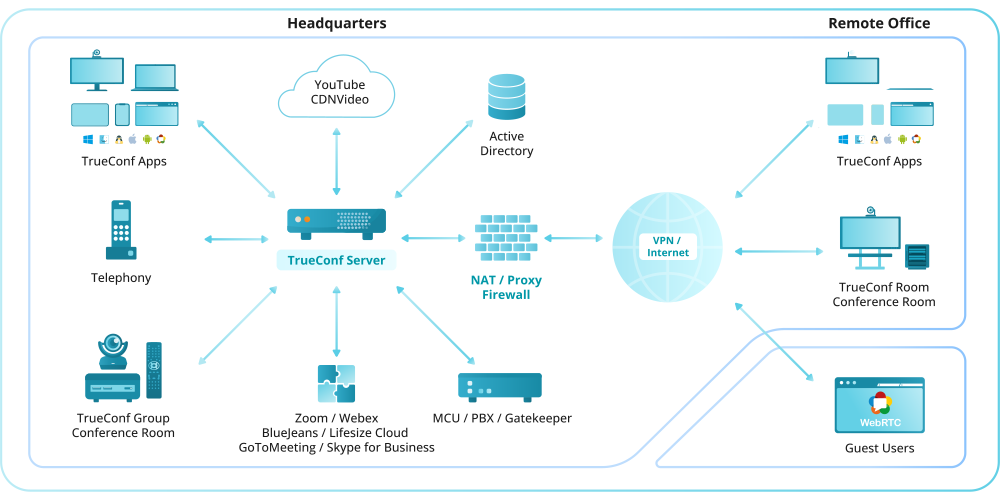
- Video conferencing software server for Windows and Linux
- Secure team messenger with personal and group chats
- Includes all the features of the free version
- Ultra HD video conferences with up to 1,500 participants
- Easily integrates with any IT systems
- Works autonomously in closed networks
Your Messages are Safe with TrueConf
Your confidential information is safe, thanks to 12 levels of security. Share patients’ lab results, clinical records and more with other practitioners over encrypted communication channels.
Learn more about TrueConf security.
Gain full control over your communications by deploying TrueConf solutions in your enterprise local or virtual network. With TrueConf you can go completely offline and run video sessions without Internet connection. TrueConf features several protection levels, GDPR and HIPAA compliance, which is crucial for clinical services delivered to patients.
FAQ
What is secure messaging in healthcare?
Secure messaging in healthcare is a protected way for clinicians, staff, and patients to exchange information through approved digital channels. It combines encryption, access controls, auditability, and workflow support so communication can move quickly without exposing patient data.
Why is regular texting not enough for healthcare communication?
Regular texting is fast, but it usually lacks the controls healthcare organizations need for sensitive information. Standard SMS does not provide the same level of recipient control, auditability, retention management, and device governance that healthcare workflows require.
Does HIPAA allow providers to message patients electronically?
Yes. HHS says providers may communicate electronically with patients if they apply reasonable safeguards, and transmission of ePHI must comply with the Security Rule. That is why secure, purpose-built channels are usually the safest operational choice.
What features matter most in a secure healthcare messaging platform?
The essentials are encryption, authentication, role-based access, audit logs, mobile controls, and integration with healthcare workflows. Platforms become much more valuable when they also support directories, escalation paths, and reliable operation across departments and devices.
Should secure messaging replace phone calls and pagers entirely?
Not always. Secure messaging should become the default for many routine and PHI-sensitive communications, but organizations still need escalation rules for emergencies, downtime scenarios, and voice-first interactions. The best approach is channel governance, not one-channel absolutism.
Can cloud-based secure messaging be HIPAA compliant?
Yes, it can. HHS says cloud services may be used for ePHI when the right contractual and security conditions are in place, including a business associate agreement and a proper risk analysis.
What is the biggest mistake organizations make when implementing secure messaging?
One of the biggest mistakes is treating secure messaging as just another app rollout. In reality, it changes workflow, escalation, documentation habits, and patient communication, so success depends on governance and training as much as on technology.
About the Author
Nikita Dymenko is a technology writer and business development professional with more than six years of experience in the unified communications industry. Drawing on his background in product management, strategic growth, and business development at TrueConf, Nikita creates insightful articles and reviews about video conferencing platforms, collaboration tools, and enterprise messaging solutions.


Follow us on social networks