
Federated Messaging: How Independent Servers Communicate?
Federated messaging is a communication model in which users on independently operated messaging servers can exchange messages without moving everyone into one centralized service. Each organization can retain its own server, accounts, policies, and administrative control while connecting selected users or spaces to external organizations.
The model is useful for companies with subsidiaries, government bodies, healthcare networks, universities, suppliers, contractors, and other organizations that need persistent cross-organization communication without placing every participant inside one centrally managed workspace.
Federated messaging differs from ordinary cloud messaging because participants do not need to belong to the same tenant. It also differs from guest access because users normally remain members of their own server and communicate through server-to-server connections.
|
Question |
Federated messaging answer |
|---|---|
|
Where do user accounts live? |
On independently managed servers or workspaces |
|
Can different organizations communicate? |
Yes, when federation policies allow it |
|
Must every user move to one central tenant? |
No |
|
Who controls local users and infrastructure? |
Each participating organization |
|
How are messages exchanged? |
Through server-to-server communication or synchronized shared spaces |
|
Can federation be restricted? |
Usually yes, through allowlists, domain policies, or trusted connections |
|
Typical approaches |
Matrix, XMPP, proprietary server federation, connected workspaces |
|
Main advantage |
Cross-organization communication with administrative independence |
|
Main challenge |
Identity, trust, security, moderation, synchronization, and data flow become distributed |
The Short Version
Federated messaging is most useful when two or more organizations need persistent communication but should not share one identity domain, one administrator, or one central collaboration tenant.
Choose open protocol federation when cross-vendor interoperability matters. Choose private or proprietary federation when communication should be limited to known deployments. Use guest access instead when external collaboration is temporary and does not justify a permanent server-to-server trust relationship.
- Use open federation when independent organizations need protocol-level interoperability across compatible products or server implementations.
- Use private federation when known organizations need persistent communication but must retain separate administration and infrastructure.
- Use connected workspaces when the same product is deployed by several organizations and administrators want explicit trusted relationships.
- Use guest access when external collaboration is temporary and a permanent server trust relationship would add unnecessary operational overhead.
The buyer question is not simply “Does the platform support federation?” It is “Which organizations should trust each other, what data crosses that boundary, and who can revoke the connection?”
Federation Decision Matrix
|
Requirement |
Best-fit model |
Main reason |
|---|---|---|
|
Temporary external participant |
Guest access |
Avoids creating a permanent server trust relationship |
|
Known partner organizations using the same platform |
Private or proprietary federation |
Keeps administration separate while limiting trust to approved deployments |
|
Cross-vendor or cross-implementation interoperability |
Open protocol federation |
Allows compatible servers to communicate without one vendor controlling every endpoint |
|
Communication between unrelated protocols |
Bridge or gateway |
Translates between communication models rather than federating identical ones |
What Is Federated Messaging?
Federated messaging connects independently administered communication servers so their users can communicate without moving into the same tenant. Each participating server remains responsible for its own accounts, policies, infrastructure, and identity lifecycle.
A simple federation can involve two organizations:
Company A server → federation connection → Company B server
A larger environment can connect several administrative domains:
Organization A ↔ Organization B ↔ Organization C ↔ Regional Server D
The servers do not need to share the same database, directory, administrator, or infrastructure. Matrix is one example of this architecture: users remain associated with homeservers while those homeservers exchange information through federation.
Insight 1: Federated messaging separates communication membership from infrastructure ownership. Two users can participate in the same conversation while their identities and server administration remain under different organizations.
How Federated Messaging Works?

Federation usually depends on four functions: identity, server discovery, message exchange, and local policy enforcement.
Identity remains associated with a server
A federated user normally has an identity that indicates which server or domain is responsible for the account.
In Matrix, identities can follow a structure such as:
@user:example.com
In XMPP, a common identity format is:
user@example.com
The domain therefore becomes part of the administrative boundary rather than only part of the address.
Servers discover each other
Before independent servers exchange traffic, they need a way to locate the system responsible for a user or domain.
Depending on the protocol, discovery can involve DNS records, federation endpoints, domain configuration, or administrator-defined connections.
Discovery answers a practical routing question: which remote server should receive the communication?
Servers exchange messages and state
Once a server relationship is available, participating systems can exchange message content, files, membership changes, reactions, edits, presence information, delivery data, or shared room state.
The exact information exchanged depends on the protocol and product, so federation support should never be interpreted as automatic feature parity.
Each server applies local policy
Federation does not normally give remote administrators control over local infrastructure.
Each organization can continue to manage its local accounts, authentication, retention, federation permissions, storage settings, logging, and moderation policies.
Federation vs Centralized Messaging
Traditional workplace messaging usually places users inside one provider-controlled environment. Federation changes the trust and administration model by allowing several independently managed environments to communicate.
|
Area |
Centralized messaging |
Federated messaging |
|---|---|---|
|
User accounts |
One service or tenant |
Distributed across independent servers |
|
Administration |
Centralized |
Controlled independently by each organization |
|
External collaboration |
Guest accounts or external channels |
Server-to-server communication |
|
Infrastructure control |
Mainly provider or primary tenant |
Each participant can control its own infrastructure |
|
Identity |
Controlled by central platform |
Associated with local server or domain |
|
Policy |
Primarily platform-wide |
Can differ between servers |
|
Failure domain |
Central service can affect all users |
Local servers can remain independently operational |
|
Protocol |
Usually proprietary |
Can be open or proprietary |
|
Cross-vendor interoperability |
Usually limited |
Possible when systems share a federation protocol |
Centralization is not inherently inferior. It is often simpler to deploy and administer.
Federation becomes valuable when organizational independence matters enough to justify the additional complexity.
Federation vs Guest Access
Guest accounts solve a different problem. With guest access, an external user usually enters another organization’s workspace, where the host controls the workspace and its policies. Federation allows that user to remain on their own system.
Guest model
Supplier employee → Customer Workspace
Federated model
Supplier Server ↔ Customer Server
The difference affects identity ownership, account lifecycle, security policy, administration, and sometimes data residency.
Insight 2: Guest access extends one workspace to outsiders. Federation connects independently controlled workspaces.
Federation vs Bridging
Federation and bridging are related but different.
Federation connects systems that understand the same server communication model.
Bridging translates between different protocols or applications.
Two Matrix servers can federate directly. A Matrix environment communicating with an unrelated protocol may require a bridge.
Bridges can translate identities, messages, permissions, and features between systems, but they add another component that must be operated and secured.
Federation preserves a shared communication model. Bridging translates between different communication models.
Federation vs Interoperability
Federation is a specific form of interoperability between independently administered communication domains.
Interoperability is broader. Two systems can interoperate through APIs, gateways, bridges, protocol translation, shared identity mechanisms, or file exchange without being federated.
A system can therefore be interoperable without supporting federation.
This distinction matters when evaluating enterprise platforms because “supports integration” and “supports federation” are not equivalent claims.
Why Organizations Use Federated Messaging?

Federation becomes useful when collaboration crosses organizational boundaries but each participant still needs independent control.
Cross-organization collaboration
Companies can communicate with subsidiaries, suppliers, customers, or project partners without moving every participant into one master workspace. This is particularly useful for long-term B2B relationships where guest account management becomes difficult.
Infrastructure and administrative independence
Self-managed federation allows each organization to retain control over its own communication server, user directory, authentication, storage configuration, backups, updates, account lifecycle, and administrative policies.
This is useful when organizations collaborate but cannot share one infrastructure owner or identity domain.
Federation does not automatically mean that all conversation data remains local. Once communication crosses a federation boundary, some data may also be processed or stored by remote participants.
Protocol independence where required
Open protocols such as Matrix and XMPP can allow organizations to use different compatible server or client implementations while remaining in the same communication ecosystem.
This advantage does not apply equally to proprietary federation, where participating organizations normally need compatible products from the same vendor.
Distributed availability
A federated architecture can reduce dependence on one central service. If one organization becomes unreachable, other independent servers may still continue local communication. The exact behavior of shared conversations during an outage depends on the platform.
Federated Messaging Adoption and Network Scale
The Matrix ecosystem provides one of the clearest public indicators of federation operating at meaningful scale.
Public ecosystem reporting shows that the open Matrix federation spans tens of thousands of discoverable servers and a large population of shared rooms. These measurements still exclude many private servers, closed enterprise deployments, government environments, and systems that do not publish population data.
Synapse remains one of the most widely observed Matrix homeserver implementations, but the architectural point is more important than any single deployment count: federation is already used across large public and private communication environments rather than only in small experimental networks.
These figures should be treated as ecosystem indicators rather than market share. Federated messaging also includes XMPP, proprietary server federation, connected workspaces, and private enterprise networks that are not visible through public Matrix measurements.
Open Federation vs Private Federation
Federation does not have to mean communication with an unrestricted public network.
Open federation
An openly federated server can communicate with a broad network of compatible servers, subject to local policies and protocol rules. This model is common in public decentralized ecosystems.
Private federation
A private federation connects only known or approved organizations.
For example:
Company A ↔ Company B ↔ Company C
The participating servers remain independent, but communication is restricted to the defined trust group. This model is often more relevant to enterprise environments because administrators can define exactly which organizations participate.
Selective federation
Some platforms allow federation to be restricted through domain allowlists, server blocklists, permissions, or administrator-approved connections.
Insight 3: Federation is not a binary choice between an isolated server and a global public network. A private federation can connect a controlled group of organizations while preserving separate administration.
What Data Moves Between Federated Servers?
This is one of the most important questions in a security or compliance review.
Depending on the platform, federation can transmit message content, sender identity, timestamps, room membership, files, reactions, edits, encryption metadata, profile information, or shared room state.
In some distributed room models, parts of a conversation can be replicated across several participating servers.
This means that self-hosting one server does not automatically mean every federated conversation remains only on that server.
Organizations should determine which information leaves the local environment, which remote servers receive it, how long it is retained, whether remote copies can be deleted, what metadata remains visible, and whether message content is protected from server operators.
Insight 4: Data sovereignty in a federated environment is scoped rather than absolute. An organization can control its own server while still intentionally sending conversation data to another independently controlled server.
Federation Data Boundary Review
|
Data type |
What to verify |
Buyer risk |
|---|---|---|
|
Messages and edits |
Whether content is copied, synchronized, or retained on remote servers |
Remote retention may outlive the local copy |
|
Files |
Where attachments are stored and how remote access is revoked |
A file can cross the trust boundary even when the local server remains private |
|
Identity and profile data |
Which account attributes remote servers can see |
Metadata exposure can exist even when message content is encrypted |
|
Room state and permissions |
How membership, roles, moderation, and deletions propagate |
Policy differences between organizations can create inconsistent behavior |
Security in Federated Messaging
Federation expands the trust boundary beyond one server or tenant.
Peer verification
Participating systems need a way to verify remote federation peers. Depending on the implementation, this may involve TLS certificates, DNS validation, signing keys, or explicit trust configuration.
Matrix federation uses server signing keys and signed events. XMPP commonly relies on TLS and server-to-server authentication mechanisms.
Federation access control
Administrators should be able to determine which servers, domains, or users may communicate externally. Controls can include domain allowlists, blocklists, federation permissions, administrator-approved connections, and room membership rules.
Encryption boundaries
Transport encryption and end-to-end encryption solve different problems.
TLS protects traffic while it moves between systems. End-to-end encryption protects message content between endpoints and can reduce the amount of readable content available to participating servers, depending on the implementation.
Identity lifecycle and revocation
Federation complicates account lifecycle management because participants belong to different administrative domains. Organizations need defined behavior for employee departures, account suspension, remote server removal, compromised identities, room ownership changes, and federation revocation.
Moderation and incident response
A federated conversation can contain participants governed by different administrators. Moderation therefore requires clear rules for user removal, server blocking, message handling, room access, incident response, and communication between administrators.
Federation Operational Ownership
|
Operational area |
Local organization |
Remote organization |
Shared responsibility |
|---|---|---|---|
|
Accounts |
Own users and local authentication |
Own users and local authentication |
Remote identity visibility and revocation behavior |
|
Server security |
Patching, certificates, access controls |
Patching, certificates, access controls |
Peer trust and incident notification |
|
Moderation |
Local users and local spaces |
Remote users and remote spaces |
Shared room rules and escalation path |
|
Federation revocation |
Block or disconnect remote peer |
Block or disconnect local peer |
Determine remaining data, queued events, and investigation records |
Federated Messaging Protocols and Approaches
|
Protocol or model |
Federation approach |
Typical use |
Architectural characteristic |
|---|---|---|---|
|
Matrix |
Distributed homeserver federation |
Messaging, rooms, collaboration |
Shared room state across participating homeservers |
|
XMPP |
Domain-based server communication |
Messaging, presence, group chat |
Mature server-to-server federation |
|
Proprietary federation |
Vendor-specific server connection |
Federation limited to compatible deployments |
|
|
Connected workspaces |
Explicit trusted server connection |
Enterprise collaboration |
Selected channels or workspaces are synchronized |
Matrix federation
Matrix is an open decentralized communication protocol. Users belong to homeservers, and homeservers exchange events using a server-to-server API. Several homeservers can participate in the same room and maintain the state needed for their local users.
Matrix can be used for public federation or restricted enterprise deployments.
XMPP federation
XMPP uses domain-based identities and server-to-server communication. An XMPP server can locate another domain and establish a connection when users need to communicate across domains.
The protocol has been implemented by multiple server and client projects.
Proprietary server federation
Not every federation model uses an open protocol. Some platforms connect independently managed instances of the same product, preserving separate administration while keeping the federation relationship inside one vendor ecosystem.
Connected workspaces
Another model uses explicitly trusted connections between enterprise deployments. Administrators decide which servers connect and which channels or spaces are synchronized. This is usually more controlled than joining a broad protocol federation.
Federated Messaging Platforms and Server Technologies
The list below includes both end-user collaboration platforms and federation server technologies. This distinction matters because federation can be implemented either as a user-facing product capability or as an underlying server layer.
1. Element and Matrix

Element is a collaboration platform built around the Matrix protocol. Matrix provides the underlying federation model, while users remain associated with their own homeservers.
Element Server Suite can be deployed on organization-controlled infrastructure and configured for broad Matrix federation or restricted private federation. Administrators can restrict trusted remote servers and integrate the platform with enterprise identity and infrastructure environments.
Because Matrix is an open protocol, an Element deployment is not limited to communication with only Element clients or one specific Matrix homeserver implementation.
Federation model: Native Matrix federation.
Cross-vendor interoperability: Yes, with compatible Matrix implementations.
Administrative model: Independent homeservers with configurable trust boundaries.
Relevant scenario: Organizations that prioritize open protocol federation, private federation, or multiple Matrix-compatible clients and server implementations.
May not fit when: The organization wants a narrowly controlled same-product federation without operating or governing a broader Matrix architecture.
What to verify: Federation allowlists, identity integration, room access policy, encryption model, data replication, moderation, and which Matrix server and client implementations will participate.
2. Rocket.Chat

Rocket.Chat supports federation based on Matrix. Current implementations integrate Matrix federation into the Rocket.Chat environment rather than requiring administrators to operate a separate Matrix server solely for federation.
Federated users can exchange direct messages and participate in shared rooms. Depending on configuration, messages, files, reactions, mentions, replies, and threads can cross the federation boundary.
An important consideration is permission translation. Rocket.Chat uses its own role model, while Matrix rooms use power levels, so permissions do not always map one-to-one.
Federation model: Embedded Matrix federation.
Cross-vendor interoperability: Yes, with compatible Matrix environments.
Administrative model: Rocket.Chat administration with Matrix-based server communication.
Relevant scenario: Organizations that want Rocket.Chat collaboration while retaining access to Matrix federation.
May not fit when: The organization requires federation behavior and permissions to map identically between every participating Matrix environment.
What to verify: Domain policies, supported federated features, permission translation, file exchange, moderation behavior, Matrix compatibility, and upgrade dependencies.
3. Mattermost Connected Workspaces

Mattermost provides cross-server collaboration through Connected Workspaces. Administrators establish a trusted relationship between Mattermost instances and select the channels that should be shared.
Public and private channels can be connected according to deployment configuration. Remote users can participate interactively or with more limited permissions.
Connected Workspaces can synchronize channel membership and selected message-related functionality. If connectivity is interrupted, synchronization can resume when the connection returns.
Unlike public Matrix or XMPP federation, the relationship is explicitly created between known Mattermost environments.
Federation model: Trusted connected workspaces.
Cross-vendor interoperability: No general cross-vendor federation.
Administrative model: Explicit administrator-controlled connections between Mattermost deployments.
Relevant scenario: Enterprises that want controlled channel sharing between known Mattermost environments.
May not fit when: Cross-vendor protocol federation or participation in a broad public federation network is required.
What to verify: Which channels can be shared, membership synchronization, remote permissions, read-only behavior, reconnection handling, and administrative responsibility on both instances.
4. TrueConf Server

TrueConf Server supports federation between independently deployed TrueConf Server instances.
Users on federated servers can exchange chat messages, make calls, and participate in conferences while remaining registered on their local servers.
Administrators can disable federation, allow only selected servers, or permit broader federation while blocking specific systems. Domain-based rules can also be applied.
A notable characteristic is media locality. Media from federated users can be processed by the servers where those users are authorized, which can reduce unnecessary traffic between distributed networks.
TrueConf federation remains inside the TrueConf ecosystem rather than using Matrix or XMPP federation.
Federation model: TrueConf server-to-server federation.
Cross-vendor interoperability: Federation is limited to compatible TrueConf environments.
Administrative model: Independent TrueConf Server instances with configurable federation policies.
Best for: Distributed organizations, subsidiaries, partner networks, and environments that need messaging, calls, and conferencing between separately managed TrueConf deployments.
Strengths: Messaging, voice, video conferencing, configurable server trust, domain rules, and media routing within one enterprise communication platform.
Limitations: Federation remains inside compatible TrueConf environments and does not provide protocol-level federation with unrelated Matrix or XMPP servers.
What to verify: Federation allowlists and blocklists, domain rules, remote user behavior, media routing, messaging and conference permissions, directory integration, outage handling, and which TrueConf Server versions will participate.
Boost your team’s productivity with TrueConf Server Free!
5. Nextcloud Talk
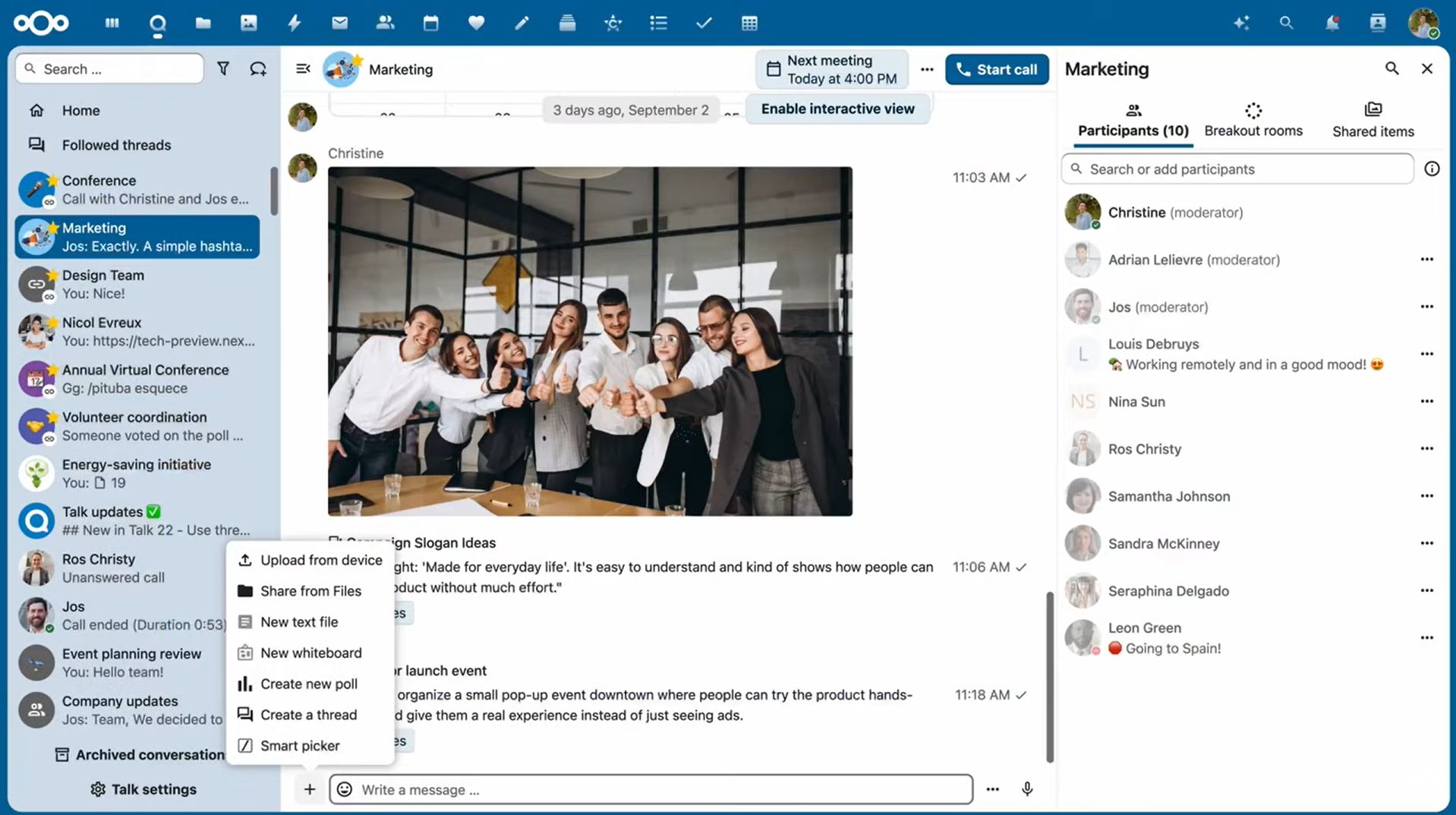
Nextcloud Talk combines text messaging, voice, video, and file-oriented collaboration within the Nextcloud ecosystem.
Federation allows users on separate compatible Nextcloud systems to communicate without consolidating all participants into one server. Users can exchange invitations across compatible environments while administrators retain control over their own infrastructure and accounts.
Talk is closely integrated with other Nextcloud services, so communication can exist alongside files, calendars, and broader collaboration workflows.
This model is narrower than Matrix or XMPP because federation is designed primarily for communication between compatible Nextcloud deployments.
Federation model: Nextcloud Talk federation.
Cross-vendor interoperability: Primarily compatible Nextcloud environments.
Administrative model: Independently operated Nextcloud servers.
Relevant scenario: Organizations already using Nextcloud that need communication between separate deployments.
May not fit when: The organization needs protocol-level federation across unrelated collaboration products rather than communication primarily between Nextcloud environments.
What to verify: Compatible Nextcloud versions, invitation behavior, external user policy, file access, Talk federation settings, identity handling, and which collaboration data crosses server boundaries.
6. Openfire
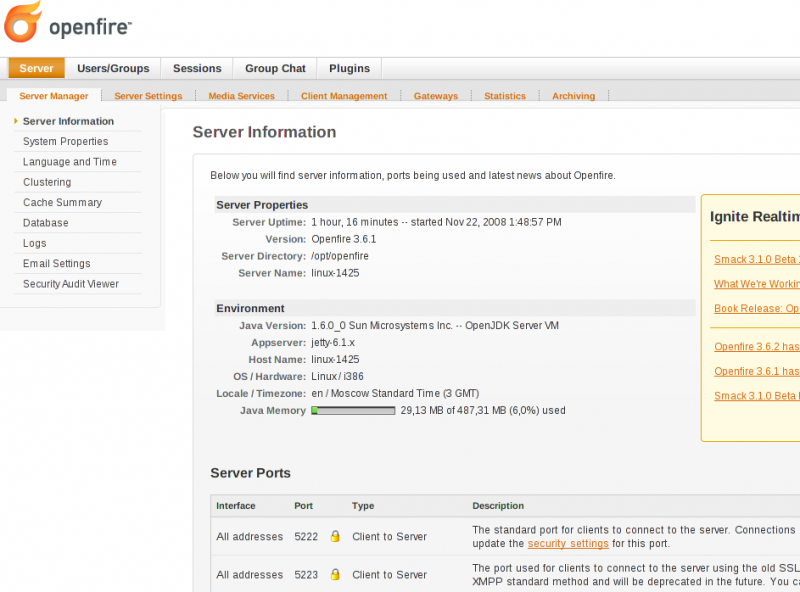
Openfire is an open-source XMPP server. Its federation model is based on XMPP server-to-server communication, so users on one domain can communicate with users on another compatible XMPP domain while keeping their accounts local.
Openfire supports domain-based discovery, TLS configuration, server connection policies, external user directories, plugins, and clustering options.
Because federation is based on XMPP rather than one proprietary client, Openfire can communicate with other compatible XMPP servers.
Federation model: XMPP server-to-server federation.
Cross-vendor interoperability: Yes, with compatible XMPP implementations.
Administrative model: Independent XMPP domains and server policies.
Relevant scenario: Organizations that want protocol-based federation and prefer a mature open server ecosystem.
May not fit when: The organization expects a complete end-user collaboration suite with native document workflows, conferencing, and enterprise workspace features out of the box.
What to verify: DNS discovery, TLS configuration, server-to-server policies, directory integration, clustering, plugins, supported XMPP extensions, and remote domain restrictions.
7. Matrix Synapse

Synapse is a Matrix homeserver implementation rather than a complete end-user collaboration product.
It implements Matrix client and federation APIs and can participate in public, private, or restricted Matrix federations. Users registered on a Synapse homeserver can communicate with users on other compatible Matrix servers when federation policies permit it.
Synapse handles room state, federation events, user accounts, server signing, and communication with other homeservers. Its significance is architectural: collaboration products and clients can use Synapse as the underlying server layer.
Federation model: Native Matrix federation.
Cross-vendor interoperability: Yes, across the Matrix ecosystem.
Administrative model: Self-managed Matrix homeserver.
Relevant scenario: Organizations building or integrating a Matrix-based communication environment rather than deploying a single all-in-one collaboration application.
May not fit when: The requirement is for a complete ready-to-use collaboration product rather than a homeserver layer that still needs suitable clients and administration.
What to verify: Federation restrictions, signing keys, identity architecture, room state behavior, storage requirements, moderation tooling, client compatibility, and operational responsibility for the homeserver.
Federated Messaging Platforms Compared
|
Platform or technology |
Federation approach |
Open protocol |
Cross-organization messaging |
Main distinction |
|---|---|---|---|---|
|
Element |
Matrix federation |
Yes |
Yes |
Enterprise collaboration built around native Matrix federation |
|
Rocket.Chat |
Embedded Matrix federation |
Yes |
Yes |
Matrix federation integrated into Rocket.Chat |
|
Mattermost |
Connected Workspaces |
No general public protocol federation |
Yes |
Explicit trusted connections and shared channels |
|
TrueConf Server |
TrueConf server federation |
Proprietary |
Yes |
Messaging, calls, and conferences across TrueConf servers |
|
Nextcloud Talk |
Nextcloud federation |
Product ecosystem |
Yes |
Messaging integrated with Nextcloud collaboration |
|
Openfire |
XMPP server federation |
Yes |
Yes |
Protocol-level federation across XMPP domains |
|
Synapse |
Matrix federation |
Yes |
Yes |
Homeserver technology underlying Matrix environments |
The relevant distinction is whether an organization needs open protocol interoperability or simply controlled communication between known server deployments.
Technical Characteristics of Federation Models
The models below can solve similar cross-organization communication problems, but they differ in discovery, trust establishment, cross-vendor support, and the amount of state exchanged between servers.
|
Model |
Discovery |
Trust establishment |
Cross-vendor support |
Typical data scope |
|---|---|---|---|---|
|
Open protocol federation |
Protocol or domain based |
Distributed protocol trust plus local policy |
Yes, across compatible implementations |
Protocol dependent, potentially including messages, membership, files, and shared state |
|
Restricted protocol federation |
Protocol based |
Allowlist, blocklist, or policy restricted |
Yes, if implementations share the protocol |
Protocol data limited by local federation policy |
|
Proprietary server federation |
Vendor defined |
Administrator configured |
Usually no |
Defined by the vendor and product capabilities |
|
Connected workspaces |
Explicit administrator pairing |
Direct trusted relationship |
Usually no |
Selected channels, membership, and synchronized workspace data |
How to Choose a Federated Messaging Platform?

The most important selection criteria are architectural rather than cosmetic. Use the six-step checklist below as a summary; each step is explained in detail in the subsections that follow.
- Define federation participants. List the organizations, domains, or server instances that need persistent communication.
- Choose the interoperability model. Decide whether same-product federation is enough or an open protocol is required.
- Map the data boundary. Document messages, files, metadata, room state, media, and identity information that can cross servers.
- Set trust and revocation rules. Define which peers are allowed, who approves them, and how a connection is removed.
- Test federated feature parity. Verify messaging, files, calls, permissions, search, moderation, edits, and deletions across servers.
- Test outage behavior. Confirm what remains available when a remote server or network path is temporarily unavailable.
Decide who must federate
Start with the trust relationship. A federation between internal departments is different from one connecting subsidiaries, customers, suppliers, government bodies, or unrelated public servers. This determines whether the environment should use open, private, or highly restricted federation.
Determine whether cross-vendor interoperability matters
If every organization uses the same product, proprietary server federation may be sufficient. If participants need freedom to choose different server implementations, an open protocol such as Matrix or XMPP becomes more important.
Map the data flow
Determine exactly what remote servers receive. Review message replication, file transfer, metadata, encryption behavior, retention, shared room state, and profile information.
Do not assume that self-hosting automatically means federated information remains local.
Define the trust boundary
Administrators should know whether any compatible server can connect or whether federation is limited to approved domains or deployments. Private enterprise deployments often benefit from explicit federation policies.
Test feature parity
Local and federated conversations may not support the same functionality. Threads, reactions, message deletion, editing, calls, bots, search, presence, permissions, and moderation can behave differently across federation boundaries.
Plan for temporary disconnection
Determine whether local users can continue communicating, whether outgoing events are queued, whether missed data is synchronized later, and how shared state is reconciled when connectivity returns.
What the evaluation should produce?
|
Evaluation area |
Required output |
|---|---|
|
Participants |
List of organizations and administrative domains that must communicate |
|
Interoperability |
Decision between open protocol and same-product federation |
|
Data flow |
Map of messages, files, metadata, room state, and media crossing the boundary |
|
Trust |
Allowlist, blocklist, domain, or server approval policy |
|
Feature parity |
List of functions that change or disappear in federated conversations |
|
Failure behavior |
Documented behavior during remote server or network outages |
When Federated Messaging Is the Right Architecture?
|
Scenario |
Federation value |
|---|---|
|
Company with autonomous subsidiaries |
Each subsidiary can manage its own users and infrastructure |
|
Supplier or partner network |
Organizations can communicate without joining one central tenant |
|
Government organizations |
Separate administrative domains can establish controlled communication |
|
International enterprise |
Regional systems can remain independently operated |
|
Regulated industries |
Infrastructure control and external communication can be separated |
|
Open communication ecosystem |
Compatible servers and clients can participate |
|
Short external project |
Federation may be unnecessary compared with guest access |
Federation is most valuable when the organizational boundary is persistent and technically meaningful.
Insight 5: Federation becomes useful when an organizational boundary is permanent enough to justify its own technical boundary. For occasional external participants, guest access may be simpler.
Common Federation Design Mistakes
Treating federation as a simple external chat feature
Federation creates a persistent trust relationship between administrative domains. It should be designed around identity, data exchange, revocation, moderation, and outage behavior rather than enabled only because external users need to message each other.
Assuming self-hosting keeps all federated data local
A locally operated server controls its own infrastructure, but information intentionally sent through federation may reach or be replicated by remote systems. Data flow should be documented before federation is enabled.
Using open federation when only a few partners need access
A broad federation model can create unnecessary trust and moderation complexity when communication is limited to a known group of organizations. Private federation, allowlists, or explicitly connected workspaces may be easier to govern.
Ignoring feature differences across the federation boundary
Local chat functionality does not guarantee identical federated behavior. Editing, deletion, threads, calls, presence, search, bots, files, or moderation can behave differently on remote systems.
No federation revocation procedure
Organizations should know how to disconnect a compromised or former partner, block its domain or server, preserve investigation logs, and determine what previously replicated data remains outside the local environment.
Limitations of Federated Messaging
Federation distributes administrative control, but that also distributes trust, policy enforcement, and troubleshooting. Remote organizations can use different permission, moderation, retention, and incident-response processes.
Data may continue to exist on remote infrastructure after it crosses the federation boundary, and feature parity can be incomplete. Cross-server communication also depends on discovery, authentication, connectivity, and compatible implementations.
These limitations are the operational cost of maintaining separate administrative domains. Federation is most useful when that independence provides more value than the complexity it introduces.
Federated Messaging Architecture Checklist
Before enabling federation, an organization should be able to answer:
Which servers are trusted? Which users may communicate externally? What data crosses server boundaries? Is federation open or restricted? Where is conversation data stored? How are remote identities verified? Can a remote organization be disconnected quickly? Which features work across federation? What happens during an outage? Which logs are available for investigation?
If these questions cannot be answered, the federation architecture is not yet fully defined.
Conclusion
Federated messaging connects independently administered communication systems without forcing every participant into one central workspace. The model is most useful when organizations need persistent cross-company or cross-department collaboration while retaining separate identities, infrastructure, policies, and administration. Matrix and XMPP provide open protocol federation, while platforms such as Mattermost and TrueConf use more controlled server relationships within their own ecosystems.
The central decision is not simply whether a product has a federation checkbox. Organizations should determine who must communicate, which servers are trusted, what information crosses server boundaries, whether cross-vendor interoperability is required, and how permissions, outages, revocation, and account lifecycle are handled. Federation provides organizational independence, but that independence is useful only when the trust and data model are designed as carefully as the messaging features.
Empower your video conferencing experience with TrueConf!
FAQ
When should a company use federation instead of guest access?
Federation is more appropriate when two organizations collaborate repeatedly but need to keep separate accounts, infrastructure, and administration. Guest access is usually simpler for temporary external participants. TrueConf Server supports server-to-server federation when separately managed TrueConf environments need persistent communication.
Is federated messaging the same as decentralized messaging?
Not exactly. Federation is one decentralized model in which independently administered servers communicate through an agreed protocol or server relationship. TrueConf Server uses controlled same-product server federation rather than a public decentralized protocol such as Matrix.
What security risks does federated messaging introduce?
Federated messaging expands the trust boundary to remote servers and administrators. Key risks include incorrect federation permissions, metadata exposure, inconsistent moderation, remote data retention, compromised peers, and identity lifecycle problems. In TrueConf Server, administrators should review federation allowlists, blocklists, domain rules, and remote communication permissions before enabling cross-server communication.
Does federated messaging keep all data on my server?
No. Local infrastructure can remain under your control, but federated conversations may transmit messages, files, metadata, room state, or media to remote systems. With TrueConf Server, organizations should map which communication data and media cross between federated servers rather than assuming that every federated interaction remains only on the local server.
What is the difference between Matrix federation and XMPP federation?
Matrix federation distributes room events and state between homeservers participating in a conversation, while XMPP traditionally uses domain-based server connections for messaging and presence. TrueConf Server follows a different model: controlled federation between compatible TrueConf deployments rather than Matrix or XMPP protocol federation.
Can federation work only between trusted companies?
Yes. Federation does not need to be public and can be limited to approved organizations or servers. TrueConf Server supports configurable federation policies that can restrict communication to selected servers and domains.
What should I check before enabling federated messaging?
Check the federation model, remote server trust, identity management, encryption, data flow, retention, administrator controls, feature compatibility, outage behavior, and revocation process. For TrueConf Server, also verify allowlists and blocklists, domain rules, media routing, remote user behavior, directory integration, and compatibility between participating server versions.
About the Author
Diana Shtapova is a product specialist and technology writer with three years of experience in the unified communications industry. At TrueConf, she leverages her deep product expertise to create clear and practical content on video conferencing platforms, collaboration tools, and enterprise communication solutions. With a strong background in product research and user-focused content development, Diana helps professionals and businesses understand core product features, adopt new technologies, and unlock the full potential of modern collaboration software.


Follow us on social networks