
Video Conferencing Protocols
Video conferencing is a great way to communicate with your colleagues, partners, and clients. Online meetings are more engaging than traditional phone calls, email conversations or instant messages and can really boost your team productivity. However, video meetings are also more demanding: they impose increased requirements for both video conferencing endpoints and your communication channels.
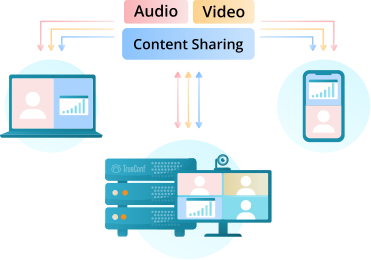
What Affects the Quality of Your Video Conferences?
Bandwidth is possibly the most important asset to a successful video conference, and we are used to evaluating video conferencing quality with the bandwidth. However, this might not be totally true. The connection speed can rapidly change during the meeting, drop or shift depending on the transmission mode, while it is critically important for the data streams to be stable, smooth and predictable during video conferences.
Video conferencing system can easily adjust the bandwidth from 64kb/s to 4Mb/s depending on the conferencing mode and signal quality of the participants. It is much more difficult to adapt the stream to constantly changing network conditions of each conference participant.
Video conferencing architecture and its ability to operate under constantly changing conditions plays the key role in ensuring video conferencing quality. Here are some common video conferencing challenges that may negatively affect your meetings:
- CPU power of your endpoint. During video conferences users might simultaneously perform resource-intensive tasks and load endpoint’s CPU.
- How video is captured on your endpoint’s camera. Even large resolution cameras can produce grainy picture in low light conditions.
- How video conference is displayed on your endpoint’s screen. For example, if user exits the full-screen mode, there is no need to send him or her high resolution video.
- Channel bandwidth between your video conferencing server and conference participants. That’s the most common issue. For example, your colleague started downloading large amounts of data and reduced network resources for the video meeting. Or you’ve been running a video conference on your smartphone and got in a very crowded space – and you provider is unable to maintain the same speed and connection quality.
How to prevent the most common video conferencing challenges? The simplest and the most expensive solution is to put fixed restrictions on both hardware and network resources of your video conferencing system.
Fortunately, science and technologies are evolving fast and modern video conferencing systems provide excellent connection quality under any conditions due to advanced software architecture.
Video Conferencing Architecture
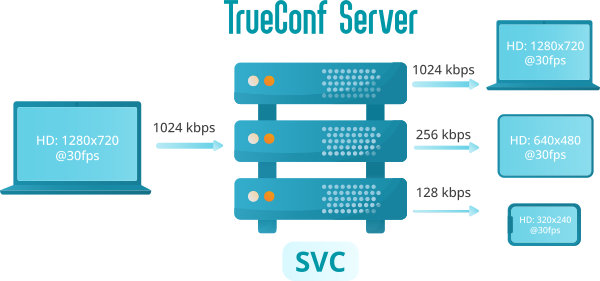
In any group video conference, there is a certain way to transmit video data between its participants. Given the fact that direct connection between conference participants is hardly applicable due to the most common video conferencing challenges, we need to consider a system that supports star typology and can be used as a medium, i.e. video conferencing server.
All solutions were previously divided into two categories: software and hardware solutions. but this approach has been considered outdated since 2014, because clear separation between hardware and software solutions simply disappeared: there are hardware systems that combine typical software architecture (switching and SVC) and software systems with built-in MCU. Second, leading video conferencing vendors tend to deliver their video infrastructure as a software in a virtualized environment.
SFU (Selective Forwarding Unit)
SFU (Selective Forwarding Unit) is a video conferencing architecture in which the data transfer process between the server and endpoints occurs in multiple stages: first, the server receives incoming video streams from all endpoints, then, it transmits several copies of the video streams of the other participants to each endpoint without compression, and, finally, the endpoints glue the incoming video streams together.
One of the advantages of this system is the reduction in channel requirements, thanks to a single outgoing stream. At the same time, the server load is reduced due to a significant increase in the load on the participants’ equipment, as they have to process numerous threads.
SVC-Based Video Conferencing Architecture
This type of architecture includes all advantages of mixing approach and escapes all drawbacks of multiplex-based systems. It is affordable and easily scalable, and it runs on any platform thanks to advanced signal processing and data compression technologies.
Here’s what SVC-based architecture does: an endpoint compresses its video stream in layers – each additional layer comes with an increased video resolution, quality and FPS. If the channel between an endpoint and a video conferencing server provides high bandwidth, the endpoint sends the maximum number of layers. SVC stream varies by only 15-20% bandwidth as compared to non-SVC stream, and requires much less bandwidth than the switching approach.
After receiving an SVC stream with layers, the video conferencing server cuts off excessive layers without transcoding by getting rid of data packages. In this way it creates individual sets of streams for each participant of a group video conference on the fly, in accordance with its actual connection conditions, available resources, layout requested, screen resolution etc. This in turn brings great resiliency.
This type of architecture includes all advantages of mixing approach and escapes all drawbacks of multiplex-based systems. It is affordable and easily scalable, and it runs on any platform thanks to advanced signal processing and data compression technologies.
The Use of Advanced Protocols and Codecs
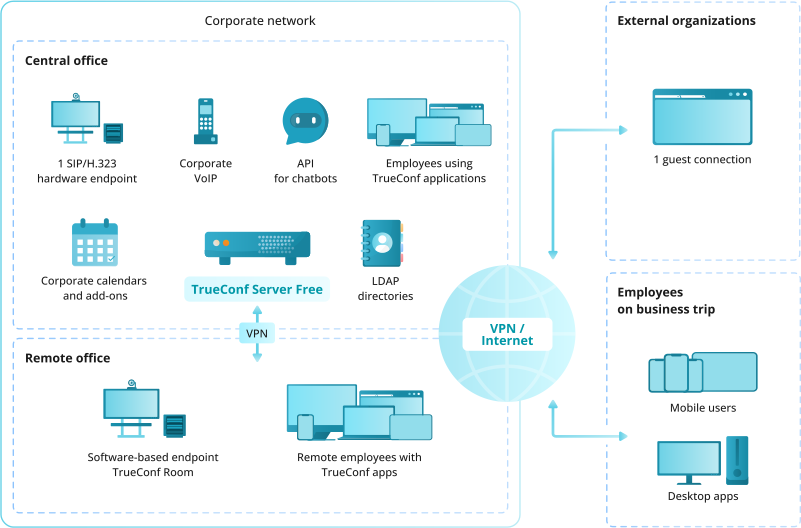
Standard data transfer protocols are used to hold video conferences between software systems and hardware endpoints from third-party manufacturers.
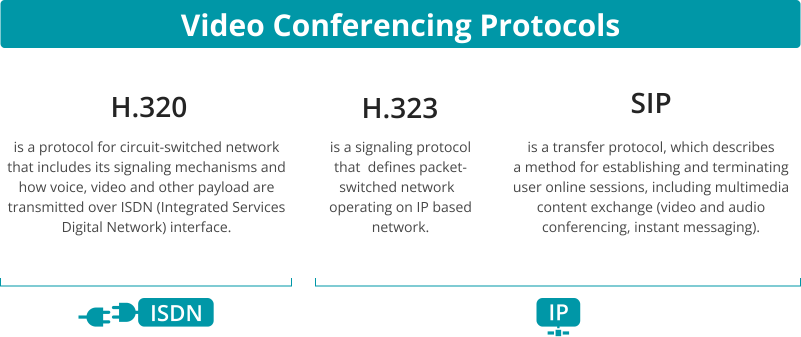
- H.239 is a communication protocol that supports two media streams from different sources. It is used for conducting video conferences where the picture is displayed on two different screens (e.g. two screens in a meeting room, one displaying the speaker and the other displaying the shared content).
- H.323 is a data transfer protocol with non-guaranteed bandwidth applied in both personal and group video conferences.
- SIP is a network protocol for connecting client applications from different vendors. SIP has replaced H.323 and is used in video conferencing and IP telephony.
Compression and playback of video and audio during a video session is carried out through the use of audio and video codecs.
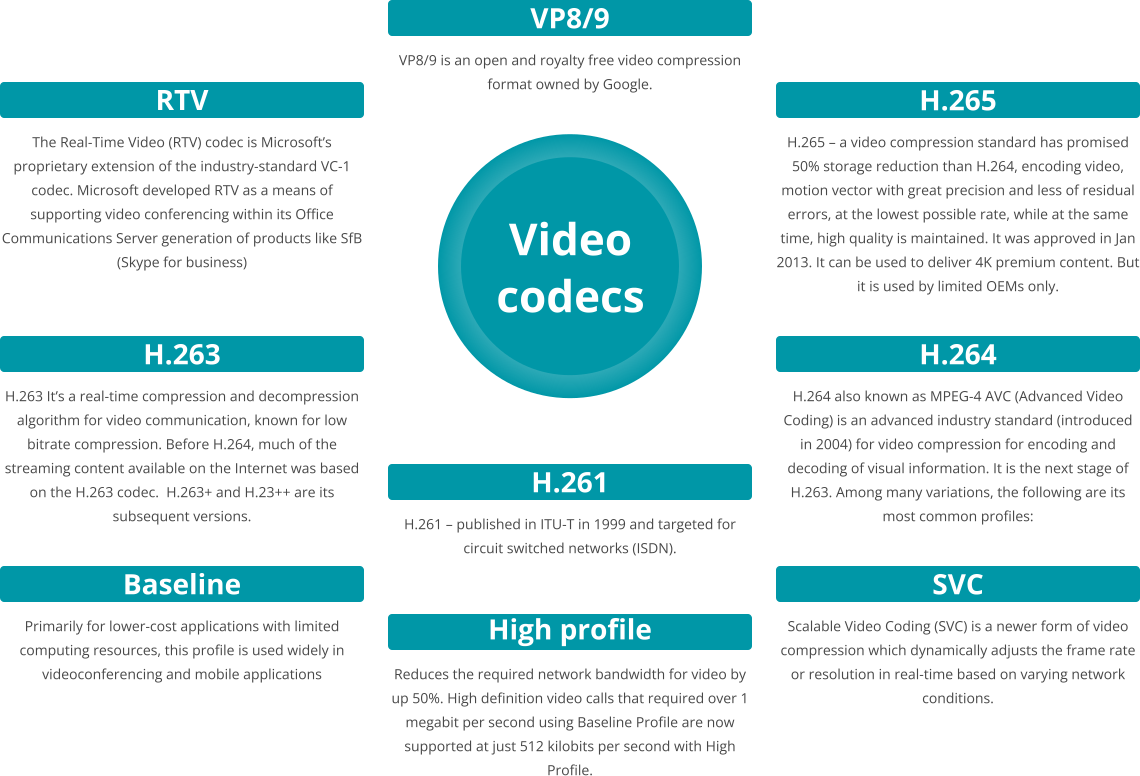
- H.264 is a video compression standard providing a high compression level while preserving the original quality.
- H.264 Scalable Video Coding (SVC) is a video codec that compensates missing data and transfers video through several video streams. Resistant to network errors, e.g. packet loss.
- H.265 is a video compression standard that features more efficient encoding algorithms than H.264. The key elements of this video codec include an increased resistance to data packet loss during media data transfer, and minimal signal delay during video conferences. This standard supports UltraHD formats: 4K and 8K.
- Opus is a codec for audio compression with exceptional performance, not impacted by changes in internet connection during sessions.
- G.722.1 Annex C is a broadband audio signal compression standard.
- VP8 is a video codec with a high-speed decoding and an increased resistance to frame loss.
- VP9 is an open source video compression standard. Its initial purpose was to improve the characteristics of VP8 and H.265 codecs. In case of VP8, the main objective for the developers was to achieve bitrate decrease by 50% with no initial video quality loss. For H.265, the main goal was to improve video stream compression efficiency.
Empower your video conferencing experience with TrueConf!
FAQ
How does Scalable Video Coding (SVC) prevent video freezing when network bandwidth drops?
SVC encodes video in multiple layers, allowing the server to dynamically drop lower-priority layers instead of transcoding the entire stream when bandwidth decreases. This ensures a seamless, uninterrupted meeting experience even on unstable connections. TrueConf utilizes this advanced SVC-based architecture to automatically adapt video quality in real-time, keeping your team connected without frustrating lag or dropped calls.
Can we integrate our existing legacy SIP and H.323 conference room hardware with modern video conferencing software?
Yes, modern enterprise platforms are designed to bridge the gap between older hardware and new software endpoints using standard protocols. By supporting both SIP and H.323 natively, TrueConf allows organizations to seamlessly connect their existing physical room systems and IP phones to software-based video conferences. This protects your previous hardware investments while enabling smooth, unified collaboration across all devices.
How do video conferencing systems handle simultaneous video and content sharing without freezing the screen?
Systems use specific protocols, such as H.239, to transmit dual media streams simultaneously—one for the speaker’s video and another for shared content like presentations. This ensures that both the presenter and the shared slides are displayed clearly on separate screens or in split-view layouts. TrueConf fully supports these dual-stream protocols, allowing presenters to share high-resolution content while maintaining crystal-clear video of the speaker.
What is the main advantage of using an SFU (Selective Forwarding Unit) architecture for large group meetings?
An SFU architecture significantly reduces server processing load by simply forwarding incoming video streams to participants without mixing or transcoding them on the server side. This makes it highly scalable and cost-effective for hosting large webinars or company-wide town halls. TrueConf leverages advanced server architectures to efficiently manage massive multipoint conferences, ensuring low latency and high stability even when hundreds of users are connected simultaneously.
Which video codecs are best for maintaining high-quality UltraHD video over limited bandwidth?
Modern codecs like H.265 and VP8/VP9 offer superior compression efficiency, allowing for 4K UltraHD streaming at significantly lower bitrates than older standards. They also feature enhanced resistance to packet loss, which is crucial for maintaining smooth playback on congested networks. TrueConf supports these advanced codecs, including an optimized VP8 implementation with SVC, to deliver stunning visual clarity and reliable audio even when network conditions are less than ideal.
How do modern video platforms ensure clear audio quality when participants are joining from noisy or mobile environments?
Platforms rely on advanced audio codecs like Opus, which dynamically adapts to network conditions and provides exceptional noise suppression and bandwidth efficiency. This ensures that voice communications remain crisp and intelligible, even if a participant’s connection fluctuates or they are in a loud environment. TrueConf integrates these high-performance audio codecs to guarantee that every word is heard clearly, making hybrid and remote meetings feel as natural as in-person conversations.

Follow us on social networks