
Air-Gapped Messaging Platform: The Complete Buyer’s Guide
An air-gapped messaging platform is software that runs on a network with no physical or logical connection to the public internet, so a chat, call, or file transfer never has a path to leave the organization’s own infrastructure. This is a stricter requirement than “on-premise” or “encrypted,” and confusing the three leads buyers toward platforms that fail the actual use case: a server installed on company hardware but still phoning home to a vendor’s cloud for licensing checks, push notifications, or update delivery is not air-gapped, no matter how strong its encryption is.
This guide compares seven platforms relevant to organizations that need this level of isolation, spanning true air-gapped deployment, on-premise and hybrid secure communication, and governance-focused enterprise messaging: TrueConf, Messagenius, Rocket.Chat, CometChat, Element (Matrix), Wire, and NetSfere. Each is assessed on deployment model, whether it can run fully disconnected from the internet, directory and identity integration, and where it realistically fits inside a defense, government, or regulated enterprise technology stack.
Quick Answer: Which Air-Gapped Messaging Platform Should You Choose?
|
If your priority is… |
Choose |
Why? |
|---|---|---|
|
Fully disconnected video conferencing and messaging with no phone-home dependency |
TrueConf |
TrueConf Server runs autonomously with no required internet connection, including video, messaging, and directory integration in one platform |
|
White label, self-hosted messaging you can rebrand and customize |
Messagenius |
Built specifically for self-hosting with full source-level customization and no external API dependency |
|
Open-source team chat with flexible on-premise or hybrid deployment |
Rocket.Chat |
Community and enterprise editions both support fully self-managed infrastructure |
|
Team chat marketed specifically as air-gapped by default |
CometChat |
Core messaging is isolated by default, with optional add-ons kept opt-in rather than always-connected |
|
Federated, auditable open-source messaging |
Element (Matrix) |
Runs on the Matrix protocol, self-hostable, with code open to security review |
|
End-to-end encrypted messaging with a self-hosted option |
Wire |
MLS protocol based encryption with both cloud and self-hosted deployment |
|
Governance-first enterprise messaging with strong audit and retention controls |
NetSfere |
Built around admin oversight, audit logs, and retention policy rather than isolation itself |
TrueConf is the strongest fit specifically for organizations that need video conferencing and messaging combined on a network with zero internet dependency, since TrueConf Server operates fully autonomously once deployed, a requirement several platforms marketed as “on-premise” do not actually meet.
Messagenius, Rocket.Chat, CometChat, and Element (Matrix) are the right choice when the priority is a self-hosted, customizable messaging layer, with varying degrees of true air-gapped readiness depending on how the specific deployment is configured.
Wire fits organizations prioritizing protocol level end-to-end encryption with the option to self-host, while NetSfere fits enterprises whose main requirement is administrative governance and compliance reporting rather than full network isolation.
Our Rating
|
Platform |
Air-Gapped Readiness |
Governance and Compliance |
Deployment Flexibility |
Overall Score (out of 10) |
|---|---|---|---|---|
|
TrueConf |
10 |
8 |
9 |
9.0 |
|
Messagenius |
9 |
6 |
9 |
8.1 |
|
CometChat |
8 |
6 |
8 |
7.7 |
|
Rocket.Chat |
7 |
6 |
9 |
7.5 |
|
Element (Matrix) |
8 |
5 |
9 |
7.4 |
|
Wire |
6 |
7 |
6 |
6.8 |
|
NetSfere |
3 |
9 |
4 |
6.5 |
Scores weigh whether a platform can genuinely operate with zero internet connectivity against how strong its governance, audit, and identity controls are, and how much deployment choice an organization actually has.
TrueConf scores highest overall because it combines full autonomous operation with directory integration and tiered governance controls rather than requiring a trade-off between isolation and administration.
NetSfere scores lowest on air-gapped readiness because it is architected as a cloud governed platform focused on oversight rather than disconnected operation, which is a legitimate but different design goal.
What Is an Air-Gapped Messaging Platform?

An air-gapped messaging platform is a communications system deployed on a network that has no physical connection, no logical connection, and no intermittent connection to the public internet or any external network. The defining test is not whether the software can technically be installed without internet access during setup, but whether it can run indefinitely afterward, including software updates, license validation, and push notification delivery, without ever reaching outside the isolated network.
This distinction matters because many platforms marketed as “secure” or “on-premise” still depend on an external service for at least one function. A messaging app that stores chat history on company servers but still calls a vendor’s cloud API for push notifications on mobile devices is not air-gapped, it is on-premise with a cloud dependency, which is a meaningfully weaker security posture for organizations where that dependency itself is the risk being mitigated. TrueConf Server addresses this directly by supporting fully autonomous operation with no required internet connection at all, a specific architectural claim that not every vendor calling itself “on-premise” can make.
How Air-Gapped Messaging Actually Works?
Running a messaging platform with zero internet connectivity requires replacing several functions that most software quietly outsources to the public internet. Understanding these replacements is what separates a platform genuinely built for isolation from one that merely tolerates it.
A connected messaging app typically relies on a vendor’s cloud DNS and certificate infrastructure to establish trusted, encrypted connections. An air-gapped deployment instead needs its own internal certificate authority and internal DNS resolution, so devices on the isolated network can still verify server identity and encrypt traffic without ever resolving a public hostname.
Push notifications present a similar problem: on a connected device, a new message typically triggers a call to a vendor’s cloud push service (Apple’s or Google’s infrastructure, for example), which is structurally impossible on a disconnected network, so an air-gapped platform has to either run its own internal notification relay or accept that mobile push simply will not function outside the isolated segment. Video and voice calls need a local media relay server for routing traffic between participants, replacing the cloud based TURN and STUN servers that most video platforms depend on by default.
Finally, software updates and security patches cannot be pulled automatically, so the platform needs a defined process for offline package delivery, typically a signed update file transferred in physically or through a controlled one way channel and installed manually by an administrator.
TrueConf Server addresses each of these points directly rather than requiring custom engineering around them: it supports offline update packages, integrates with an organization’s internal Active Directory rather than an external identity provider, and routes video and voice traffic through its own server infrastructure rather than a cloud relay. Messagenius takes a similar approach, requiring no external API or SaaS service for any core function, including calls and video calls.
Why End-to-End Encryption Alone Isn’t Enough?

End-to-end encryption protects the content of a message or call from being read in transit, but it says nothing about where metadata, session logs, or the server infrastructure itself resides. A platform can encrypt every message end to end and still leak who is talking to whom, when, and how often, simply through server logs and connection metadata sitting on infrastructure the organization does not control.
For government, defense, and critical infrastructure buyers, that metadata is frequently as sensitive as the message content itself, since a pattern of communication between two parties can reveal an operation even if the actual words exchanged stay encrypted. This is the specific gap that air-gapped deployment closes: it is not a stronger form of encryption, it is a different guarantee entirely, that no data of any kind, encrypted or not, leaves the organization’s controlled network.
Air-Gapped vs. On-Premise vs. Private Cloud
These three deployment terms get used loosely in vendor marketing, but they describe meaningfully different levels of isolation.
|
Dimension |
Air-Gapped |
On-Premise |
Private Cloud |
|---|---|---|---|
|
Network connectivity |
None, fully isolated with no internet path |
Runs on company hardware, may still require internet for updates or licensing |
Hosted on dedicated infrastructure, typically vendor managed and internet connected |
|
Who administers the servers |
The organization’s own IT team, entirely |
The organization’s own IT team, though sometimes with vendor remote support |
Usually the vendor, even though infrastructure is dedicated |
|
Typical buyer |
Military, intelligence, courts, high-security research facilities |
Regulated enterprises, government agencies without a full isolation requirement |
Enterprises wanting dedicated infrastructure without operating it themselves |
|
Update delivery |
Manual, offline package transfer |
Can be online or offline depending on configuration |
Vendor managed, always online |
|
Example from this comparison |
TrueConf Server (autonomous mode), Messagenius |
TrueConf Server (connected mode), Rocket.Chat self-hosted |
NetSfere |
Strategic Benefits of Air-Gapped Deployment
The case for air-gapped messaging goes beyond a single compliance checkbox, and the strategic value shows up differently depending on which part of the organization is evaluating it.
For a CISO, the primary benefit is eliminating an entire category of attack surface: a network with no internet path cannot be reached by a remote attacker, regardless of how sophisticated the attack, which removes whole classes of ransomware, phishing, and remote exploitation risk that no amount of cloud vendor security investment can fully close off.
For a compliance team, the benefit is data sovereignty that does not depend on contractual language: when TrueConf Server or Messagenius runs entirely inside an organization’s own network, there is no cross-border data transfer question to evaluate, no subprocessor list to audit, and no vendor breach that can expose the organization’s communications, since the vendor never holds a copy of that data in the first place.
For operational leadership, particularly in defense and classified research settings, air-gapped deployment supports compartmented operations where different teams or missions need provably separate communication channels, something a shared cloud platform cannot guarantee no matter how strong its internal access controls are. And for organizations with a genuine insider risk concern, physical network isolation adds a layering effect: even a malicious or compromised insider account is constrained by what that isolated network physically permits, rather than what a cloud vendor’s access policy theoretically restricts.
Vendor Analysis
TrueConf
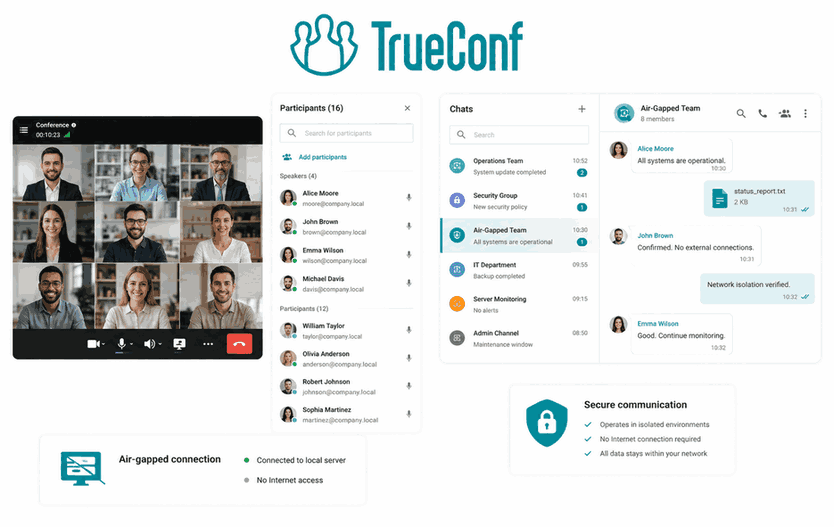
TrueConf is a video conferencing and messaging platform built around on-premise and air-gapped deployment as a core design choice rather than an add-on configuration. TrueConf Server installs directly on an organization’s own infrastructure and supports fully autonomous operation with no required internet connection, combining video calls, messaging, and directory integration in a single platform rather than requiring separate tools for each channel.
Isolation model: TrueConf Server can run entirely disconnected from the internet once deployed, including internal software updates delivered through offline packages, and integrates with an organization’s existing Active Directory or LDAP for authentication without needing to reach an external identity provider.
Governance and interoperability: TrueConf Enterprise adds role separation, multi-factor authentication, and trusted zones for organizations needing tiered governance on top of the isolation guarantee, and TrueConf supports SIP and H.323 for connecting classic video conferencing hardware without bypassing its own access controls.
Best for: Military operations, government agencies, defense contractors, and research facilities that need video conferencing and messaging combined on a network with zero internet dependency, not just a self-hosted chat tool.
Boost your team’s productivity with TrueConf Server Free!
Messagenius
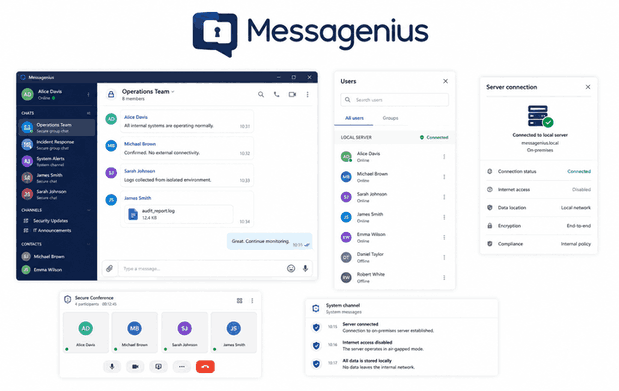
Messagenius is a self-hosted, white label messaging platform built specifically for organizations that need to deploy on air-gapped networks and customize the platform at a source level rather than through a limited admin panel.
Isolation model: Messagenius requires no external API or SaaS service to function, meaning calls, video calls, file sharing, and chat all operate without any outbound dependency once installed on an organization’s infrastructure.
Governance and interoperability: Because it is white label, Messagenius is frequently rebranded and integrated into an organization’s existing internal tools, which makes it a common choice for organizations building a bespoke internal communications product rather than adopting an off the shelf brand.
Best for: Military operations, government agencies and public safety organizations, research centers and field operators, and maritime or cruise line operations, four use cases where a fully disconnected, customizable messaging layer is specifically required.
Rocket.Chat
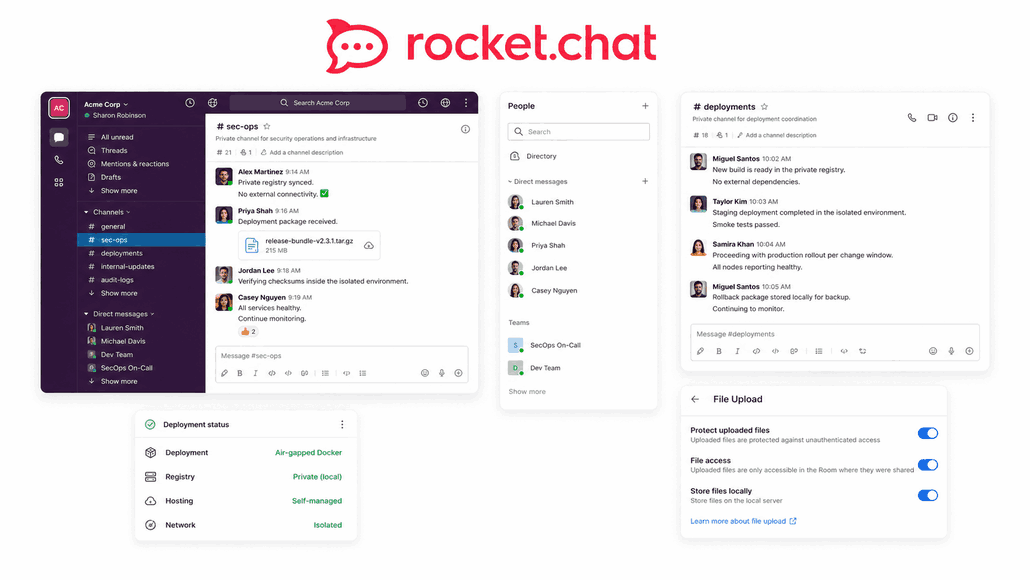
Rocket.Chat is an open-source team chat platform available in both a community edition and an enterprise edition, with self-hosted deployment supported across both, which gives organizations a lower cost entry point into on-premise messaging than most commercial alternatives.
Isolation model: A self-hosted Rocket.Chat deployment can be configured to run without external dependencies, though achieving genuine air-gapped operation requires deliberate configuration to disable default connections to Rocket.Chat’s cloud services for things like push notifications and marketplace apps.
Governance and interoperability: Rocket.Chat supports LDAP and SAML based authentication, audit logging, and data retention policies on its enterprise tier, and its open-source codebase allows a security team to audit the platform directly rather than relying on vendor claims alone.
Best for: Organizations wanting an open-source foundation for self-hosted team chat with the flexibility to configure toward full air-gapped operation, particularly where budget favors an open-source starting point over a commercial platform.
CometChat
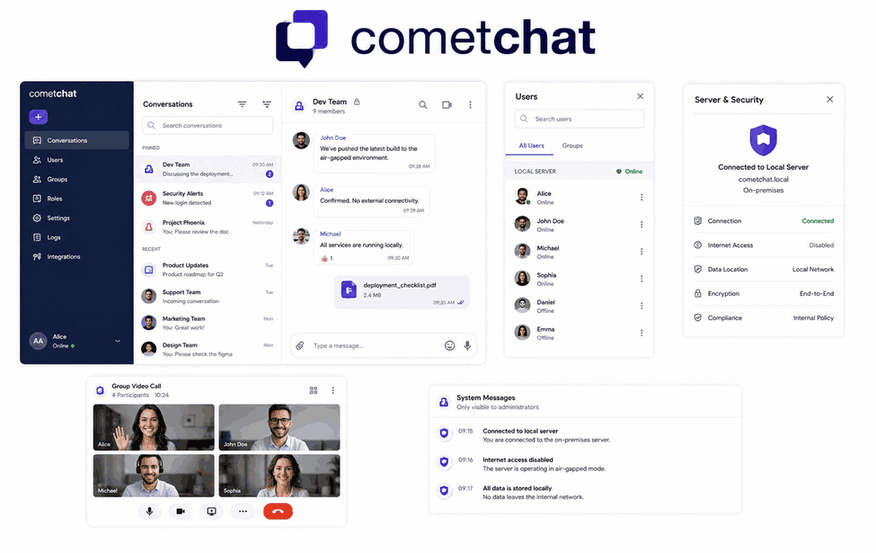
CometChat positions its air-gapped offering explicitly around the idea of a sealed core: core messaging functionality is isolated by default, while optional add-ons like AI agents remain opt-in rather than always-connected, which keeps the disconnected baseline clean even as an organization adds functionality later.
Isolation model: The architecture separates the always-isolated messaging core from connected extensions, so an organization can run the core chat, threads, search, voice, and video functionality fully air-gapped while deciding case by case whether to enable any connected add-on at all.
Governance and interoperability: CometChat offers multiple deployment tiers, from fully air-gapped to on-premise connected to cloud-hosted, letting an organization choose different isolation levels for different environments within the same product family rather than switching vendors entirely.
Best for: Organizations that want a clear architectural separation between an always-isolated messaging core and optional connected features, useful when only part of an organization’s operations require full air-gapped isolation.
Element (Matrix)
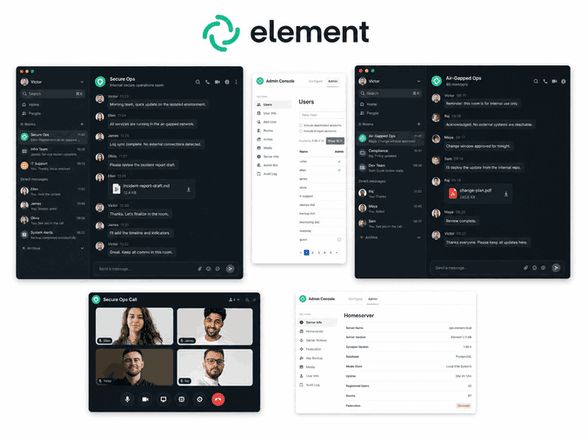
Element is a messaging client built on the open-source, federated Matrix protocol, which allows an organization to run its own server (a homeserver) entirely self-hosted, with the added option of federating with other Matrix servers when that is appropriate.
Isolation model: A self-hosted Matrix homeserver can be run fully disconnected from the public Matrix federation network, giving an organization the choice between complete isolation and selective connection to trusted partner servers, rather than an all-or-nothing decision.
Governance and interoperability: Because Matrix and Element’s reference implementation are open-source, a security team can audit the code directly, and end-to-end encryption is supported for both messaging and calls, with the federation model offering a middle ground between full isolation and open connectivity that few other platforms in this comparison provide.
Best for: Organizations wanting the auditability of open-source software combined with the option to selectively federate with partner organizations’ own Matrix servers, such as inter-agency communication where neither side wants to host on the other’s infrastructure.
Wire
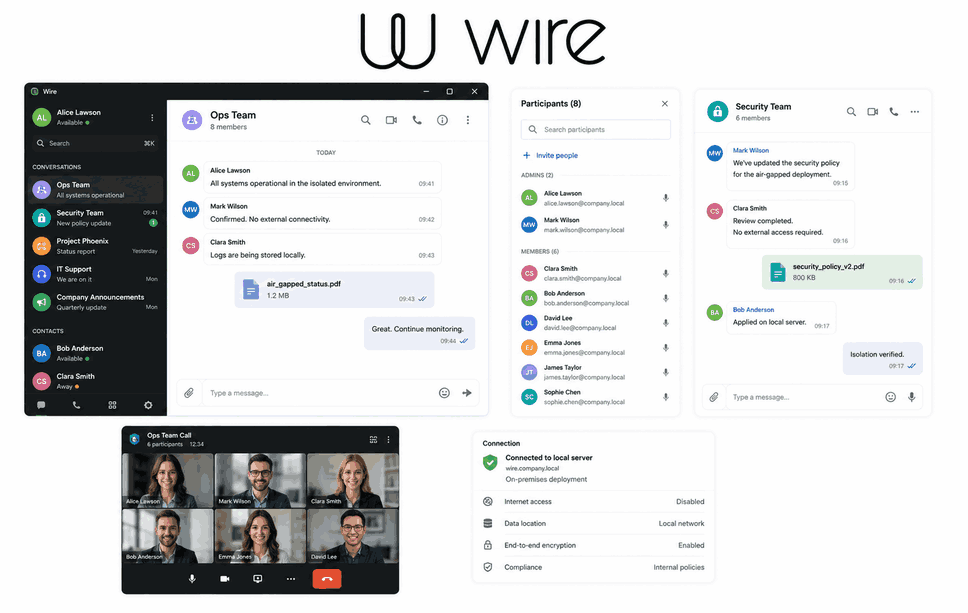
Wire is a secure messaging and video platform built around the Messaging Layer Security (MLS) protocol, applying end-to-end encryption by default rather than as an opt-in setting, with both a cloud hosted and a self-hosted deployment option.
Isolation model: Wire’s self-hosted option allows an organization to run the platform on its own infrastructure, though Wire’s architecture and update model were built primarily around a hosted service, so achieving a fully air-gapped deployment requires more deliberate configuration than platforms like TrueConf or Messagenius that are designed around disconnection from the start.
Governance and interoperability: Wire’s protocol has been subject to external cryptographic review, and the platform supports EU data residency for organizations bound by GDPR data localization requirements even when not running fully air-gapped.
Best for: Organizations where protocol level end-to-end encryption is the primary evaluation criterion and where a self-hosted deployment is preferred but full network isolation is not a strict requirement.
NetSfere
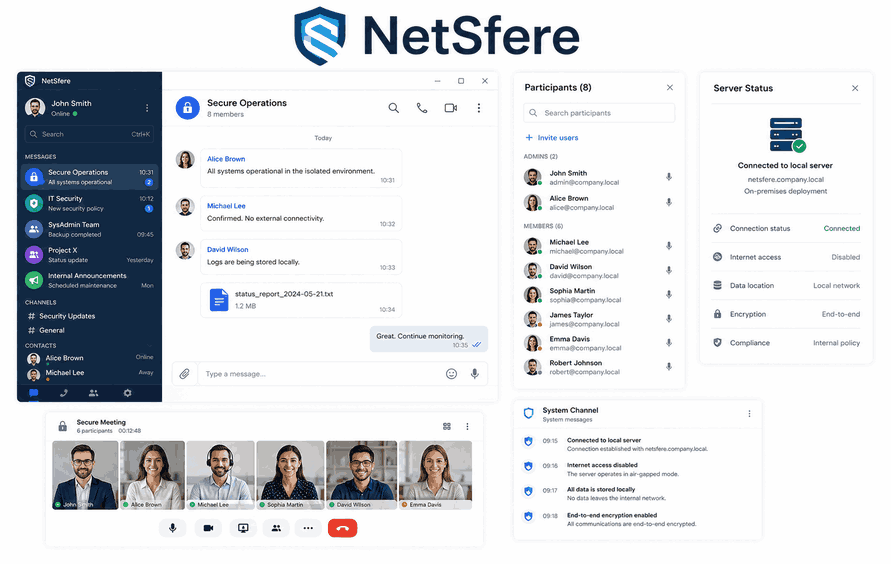
NetSfere is an enterprise messaging platform built around administrative governance rather than network isolation, with strong audit logging, retention policy enforcement, and admin visibility positioned as its core value rather than air-gapped deployment.
Isolation model: NetSfere operates primarily as a cloud governed platform, and while it offers strong data controls, it is not architected for the fully disconnected operation that TrueConf, Messagenius, or a properly configured Rocket.Chat or Element deployment can achieve.
Governance and interoperability: NetSfere’s differentiation is admin oversight: detailed audit logs, configurable retention policies, and centralized control over user provisioning, which matters for compliance teams whose primary concern is demonstrable governance rather than physical network isolation.
Best for: Enterprises whose regulatory requirement centers on auditability and retention policy rather than full air-gapped isolation, where a governance-first cloud platform satisfies the compliance need without the operational overhead of running disconnected infrastructure.
Data Ownership and the Real Cost of “On-Premise” Claims
Many platforms describe themselves as on-premise while still depending on a vendor’s cloud for at least one operational function, and that gap only becomes visible during procurement if a buyer asks the right question directly. Complete data ownership means the organization controls not just where chat history is stored, but where every operational dependency lives, including push notification delivery, license validation, update packages, and any AI or search feature that might quietly call out to a vendor API.
TrueConf Server and Messagenius both close this gap by design, since neither requires an external service to function once deployed, while Rocket.Chat, Element (Matrix), and Wire can reach the same standard but require the organization to deliberately configure away default cloud dependencies rather than getting there out of the box. A buyer evaluating any platform for a genuinely air-gapped environment should request a full list of every external endpoint the software contacts by default, not just a confirmation that “on-premise deployment is supported.”
Privacy and Data Controls Beyond Network Isolation

Network isolation controls where data can travel, but it does not by itself control what happens to that data once it reaches an authorized recipient inside the isolated network. A separate set of application level privacy controls determines whether a message can be screenshotted, forwarded, or retained indefinitely by someone who was legitimately allowed to see it in the first place, and these controls matter even inside a fully air-gapped environment.
Self-destructing or expiring messages remove sensitive content from a device automatically after a set period, which limits exposure if a device is later lost, stolen, or accessed by someone without clearance for that specific conversation. Screen capture protection blocks or flags attempts to screenshot a sensitive chat or a video call frame, closing a gap that message expiration alone does not, since a screenshot taken before expiration preserves the content indefinitely.
Remote wipe capability lets an administrator revoke a lost or stolen device’s access and clear locally cached messages without needing physical possession of that device. Recording watermarking, relevant specifically for video conferencing platforms like TrueConf, embeds a visible or forensic marker into a recorded session, which deters unauthorized redistribution and helps trace a leak back to its source if one occurs.
TrueConf and Wire both support privacy controls in this category alongside their core encryption and access management features, while platforms built primarily around open messaging protocols, including Element (Matrix) and Rocket.Chat, generally require additional configuration or third party tooling to reach the same level of application level privacy control.
Feature Comparison Table
|
Feature |
TrueConf |
Messagenius |
Rocket.Chat |
CometChat |
Element (Matrix) |
Wire |
NetSfere |
|---|---|---|---|---|---|---|---|
|
Fully autonomous operation (no internet required) |
Yes |
Yes |
Configuration dependent |
Yes (core) |
Configuration dependent |
Configuration dependent |
No |
|
Video conferencing included |
Yes (core product) |
Yes |
Limited |
Yes |
Yes |
Yes |
Limited |
|
White label / rebrandable |
Limited |
Yes |
Yes |
Limited |
Yes |
No |
No |
|
Open-source |
No |
No |
Yes |
No |
Yes |
No |
No |
|
SIP/H.323 hardware interoperability |
Yes |
No |
No |
No |
No |
No |
No |
|
Directory integration (AD/LDAP) |
Yes |
Yes |
Yes |
Yes |
Limited |
Limited |
Yes |
|
Federation with external servers |
Limited |
No |
No |
No |
Yes |
No |
No |
Deployment and Governance Table
|
Platform |
True air-gapped capability |
On-premise option |
Audit logging |
Role-based access |
MFA available |
|---|---|---|---|---|---|
|
TrueConf |
Yes, by design |
Yes |
Yes |
Yes |
Yes (Enterprise tier) |
|
Messagenius |
Yes, by design |
Yes |
Limited |
Yes |
Configuration dependent |
|
Rocket.Chat |
Configuration dependent |
Yes |
Yes (Enterprise tier) |
Yes |
Yes |
|
CometChat |
Yes (core), No (some add-ons) |
Yes |
Limited |
Yes |
Configuration dependent |
|
Element (Matrix) |
Configuration dependent |
Yes |
Limited |
Yes |
Yes |
|
Wire |
Configuration dependent |
Yes |
Limited |
Limited |
Yes |
|
NetSfere |
No |
Limited |
Yes |
Yes |
Yes |
Insight: SIP/H.323 support is really a proxy for buyer type, not a minor interoperability checkbox.
TrueConf is the only platform in this comparison that supports SIP/H.323, and that’s not incidental — air-gapped buyers are disproportionately defense, government, and legacy-hardware environments that purchased conferencing endpoints years before any messaging RFP existed, and replacing that hardware is rarely funded.
A platform without this support forces the organization to either run a second, unintegrated system for those endpoints or write off working equipment. So this single spec filters the comparison down to the actual buyer profile the article targets more precisely than any encryption claim does.
Common Challenges in Air-Gapped Messaging Deployment

Running a compliant platform solves half the problem. The operational reality of maintaining an isolated network surfaces challenges that a standard cloud deployment never has to address.
Update and Patch Delivery Without Internet Access
An air-gapped network cannot receive automatic software updates, which means every security patch has to be manually verified, packaged, and physically or procedurally transferred into the isolated environment. This is a genuine operational cost of true isolation, and it means an air-gapped deployment of TrueConf Server or Messagenius requires a defined internal process for update delivery that a cloud platform’s automatic patching entirely avoids, trading a real security benefit for real administrative overhead that IT teams need to plan for.
Interoperability With Legacy Hardware
Government and defense organizations frequently operate video conferencing hardware purchased years before an air-gapped messaging project began, and replacing that hardware is rarely in budget. Platforms without SIP or H.323 support force organizations to either replace working hardware or run a separate, unintegrated system for legacy endpoints, which is a specific reason TrueConf’s SIP/H.323 interoperability matters more in this category than it would for a typical cloud collaboration tool, since air-gapped buyers are disproportionately likely to have this exact legacy hardware constraint.
The Gap Between “Self-Hosted” and Genuinely Disconnected
The most consistent real world risk in this category is not a weak encryption implementation, it is a platform marketed as self-hosted that still phones home for a function the buyer never audited. A self-hosted Rocket.Chat, Element, or Wire deployment defaults to at least one external connection, whether for push notifications, marketplace apps, or federation discovery, and disabling every one of them requires a security team to actively hunt down each dependency rather than trust the “self-hosted” label at face value.
This is the specific reason platforms architected for disconnection from the start, like TrueConf Server and Messagenius, carry less residual risk than platforms retrofitted toward isolation, even when both are technically capable of running air-gapped once fully configured.
Insight: “self-hosted” describes where software runs, not what it talks to — and conflating the two is the most common procurement mistake in this category.
A buyer who confirms a platform can be installed on their own servers has answered a question about physical location, not about network behavior. Push notification relays, marketplace app stores, and federation discovery can all run silently in the background of a self-hosted deployment, invisible in a demo and often undocumented in a features list.
This is why the article’s recommended audit step — requesting a full list of external endpoints contacted by default — functions as a completely different, stricter test than asking whether on-premise deployment is supported, and why platforms retrofitted toward isolation carry structurally more residual risk than ones designed for disconnection from day one, even when both pass the same pilot test.
Data Transfer Into and Out of an Air-Gapped Network
A fully air-gapped network is never permanently and completely sealed in practice, since even the most restrictive military or intelligence environment eventually needs to move a software update, a document, or an approved message out to a connected system, and pretending otherwise leads to organizations either breaking their own isolation policy informally or being unable to operate at all. The realistic model is not “never connected” but “connected only through a controlled, auditable, and typically physical channel.”
Most genuinely air-gapped organizations rely on a staged transfer process rather than a direct connection: a separate bridge environment, sometimes enforced by a hardware data diode that physically permits data flow in only one direction, sits between the isolated network and the outside world. Software updates, including TrueConf Server’s offline update packages, move into the isolated network through this bridge, typically after a manual security review of the package contents, rather than through any live connection between the two environments. This staged approach preserves the isolation guarantee while still allowing the network to receive necessary updates and, where policy permits, export specific approved outputs.
Platforms built around a defined, auditable transfer process from day one, like TrueConf Server’s offline update packages, hold up better in genuinely isolated deployments than platforms where offline update delivery is a workaround bolted onto an architecture designed for continuous cloud connectivity, since that difference determines how much manual effort an IT team spends every single patch cycle for the life of the deployment.
Insight: the “sealed core” model reframes air-gapping as a boundary decision rather than a deployment-wide one.
Instead of asking “is this platform air-gapped or not,” CometChat’s architecture asks “which functions sit inside the seal and which sit outside it” — core messaging, threads, search, voice, and video stay isolated by default, while AI agents and other extensions remain opt-in. This matters because most organizations don’t actually need every feature to be disconnected; they need a guaranteed boundary around the sensitive core with the freedom to evaluate connected add-ons case by case.
That’s a meaningfully different value proposition than “fully air-gapped” as a single yes/no attribute, and it’s likely why CometChat scores well on air-gapped readiness without matching TrueConf or Messagenius on the “no external dependency at all” standard.
Use Cases for Air-Gapped Messaging Platforms

Military operations represent the clearest use case, where command and control communication cannot risk any connection to a network an adversary might access, making full isolation a non-negotiable requirement rather than a preference. Government agencies and public safety organizations use air-gapped messaging for classified or sensitive coordination where a data leak carries national security consequences beyond typical corporate risk.
Research centers and field operators, particularly in scientific or industrial settings handling proprietary or classified research data, adopt air-gapped platforms to prevent intellectual property exposure during collaboration. Maritime and cruise line operations represent a less obvious but practical case, where vessels operate for extended periods with limited or no reliable internet connectivity, making an air-gapped platform a functional necessity rather than only a security choice. Financial trading floors and courts round out the category, where communication records must remain fully within the organization’s control for both security and legal evidentiary reasons.
Choosing a Platform by Buyer Type
The right platform in this comparison depends heavily on which of four buyer profiles an organization actually fits, since the same feature set that is essential for one profile is unnecessary overhead for another.
Individuals and small teams evaluating self-hosted messaging for privacy reasons, without a formal air-gapped requirement, are generally better served by Element (Matrix) or the community edition of Rocket.Chat, both of which offer a lower cost, lower administrative burden entry point than a platform built around full isolation from the start. Enterprises in regulated industries like finance and healthcare, where the core requirement is auditability and data retention rather than physical network isolation, are typically better matched to NetSfere or Wire, since both prioritize governance and compliance reporting over the operational overhead of running a disconnected network.
Government, defense, and public sector organizations with a genuine air-gapped requirement should prioritize TrueConf or Messagenius, both of which are architected for disconnection from the start rather than retrofitted toward it, and TrueConf specifically for organizations that also need video conferencing combined with messaging in one disconnected platform. Remote and hybrid teams that want flexibility to shift between cloud, on-premise, and air-gapped deployment as policy or client requirements change are well matched to CometChat’s tiered deployment model, which allows different isolation levels for different environments without switching vendors.
What to Look For in an Air-Gapped Messaging Platform?
Confirm the platform can run indefinitely with zero internet connectivity, not just install without an internet connection during initial setup. Request the vendor’s full list of external endpoints the software contacts by default, and confirm each one can be disabled or is simply absent by design.
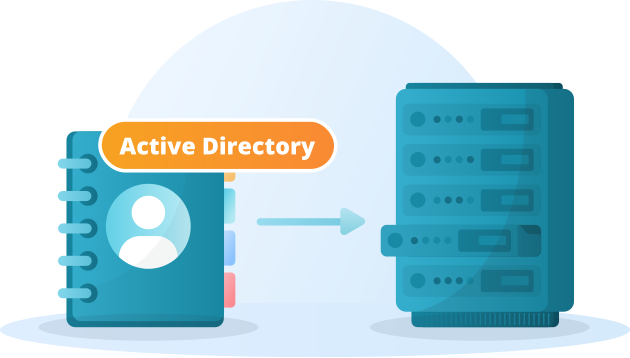
Confirm directory integration works against an internal Active Directory or LDAP server without needing to reach an external identity provider, and confirm the update and patch delivery process is documented for a fully disconnected environment rather than assumed to work the same way it would with internet access. Finally, confirm whether the platform includes video conferencing natively or only text messaging, since combining both in one platform, as TrueConf does, reduces the number of separate systems an isolated network has to support.
How to Choose and Deploy an Air-Gapped Messaging Platform?
Selecting the right platform works best as a three step process rather than a single procurement decision made from a features list.
Step one: confirm the actual isolation requirement. Determine whether the organization needs true air-gapped operation with zero internet dependency, or whether a strong on-premise deployment with occasional connectivity for updates is actually sufficient. Conflating these two requirements leads either to unnecessary operational overhead or to a platform that fails the real security requirement.
Step two: audit every candidate’s external dependencies. Compare no more than three candidates specifically on what each one contacts externally by default, not on a generic feature checklist, since this is the single factor most likely to disqualify a platform that otherwise looks like a strong fit.
Step three: pilot inside an actual isolated network segment before full deployment. Run the platform in a genuinely disconnected test environment, including a full update cycle using the offline patch process, before committing to organization-wide rollout, since a platform that performs correctly in a connected demo environment can still surface unexpected dependencies once truly isolated.
The Future of Air-Gapped Collaboration
Three shifts are changing what buyers expect from an air-gapped platform beyond simple message and video isolation.
First, staged and selective isolation architectures, where an organization runs one fully disconnected core with narrowly scoped, audited bridges for specific approved data flows, are replacing the older assumption that isolation means a permanently sealed environment with no defined transfer process at all, which mirrors the bridge model described above and is becoming an explicit design requirement rather than an afterthought.
Second, on-premise AI processing is becoming a genuine requirement rather than a nice to have, since organizations that need transcription, translation, or search inside their messaging platform can no longer accept a cloud AI API call as an acceptable exception to an otherwise air-gapped deployment, which is part of why TrueConf’s optional integration with TrueConf AI Server keeps AI processing inside the same disconnected infrastructure rather than routing it externally.
Third, the convergence of video conferencing, messaging, and file collaboration into a single disconnected platform is reducing the number of separate isolated systems an IT team has to maintain, patch, and audit, favoring platforms like TrueConf that combine these functions natively over organizations stitching together several single purpose air-gapped tools.
Empower your video conferencing experience with TrueConf!
FAQ
What makes a messaging platform truly air-gapped rather than just on-premise?
A truly air-gapped platform runs indefinitely with zero internet connectivity, including software updates, license checks, and notification delivery, not just during initial installation. TrueConf Server meets this bar through fully autonomous operation with no required internet connection, while several platforms marketed as on-premise still depend on at least one external service, which disqualifies them from genuinely air-gapped environments.
Is end-to-end encryption enough to protect sensitive communications?
No. End-to-end encryption protects message content in transit, but it does not protect metadata like who is communicating with whom and how often, which can be exposed through server logs on infrastructure the organization does not control. TrueConf and Messagenius address this by keeping all data, including metadata, inside a fully isolated network, going beyond what encryption alone can guarantee.
Can an open-source platform like Rocket.Chat or Element (Matrix) be deployed air-gapped?
Yes, but it requires deliberate configuration to disable default connections to the vendor’s cloud services, such as push notification relays or marketplace apps, since these are not disabled by default in a standard self-hosted install. TrueConf and Messagenius are architected for disconnection from the start, which reduces the risk of an overlooked dependency compared to retrofitting an open-source platform toward full isolation.
What industries most commonly need air-gapped messaging platforms?
Military, government, defense, and classified research environments are the most common users, since any risk of a data leak carries security consequences beyond typical corporate exposure. Maritime and cruise operations also adopt platforms like TrueConf and Messagenius out of practical necessity, given extended periods without reliable connectivity at sea.
Does TrueConf support video conferencing in a fully disconnected environment?
Yes, video conferencing is a core part of TrueConf Server rather than an add-on, and it operates fully within an autonomous, disconnected deployment alongside messaging and directory integration. This distinguishes TrueConf from platforms in this comparison, like Messagenius or Rocket.Chat, where video capability is more limited or requires additional configuration.
How should an organization handle software updates on an air-gapped network?
Updates must be manually verified, packaged, and transferred into the isolated environment through a defined internal process, since automatic patching over the internet is not available by design. TrueConf Server supports offline update packages specifically for this scenario, and any organization evaluating a platform for air-gapped deployment should confirm a similar documented process exists before committing to that vendor.
What should a buyer ask a vendor to confirm genuine air-gapped readiness?
Ask for a complete list of every external endpoint the software contacts by default, including push notifications, license validation, and any AI or search features, since a platform can be self-hosted and still depend on at least one of these. TrueConf and Messagenius are both designed to require no external API or SaaS service to function, which is a stronger and more specific claim than a general statement that on-premise deployment is supported.
How does an organization get software updates into a network that has no internet access?
Updates are transferred through a controlled, auditable channel, typically a staged bridge environment or a hardware data diode, rather than any live connection to the isolated network, with the update package manually reviewed before installation. TrueConf Server is built around this exact workflow through signed offline update packages, which is a specific operational advantage over platforms where offline delivery is a workaround rather than a designed feature.
About the Author
Diana Shtapova is a product specialist and technology writer with three years of experience in the unified communications industry. At TrueConf, she leverages her deep product expertise to create clear and practical content on video conferencing platforms, collaboration tools, and enterprise communication solutions. With a strong background in product research and user-focused content development, Diana helps professionals and businesses understand core product features, adopt new technologies, and unlock the full potential of modern collaboration software.


Follow us on social networks