
Two-Way Communication: What It Is, Why It Matters, and How to Do It Right
Most communication breakdowns at work aren’t caused by bad intentions. They happen because someone spoke and nobody responded — or worse, responded without being heard. That’s the gap two-way communication closes.
This article covers what two-way communication actually means, why organizations with strong feedback cultures consistently outperform those without, which formats and tools support it best, and how to build it into your daily workflow rather than treating it as a special occasion.
What Is Two-Way Communication?
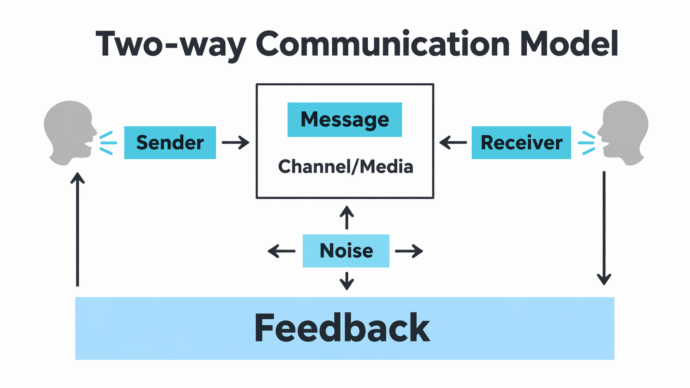
Two-way communication is an exchange of information where both parties send and receive messages, respond to each other’s input, and adjust their behavior or decisions based on that exchange. It’s not just talking and listening — it’s the continuous loop where a message goes out, a response comes back, and that response shapes what happens next.
The classic model breaks this down into six components:
|
Component |
What It Means |
|---|---|
|
Sender |
The person or system initiating the message |
|
Message |
The content being communicated |
|
Channel |
The medium used (video call, email, chat, face-to-face) |
|
Receiver |
The person interpreting and responding to the message |
|
Feedback |
The receiver’s response, which completes the loop |
|
Noise |
Anything that distorts or interrupts the exchange (tech issues, ambiguous language, emotional stress) |
In one-way communication, the loop stops at the receiver. In two-way communication, the response travels back and the sender adjusts accordingly. That distinction is what makes two-way communication genuinely interactive rather than just bidirectional by format. For customer-facing communication, two-way texting provides a simple way for businesses to maintain this ongoing exchange through text messages.
Try TrueConf Server Free!
- 1,000 online users with the ability to chat and make one-on-one video calls.
- 10 PRO users with the ability to participate in group video conferences.
- One SIP/H.323/RTSP connection for interoperability with corporate PBX and SIP/H.323 endpoints.
- One guest connection to invite a non-authenticated user via link to your meetings.

The Numbers Make the Case
Before going deeper, here are the figures that explain why this topic matters so much to organizations right now:
-
$1.2 trillion is lost annually by U.S. companies due to miscommunication and collaboration failure (Grammarly, 2024)
-
72% of business leaders report increased productivity after improving communication quality
-
61% of employees say they have considered leaving their jobs because of poor internal communication (USC Annenberg & Staffbase)
-
74% of employees say they want more information from their companies — yet only 14% of employees feel aligned with company goals, while 44% of leaders assume full alignment
-
Teams that communicate well show up to 25% higher productivity than poorly communicating counterparts
-
70% of company mistakes are rooted in communication failures, costing businesses an estimated $37 billion annually
These are not small inefficiencies. They represent the operational cost of organizations that treat communication as a one-directional broadcast rather than a two-sided exchange.
One-Way vs. Two-Way Communication: A Direct Comparison
|
Factor |
One-Way Communication |
Two-Way Communication |
|---|---|---|
|
Direction |
Sender → Receiver |
Sender ↔ Receiver |
|
Feedback |
None or delayed |
Immediate or structured |
|
Accuracy check |
Low |
High |
|
Speed of delivery |
Fast |
Slightly slower |
|
Error correction |
Difficult |
Built into the process |
|
Employee engagement |
Low |
Significantly higher |
|
Best use cases |
Announcements, alerts, mass updates |
Decisions, problem-solving, feedback, collaboration |
One-way communication isn’t always wrong. Sending a company-wide security alert, a policy update, or a public announcement often doesn’t require a response loop. The problem is when organizations default to one-way communication for everything — including situations where feedback would change the outcome.
Types of Two-Way Communication
Two-way communication takes different forms depending on the relationship between the parties and the timing of the exchange.
By direction:
-
Vertical — between people at different organizational levels (manager and employee, executive and department). This is where most communication failures occur because power dynamics create hesitation in the feedback direction.
-
Horizontal — between colleagues at the same level. Generally the most fluid form, but it can become an echo chamber if teams are too isolated from each other.
-
Diagonal — between people in different departments and at different levels, common in cross-functional projects.
By timing:
-
Synchronous — real-time exchanges: video calls, phone calls, in-person conversations. Both parties are present and responding in the moment.
-
Asynchronous — delayed exchanges: email threads, recorded video messages, comments in project management tools. Both parties contribute, but not simultaneously.
The synchronous vs. asynchronous distinction matters more than most guides acknowledge. Real-time communication builds emotional connection and resolves ambiguity faster. Asynchronous communication gives people time to think before responding, which can produce more considered, higher-quality feedback — particularly across time zones or for complex topics.
Unique insight #1:
Asynchronous two-way communication has a genuine cognitive advantage that’s often overlooked. When employees aren’t forced to respond in the moment, they avoid the social pressure to agree, which means the feedback is more likely to be honest. Organizations that structure asynchronous dialogue carefully — with clear prompts, response windows, and visible follow-through — often get better signal than those relying exclusively on live meetings.
Why Two-Way Communication Fails (And It’s Not What You Think)
Most articles focus on how to enable two-way communication. Fewer ask why it breaks down even when the channels exist.
The failure usually isn’t technical. It’s one of three things:
-
Fake openness. The feedback mechanism exists — a survey, a suggestion box, a Q&A session — but the responses never visibly influence decisions. Employees stop engaging when they learn that feedback is collected but not acted on. This is sometimes called “consultative theater.”
-
Asymmetric accountability. Managers are expected to communicate downward but employees don’t feel safe communicating upward. In organizations with strong hierarchy or low psychological safety, the two-way loop is structurally blocked even when leadership claims an open-door policy.
-
Channel mismatch. Using email for nuanced, emotionally sensitive feedback. Running brainstorming sessions in a format where only confident speakers participate. The medium shapes the quality of the exchange as much as the intent behind it.
Unique insight #2:
Research on high-performing surgical teams reveals that structured one-way communication — precise commands, confirmed receipt, no discussion during critical moments — actually reduces errors during procedures. Two-way communication is not universally better. In situations requiring speed, precision, and role clarity, a well-designed one-way structure outperforms open dialogue. The skill is knowing which mode to use when, not treating two-way communication as the automatic default for every interaction.
Benefits of Two-Way Communication in the Workplace
For employees
-
Feel heard and valued. Employees who report that their feedback is taken seriously show 3x higher engagement than those who don’t.
-
Understand their role better. Regular dialogue with managers reduces ambiguity about expectations, priorities, and performance standards.
-
Build trust with leadership. Transparency in both directions — leadership sharing context, employees sharing concerns — creates a more resilient working relationship.
For managers and leaders
-
Better decisions. Managers who actively collect and process employee input make better-informed decisions because they’re working with real signal, not assumptions.
-
Early warning system. Two-way communication surfaces problems before they become crises. Employees closest to the work typically know about operational issues long before leadership does.
-
Retention. Poor internal communication is cited by 61% of employees as a reason for considering departure. That’s a retention lever many organizations overlook.
For organizations
-
Higher productivity. Up to 25% improvement when communication is strong.
-
Lower error rates. 70% of company mistakes trace back to communication failures — reducing this directly improves quality and reduces rework costs.
-
Stronger culture. Team cultures where people communicate openly and honestly are more adaptable, more innovative, and more capable of handling change.
Where Two-Way Communication Happens: Formats and Channels
|
Format |
Synchronous or Async |
Best For |
|---|---|---|
|
Video calls and meetings |
Synchronous |
Decisions, alignment, sensitive topics |
|
Instant messaging (chat) |
Near-synchronous |
Quick questions, updates, informal exchange |
|
Email threads |
Asynchronous |
Documented decisions, detailed feedback |
|
Project management comments |
Asynchronous |
Task-specific, contextual feedback |
|
Employee surveys with follow-up |
Asynchronous |
Organization-wide sentiment collection |
|
Town halls with live Q&A |
Synchronous |
Company-wide updates with open questions |
|
1:1 manager check-ins |
Synchronous |
Individual performance, wellbeing, development |
|
Recorded video messages with comments |
Asynchronous |
Cross-timezone team updates with responses |
The channel choice shapes participation. Written formats tend to favor reflective, thorough responses. Live formats favor fast, decisive exchange. Neither is superior — the best organizations use both deliberately, not by habit.
Self-Hosted Team Messenger with Video Conferencing
A cutting-edge team collaboration server with personal and group chats, UltraHD video conferences, and advanced AI-powered features — free for up to 1,000 users!
How to Build Two-Way Communication into Your Organization
The following steps move two-way communication from a stated value to an operational reality.
-
Define what “feedback” means in your context. Vague calls for “open communication” produce nothing. Specific structures — weekly 1:1s with required discussion topics, anonymous pulse surveys with published results, post-project retrospectives with documented action items — produce consistent results.
-
Make responses visible. Every time an employee provides feedback and sees what changed because of it, the signal quality of future feedback increases. The opposite is also true: feedback that disappears teaches people to stop giving it.
-
Train managers, not just employees. Most two-way communication programs focus on tools and formats for everyone. The bottleneck is almost always managers — specifically, their ability to ask questions that invite honest responses, listen without defending, and follow through on what they hear.
-
Choose channels that fit the message. A performance concern shouldn’t live in a group chat. A quick logistics question shouldn’t require a 30-minute video call. Matching the message type to the communication format reduces friction and increases quality.
-
Build feedback into existing processes, not as separate events. Post-meeting check-outs (one question, sixty seconds), asynchronous status updates with comment fields, project kick-offs that explicitly include risk and concern discussions — these embed two-way communication into work rather than treating it as an addition to work. Organizations with mobile sales teams often achieve similar results by using door knocking software, which enables representatives to share field updates and receive feedback without disrupting their workflow.
UltraHD Video Conferences
Create conferences on the fly gathering up to 2,000 participants in a meeting. Enjoy realistic communications with cutting-edge AI algorithms. Take an active part in online meetings without being distracted by taking notes! Record video conferences and share recordings with colleagues.

Unique insight #3:
One of the most underused two-way communication strategies is structured silence. When a leader finishes speaking and asks for input, a room that produces nothing isn’t evidence of agreement — it’s often evidence of hierarchy, uncertainty, or exhaustion. Leaders who normalize a brief pause, then rotate responses around participants by name (not as a demand, but as an invitation), systematically surface input that would otherwise remain unspoken. This technique requires no technology and costs nothing.
Two-Way Communication in Remote and Hybrid Teams
The shift to distributed work has changed the shape of two-way communication in ways that are still being worked out.
Remote teams lose the ambient feedback that exists in physical environments — the visible reactions, the hallway conversations, the ability to read a room. This means feedback has to become more deliberate and more frequent to compensate. In fact, a Founder Reports study showed that only 40% of remote workers say they receive clear feedback from management.
Key challenges in distributed environments:
-
Visual cues are missing. 70% of remote workers report missing nonverbal signals during virtual meetings, which affects their ability to gauge how their message is landing.
-
Async creates delays. Without structured response windows, asynchronous feedback can simply not arrive, and the communication loop stays open.
-
Time zones create natural barriers. Teams spread across multiple time zones need explicit protocols for when and how feedback is expected.
What works:
-
Camera-on norms for synchronous calls where emotional content or important decisions are on the table
-
Async video messages (short recorded updates) rather than long email chains, which allow tone and non-verbal cues to travel across time zones
-
Structured weekly cadences so team members know when to expect responses and when to give them
-
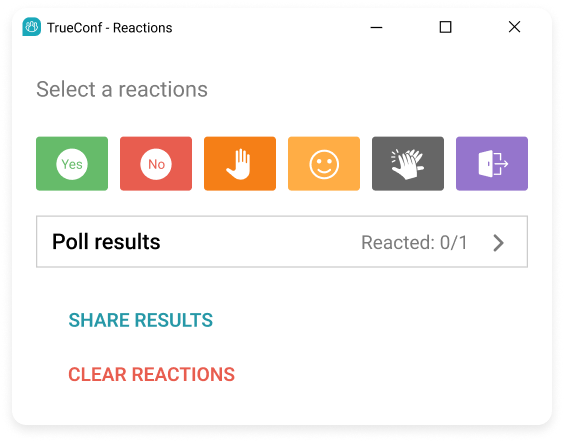
Video conferencing platforms that support live Q&A, reactions, and breakout rooms to maintain dialogue quality at scale.
TrueConf: Purpose-Built for Two-Way Communication
Two-way communication is only as good as the tools supporting it. For teams that need reliable, high-quality video dialogue — whether in the same office or across continents — the platform matters.
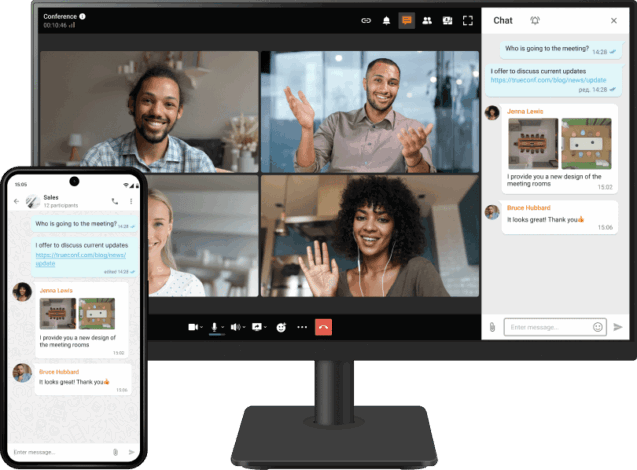
TrueConf is an enterprise video conferencing and collaboration platform that supports the full range of two-way communication formats: video calls and conferences, group chats, asynchronous video messages, screen sharing, and integrated whiteboards for collaborative work. It runs on-premises or in a private cloud, which means your communication data stays within your infrastructure — an important consideration for organizations in regulated industries.
What TrueConf supports:
-
Up to 1,500 participants in a single video conference
-
Real-time translation and transcription
-
Persistent chat alongside video calls for parallel written dialogue
-
Roles and moderation tools for structured Q&A in large meetings
-
Integration with existing enterprise systems (LDAP, Active Directory)
-
Available on Windows, macOS, Linux, iOS, Android, and browser
If your organization is working to reduce communication barriers across distributed teams, TrueConf is worth a close look.
What is the simplest definition of two-way communication? Two-way communication is any exchange where both the sender and receiver contribute messages and respond to each other. The defining characteristic is the feedback loop — a response travels back to the original sender, who adjusts based on it. How is two-way communication different from one-way communication? In one-way communication, information flows from sender to receiver with no expected or received response. In two-way communication, the receiver responds and that response influences what happens next. Email sent with no reply expected is one-way. Email with a reply that changes the sender’s next action is two-way. What are the most common examples of two-way communication at work? Video calls, 1:1 meetings, instant messaging conversations, employee surveys with published results and follow-up, performance reviews where both manager and employee contribute, and collaborative document editing with comment threads. Is two-way communication always better than one-way? No. For announcements, emergency alerts, or situations requiring fast and precise instruction without discussion, one-way communication is often more appropriate. Two-way communication requires time and mutual attention — resources that aren’t always available or necessary. The goal is to match the communication style to the situation. What stops two-way communication from working in organizations? The three most common barriers are: (1) feedback that’s collected but not acted on, which teaches employees that responding is pointless; (2) power imbalances that make upward communication feel risky; and (3) channel mismatches where the format doesn’t support the type of exchange needed. What’s the difference between synchronous and asynchronous two-way communication? Synchronous communication happens in real time — both parties are present simultaneously (video calls, phone calls, in-person meetings). Asynchronous communication involves a time gap between message and response (email, recorded video, comments). Both are valid forms of two-way communication; the choice depends on the urgency, complexity, and geography of the exchange. How does two-way communication affect employee retention? Significantly. Research by USC Annenberg and Staffbase found that 61% of employees have considered leaving their jobs because of poor internal communication. Employees who feel heard and who see their feedback reflected in decisions report higher satisfaction, stronger trust in leadership, and lower likelihood of departure. Can two-way communication work in large organizations with thousands of employees? Yes, but it requires deliberate structure. Town halls with live Q&A, pulse surveys with transparent results, tiered feedback mechanisms that aggregate input by team and department, and regular leadership responses to employee questions are all formats that scale two-way communication beyond small teams. What role does video conferencing play in two-way communication? Video conferencing reintroduces the visual and auditory cues that written communication removes — facial expressions, tone of voice, pacing. For emotionally complex discussions, important decisions, or relationship-building exchanges, video significantly increases the quality of two-way communication compared to text-based alternatives. It also reduces the cognitive load of interpreting intent in written messages. How do you measure whether two-way communication is working? Useful signals include: response rates on internal surveys and communications, quality and frequency of upward feedback, time-to-resolution on issues surfaced through communication channels, employee engagement scores, and manager-reported confidence in team alignment. The most direct measure is whether feedback visibly changes decisions — if it does, the loop is working.FAQ
About the Author
Olga Afonina is a technology writer and industry expert specializing in video conferencing solutions and collaboration software. At TrueConf, she focuses on exploring the latest trends in collaboration technologies and providing businesses with practical insights into effective workplace communication. Drawing on her background in content development and industry research, Olga writes articles and reviews that help readers better understand the benefits of enterprise-grade communication.


Follow us on social networks