
Intrapersonal Communication: The Conversation You’re Already Having (and Probably Ignoring)
Summarize article with AI



Every time you read an email and feel a prickle of irritation before typing your reply — that’s intrapersonal communication. Every time you rehearse what you’ll say in a meeting, talk yourself down from overreacting, or replay a conversation at 11 PM wondering what you should have said instead — also intrapersonal communication.
It’s the most constant form of communication humans engage in. It also gets almost no attention in professional settings, where the focus stays entirely on external communication: how to write better emails, how to run tighter meetings, how to give feedback.
This article covers what intrapersonal communication actually is, why it matters for how teams function, and what you can do about it. If you only have a few minutes, start with the summary tables below.
The Short Version: Key Facts Up Front
|
Question |
Answer |
|---|---|
|
What is intrapersonal communication? |
Communication that happens entirely within one person: internal dialogue, mental imagery, emotional processing, decision-making. |
|
Is it the same as thinking? |
Partly. Thinking is broader; intrapersonal communication specifically involves making meaning — interpreting, evaluating, and forming internal “messages.” |
|
Does it affect work performance? |
Yes, directly. Research links negative self-talk to lower performance under pressure, worse feedback responses, and more reactive decision-making. |
|
Can you change your intrapersonal habits? |
Yes, with practice. Journaling, mindfulness, cognitive reframing, and third-person self-talk all have evidence behind them. |
|
How is it different from interpersonal communication? |
Interpersonal = between people. Intrapersonal = within one person. Both affect each other constantly. |
Why it matters right now
Remote and hybrid work has quietly increased the amount of intrapersonal processing people need to do. For distributed teams, this also extends to professional development, where many people now learn English by speaking with AI to improve workplace communication skills independently. When you share an office with someone, you pick up ambient signals — tone, posture, the general mood of a room. Strip those away, and people must work harder internally to interpret incomplete information. That’s a bigger intrapersonal load, with fewer checks on whether those interpretations are accurate.
Take your team communication to the next level with TrueConf!
A powerful self-hosted video conferencing solution for up to 1,000 users, available on desktop, mobile, and room systems.
What Intrapersonal Communication Actually Is
The term comes from communication theory, not psychology, which partly explains why it gets defined differently depending on who you ask. A communication theorist treats it as a message-processing system. A psychologist might call it inner speech or self-regulation. A cognitive scientist might frame it as predictive processing or working memory.
In practice, intrapersonal communication includes:
- Inner monologue — the verbal running commentary most people recognize as “the voice in their head”
- Emotional interpretation — deciding what you feel and why, before expressing it
- Mental rehearsal — playing through future conversations or scenarios
- Memory-based reasoning — connecting what’s happening now to what happened before
- Self-concept maintenance — the ongoing internal narrative of who you are, what you’re good at, and how others see you
- Internal conflict — the experience of weighing competing impulses, values, or interpretations before acting
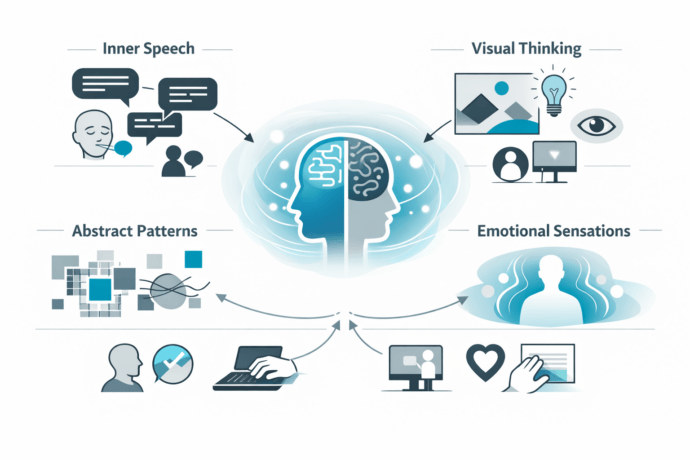
One thing worth noting: not everyone experiences intrapersonal communication as verbal. Researcher Russell Hurlburt, who studied inner experience through a method called “descriptive experience sampling,” found that inner speech is frequent for about 30–50% of people. Others think in images, abstract patterns, or emotional sensations. The forms vary widely. What doesn’t vary is that this internal processing is happening constantly and feeding directly into external behavior. Similarly, tools for data transformation convert raw information into structured formats that make patterns easier to recognize and interpret.
Intrapersonal vs. Interpersonal Communication
The comparison gets made in most articles on this topic, usually with the same table. Here’s what most of them skip: the two are not parallel systems that happen to coexist. They’re entangled.
Your intrapersonal communication is shaped by every interpersonal experience you’ve had. How a teacher responded to your questions in school, how your first manager gave feedback, whether you were praised for being right or for asking good questions — all of that is stored in the internal processing you bring to every new situation.
And your interpersonal communication is, at every moment, preceded and followed by intrapersonal processing. You interpret a message internally before you respond. You evaluate a response internally after you send it. The two forms are less like separate channels and more like the inside and outside of the same process.
|
|
Intrapersonal |
Interpersonal |
|---|---|---|
|
Who’s involved |
One person |
Two or more |
|
Channel |
Internal (thoughts, emotions, imagery) |
External (speech, text, body language) |
|
Feedback |
Self-generated |
From others |
|
Visibility |
Invisible by default |
Observable |
|
Speed |
Varies — can be near-instant or ongoing for hours |
Structured by turn-taking and response time |
|
Examples at work |
Pre-meeting mental prep, processing a critique, interpreting a short reply |
Team meetings, Slack messages, performance reviews |
Where Intrapersonal Communication Goes Wrong at Work
Most workplace communication breakdowns don’t start at the external level. They start with a distorted internal interpretation that nobody catches or questions.
The short message problem
Someone sends a colleague a four-word reply: “Let’s discuss on Friday.” The recipient’s internal processing kicks in immediately: Is that curt? Are they annoyed? Did I do something wrong? By Friday, they’ve arrived at the conversation with a defensive posture, built entirely on an assumption they never tested.
The message sender probably just had a busy afternoon.
The silent meeting problem
Someone sits through a meeting without speaking, internally arguing against a decision being made. They leave without voicing the concern. Later, the project hits exactly the problem they foresaw. Their internal objection was valid — but it never made it out.
This is sometimes about confidence, sometimes about organizational culture. At the intrapersonal level, it often involves a prediction (“If I speak up, I’ll come across as difficult”) that goes unexamined.
people
$ / hr
min
/ week
%
cost per meeting
wasted per meeting
wasted per week
wasted per year
The feedback response problem
A manager gives mixed feedback — mostly positive, with one specific criticism. The recipient’s inner processing latches onto the criticism and expands it: She thinks I’m not up to this role. The positive parts get discarded. A week later, engagement drops.
This is a textbook cognitive distortion called filtering. It’s not a character flaw; it’s an unchecked intrapersonal pattern. And it’s extremely common.
Insight #1: Video Calls Can Suppress Intrapersonal Processing
Here’s something that rarely comes up in discussions of this topic: synchronous video meetings are actually not great conditions for intrapersonal communication. They demand real-time response. There’s no pause, no processing window. You’re watching someone’s face, monitoring your own framing, managing audio delay, and expected to respond within seconds.
Many people leave video meetings feeling like they didn’t say what they meant — not because they lacked the thoughts, but because the format gave no space between receiving and responding.
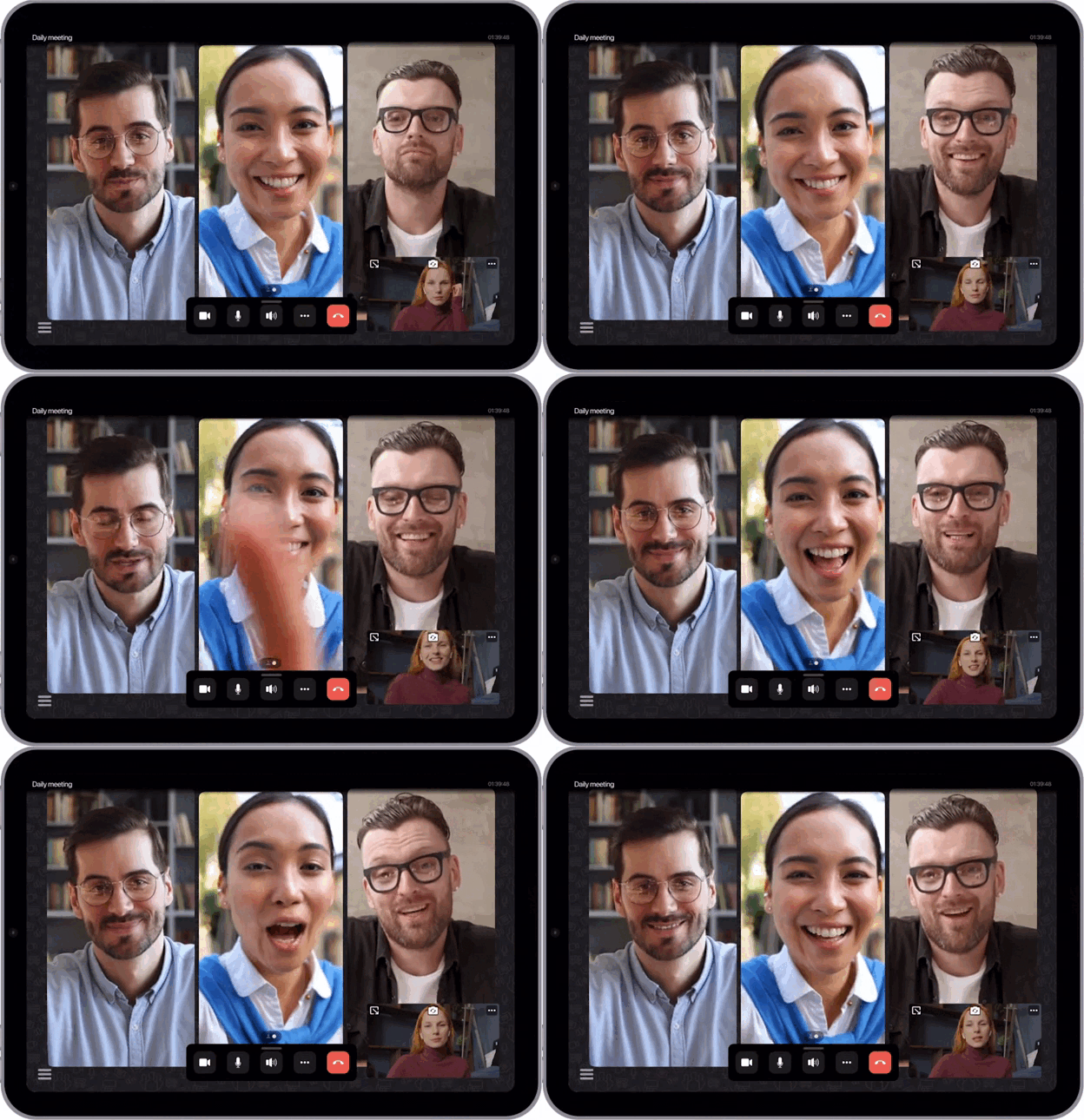
Asynchronous formats — written messages, recorded video updates, shared documents — reintroduce that processing gap. They let internal dialogue run before output is required. This is one concrete reason why async communication often produces more considered responses on complex topics than live calls do.
Types of Intrapersonal Communication
Self-Talk
Self-talk isn’t a single thing. Research distinguishes between at least three forms:
- Positive self-talk — encouraging, solution-oriented: “I’ve handled situations like this before.”
- Negative self-talk — critical, threat-focused: “I’m going to get this wrong again.”
- Instructional self-talk — procedural and task-focused: “First, address the budget question. Then ask for their timeline.”
Instructional self-talk has the clearest performance benefits, particularly for complex tasks. A 2011 study published in Psychological Science found that self-instruction before a challenging task improved performance significantly compared to motivational self-talk or no self-talk. In professional settings, this maps to pre-meeting preparation, mental walk-throughs before presentations, or thinking through a difficult email before writing it. This kind of preparation can also strengthen broader business communication skills by helping people approach difficult conversations with greater clarity and confidence.
Common self-talk distortions to recognize in yourself:
- Catastrophizing — “This project is going to fail completely.”
- Mind-reading — “They didn’t reply because they’re unhappy with me.”
- Overgeneralizing — “This always happens when I present to that group.”
- Filtering — ignoring nine positive signals and fixating on one ambiguous one.
Visualization and Mental Simulation
Mental rehearsal is well-studied in sports psychology and less discussed in organizational contexts, but the mechanism is the same. When you mentally walk through a difficult conversation before it happens, you’re training your response patterns.
The key detail: effective visualization includes obstacles, not just ideal outcomes. Imagining only the best-case scenario tends to reduce the effort people invest, because the brain partially registers the imagined success as real. Visualizing the realistic scenario — including the moment where things get awkward — produces better preparation.

Inner Dialogue vs. Monologue
Self-talk research distinguishes between internal monologue (one voice, one perspective) and internal dialogue (multiple positions, often representing different parts of yourself — your cautious self, your ambitious self, your fair witness to both).
Inner dialogue is more generative. It’s what happens when you genuinely argue both sides of a decision, rather than looking for confirmation of what you already want to believe.
Reflective Processing
This is slower, deliberate intrapersonal communication: journaling after a difficult interaction, reviewing a week’s decisions to spot patterns, sitting with an open question without rushing to answer it. It’s the mode most associated with insight and behavioral change, and the most likely to be crowded out by busy schedules.
Insight #2: Self-Concept Is Negotiated Daily, Not Fixed
Self-concept — how you see yourself — feels stable because it changes slowly. But it’s actually being revised constantly through intrapersonal communication.
Every small workplace event gets interpreted and filed: I handled that well. I missed that. They didn’t include me in that meeting. These micro-interpretations accumulate. Over time, they either reinforce or erode a person’s professional self-image.
This has a practical implication for managers: the feedback you give doesn’t only change behavior in the short term. It becomes source material for intrapersonal processing that shapes how someone sees themselves months later. A single offhand comment in a performance review can become part of someone’s internal narrative for years.
This isn’t about being overly careful or withholding honest feedback. It’s about being accurate. The most damaging feedback isn’t harsh feedback — it’s inaccurate feedback that gets internalized as truth.
How to Build Stronger Intrapersonal Communication Skills
1. Journaling — more specifically than “just write”
Generic journaling produces limited results because most people default to narrating events. More useful approaches:
- Perspective-taking entries: write about a conflict from the other person’s viewpoint.
- Decision autopsies: after a decision plays out, write about what you assumed going in versus what actually turned out to be true.
- Pattern tracking: after difficult interactions, note any common threads — same type of situation, same person, same time of day.
The goal isn’t emotional release. It’s building the habit of examining internal interpretations rather than accepting them as accurate.
2. Third-Person Self-Talk
Ethan Kross, a psychologist at the University of Michigan, has published multiple studies showing that referring to yourself by name or in the third person during stressful situations (“What should [your name] do here?”) creates psychological distance from immediate emotion and produces better outcomes.
Using your name activates slightly different processing than using “I,” which triggers the self-referential system more intensely. The distance makes it easier to access the advice you’d give a friend rather than spiraling in the threat-response mode of first-person self-examination.
3. Pre-Conversation Reflection
Before high-stakes conversations or presentations, spend five minutes asking:
- What outcome am I hoping for?
- What am I assuming about how the other person is feeling?
- What am I most likely to get defensive about, and why?
- What would a fair, outside reading of this situation look like?
This surfaces assumptions before they drive behavior unconsciously.
4. Cognitive Reframing
Reframing is the practice of examining whether your internal interpretation of a situation is accurate, then replacing distorted interpretations with more balanced ones.
|
Automatic thought |
Reframe |
|---|---|
|
“I froze during that presentation — I’m not cut out for this.” |
“I lost my thread at one point. I can identify what happened and address it next time.” |
|
“Nobody pushed back in the meeting, so they must not care.” |
“Silence has multiple explanations. I should ask for input directly.” |
|
“They replied with one word — they’re annoyed with me.” |
“Short replies often just mean someone is busy. I don’t have enough information to read tone here.” |
5. Genuine Unstructured Time
Intrapersonal processing doesn’t only happen during deliberate practices. The brain’s default mode network — which activates during rest and mind-wandering — is heavily involved in self-referential processing, memory consolidation, and perspective-taking.
Constant task-switching, notification-checking, and fully-scheduled calendars crowd this out. Building unscheduled gaps isn’t wasted time; it’s letting the brain do integration work that requires space.
Intrapersonal Communication and Team Dynamics
Strong internal communication doesn’t just benefit individuals. It shapes team culture in ways that are often invisible until they’re absent.
People with strong intrapersonal habits tend to:
- Check assumptions before escalating conflicts
- Receive feedback without collapsing or deflecting
- Notice their own emotional state before it affects how they communicate
- Make decisions based on evidence rather than anxiety-driven pattern-matching
Leaders with poor intrapersonal habits tend to:
- Project their own unprocessed stress onto team interactions
- Mistake their interpretation of a situation for fact
- Mistake silence for agreement
- Respond to pushback as a personal threat rather than as information
One of the most practical things an organization can do is create structural space for intrapersonal processing: pre-meeting prep time, post-project retrospectives, check-ins that genuinely ask how people are doing rather than only what they’re delivering.
Insight #3: The Interpretation Gap Scales with Team Size
On a small team, people have enough context about each other that their internal interpretations of ambiguous signals stay reasonably accurate. They know whether a colleague’s short email means she’s stressed or just concise.
As teams grow, that shared context thins. People interpret signals from colleagues they barely know, in writing, with no tone, no history, and no ambient information. Their intrapersonal interpretations fill the gaps with assumptions — and those assumptions tend to be shaped by past experiences with different people in different contexts.
This is one reason why communication breakdowns scale roughly proportionally with team size, and why onboarding matters beyond skills: time invested in building shared context reduces the intrapersonal load on everyone.
How TrueConf Connects to This
Video conferencing platforms are usually discussed in terms of features: resolution, call stability, screen sharing, recording. Less often discussed is how a tool’s design affects the quality of thinking that happens before and after interactions.
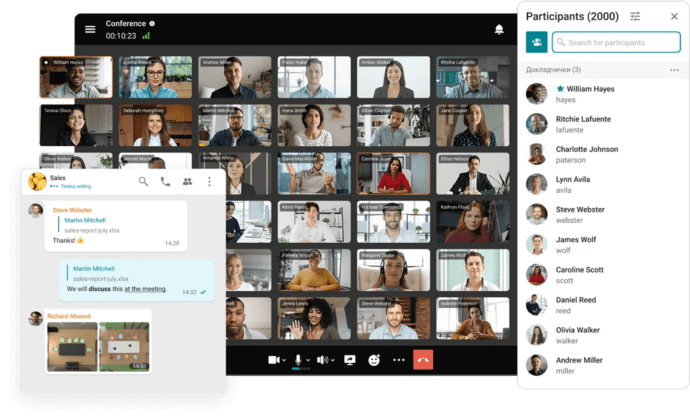
TrueConf is built around secure, high-quality video communication for distributed teams. Several aspects of how it works connect directly to what we’ve covered:
- Asynchronous video messages let people record and send responses on their own schedule — not in the pressure window of a live call. For complex topics, this produces more considered replies, because the internal processing happens before the message, not during it.
- Meeting recordings and transcripts make it possible to revisit what was said rather than relying on notes taken while simultaneously processing information. Post-meeting reflection — the kind that actually changes behavior — requires being able to accurately recall what happened. Live-only meetings make that difficult.
- Structured conference controls — where a host manages speaking order, participant permissions, and session flow — reduce the cognitive noise of large-group video calls, where simultaneous stimuli compete for attention and reduce the processing quality of everyone in the room.
None of this replaces the internal work people need to do. But tools that give people time and structure create better conditions for that work to happen.
Try TrueConf Server Free!
- 1,000 online users with the ability to chat and make one-on-one video calls.
- 10 PRO users with the ability to participate in group video conferences.
- One SIP/H.323/RTSP connection for interoperability with corporate PBX and SIP/H.323 endpoints.
- One guest connection to invite a non-authenticated user via link to your meetings.

What is the cleanest one-sentence definition of intrapersonal communication? It’s communication with yourself — the internal process of thinking, feeling, interpreting, and making meaning before, during, and after interacting with the world. Is intrapersonal communication conscious or automatic? Both. The anxiety that shows up before a performance review isn’t chosen — it happens automatically. The decision to deliberately talk yourself through that anxiety is conscious. Most intrapersonal communication is a mix, running in the background until something prompts you to examine it. Does everyone have an inner monologue? No, and this is less discussed than it should be. Research by Russell Hurlburt suggests inner speech is a frequent experience for roughly 30–50% of people. Others think in images, abstract patterns, or sensations rather than words. The form varies; the processing doesn’t. What’s the connection between intrapersonal communication and emotional intelligence? Two of the four core components of emotional intelligence — self-awareness and self-regulation — depend directly on intrapersonal communication. You can’t manage what you haven’t noticed internally first. High emotional intelligence is largely the result of well-functioning intrapersonal habits, not personality type. How does intrapersonal communication affect remote teams specifically? Remote work removes ambient social cues, forcing individuals to interpret more information internally with fewer contextual signals. The result is higher intrapersonal load, more frequent misinterpretation of ambiguous messages, and a greater chance that unchecked internal assumptions drive conflict rather than actual disagreement. Can intrapersonal communication be trained in a professional setting? Yes. Structured reflection practices, pre-meeting preparation protocols, and psychological safety that allows people to voice uncertainty all support healthier intrapersonal habits across a team. It doesn’t require a therapy framework — it requires building space for processing, not just space for output. What does poor intrapersonal communication look like at work? Reactive outbursts that the person later regrets, chronic second-guessing that slows decisions, difficulty processing criticism without becoming defensive, and persistent misreading of colleagues’ intentions are the most common signs. How is intrapersonal communication related to imposter syndrome? Imposter syndrome is largely an intrapersonal phenomenon — a persistent internal narrative that contradicts external evidence of competence. It’s maintained through selective attention (noticing failures, discounting successes), which is distorted intrapersonal processing. Addressing it as a communication habit rather than only as an emotional experience tends to be more effective. Does journaling actually work, and how quickly? Research by psychologist James Pennebaker on expressive writing showed measurable effects on psychological and physical health indicators after as few as four 20-minute writing sessions. The benefit isn’t from the writing itself — it’s from the act of converting vague internal experience into concrete, examinable language. Can better intrapersonal communication make meetings more productive? Yes, through two mechanisms. People who prepare internally before meetings contribute more clearly and less reactively. People who reflect afterward are more likely to retain, act on, and meaningfully challenge what was discussed. Both outcomes improve what meetings actually produce.FAQ
Wrapping Up
Intrapersonal communication is happening constantly, in every person on your team, before and after every interaction. The question isn’t whether it’s happening — it’s whether it’s working for or against what the team is trying to do.
The organizations that take this seriously don’t necessarily do anything dramatic. They build in reflection time. They create psychological safety that reduces defensive intrapersonal processing. They use tools that give people space to think before responding. And they develop leaders who understand that a team member’s internal life is not separate from their professional performance — it’s where professional performance begins.
About the Author
Olga Afonina is a technology writer and industry expert specializing in video conferencing solutions and collaboration software. At TrueConf, she focuses on exploring the latest trends in collaboration technologies and providing businesses with practical insights into effective workplace communication. Drawing on her background in content development and industry research, Olga writes articles and reviews that help readers better understand the benefits of enterprise-grade communication.


Follow us on social networks