



Cybersecurity for Government Applications: How Public Sector Agencies Protect Sensitive Communications?
Government agencies handle some of the most sensitive data in existence: classified briefings, citizen records, law enforcement intelligence, court proceedings, and critical infrastructure operations. A single breach of a government application is not just a financial loss. It can compromise national security, expose personal data of millions of citizens, or disrupt essential public services.
Cybersecurity for government applications is a distinct discipline from standard enterprise IT security. Agencies operate under stricter compliance mandates, face nation-state level threat actors, and must often guarantee that data never leaves a jurisdiction or even a physical building. This shapes every technology decision, including something as routine as choosing a video conferencing or messaging platform.
This guide breaks down what government-grade cybersecurity actually requires, the architectural choices agencies must weigh, and how a solution like TrueConf fits into a secure communications strategy through on-premises deployment, certified encryption, and administrator-controlled infrastructure.
Quick Answer: What Government Cybersecurity Requires?
|
Requirement |
What It Means |
Why It Matters for Agencies |
|---|---|---|
|
Data sovereignty |
Data stays within agency-controlled or national infrastructure |
Prevents foreign jurisdiction access and cloud subpoena risk |
|
Strong encryption |
AES-256, TLS, SRTP/H.235 for data in transit and at rest |
Protects classified and personally identifiable information |
|
On-premises or private cloud deployment |
No mandatory dependency on public cloud vendors |
Eliminates third-party data exposure and vendor lock-in |
|
Compliance certification |
ISO 27001, GDPR, HIPAA (for health-adjacent agencies), FedRAMP-aligned controls |
Provides auditable proof of security posture |
|
Centralized administration |
Role-based access, SSO, MFA, granular policy control |
Reduces insider risk and simplifies audits |
|
Offline / air-gapped operation |
Functions without continuous internet connectivity |
Supports defense, intelligence, and continuity-of-government scenarios |
|
Interoperability |
SIP/H.323 gateways, API/SDK integration |
Connects legacy government hardware with modern software |
Why Government Applications Face a Different Threat Model?

Government systems are higher-value targets than typical commercial software. Threat actors range from financially motivated criminals to state-sponsored groups seeking espionage, disruption, or political leverage. This changes the calculus for what “secure enough” actually means.
Insight 1: Compliance is not the same as security, and agencies that conflate the two underestimate their exposure.
Passing a compliance audit confirms that documented controls exist; it does not confirm that an application’s architecture removes the attack surface in the first place. A cloud-based tool can be technically GDPR-compliant on paper while still routing voice and video traffic through third-party data centers outside the agency’s direct control.
For government applications, the more defensible posture is to combine compliance certification with architectural control, meaning the agency decides where data physically lives, not just how it is labeled in a contract.
This is why so many public sector procurement processes now ask two separate questions: “Is this certified?” and “Who can technically access the infrastructure?” Both answers matter.
Core Pillars of Government Application Cybersecurity

1. Data Sovereignty and Deployment Control
Government data residency rules increasingly require that sensitive information stay within national borders or within infrastructure the agency directly controls. Public cloud SaaS products, even reputable ones, introduce a structural dependency: the vendor’s servers, the vendor’s jurisdiction, and the vendor’s incident response process all sit between the agency and its own data.
On-premises and private cloud deployment models remove that dependency. The agency installs the application on its own servers, inside its own network perimeter, and decides who has administrative access.
2. Encryption in Transit and at Rest
Government-grade applications need encryption that protects data at every stage:
- Transport-layer encryption (TLS) to secure the connection between client and server
- Media encryption (AES-256, SRTP, or H.235 for video/voice traffic) to protect the actual content of calls, messages, and files
- Encrypted storage for recordings, chat logs, and uploaded documents
- VPN and network-segment encryption for traffic moving between agency sites
3. Identity, Access, and Administrative Control
A secure application is only as strong as its access controls. Government IT teams need:
- Mandatory authorization for every user and device
- Multi-factor authentication (MFA)
- Single sign-on (SSO) integrated with Active Directory or LDAP
- Granular user roles and group-based permissions
- Centralized, web-based administration for policy enforcement and monitoring
4. Network Resilience and Offline Capability
Government and defense operations frequently happen in environments with degraded, intermittent, or intentionally disconnected internet access: secure facilities, military deployments, disaster response zones, or remote provincial offices. Applications built only for constant cloud connectivity fail in these scenarios.
Insight 2: The ability to operate without the public internet is a security control, not just a convenience feature.
Most procurement checklists for government communications tools focus on encryption strength and certifications, but overlook a more fundamental question: does the application require a live connection to an external, internet-facing service to function at all? A platform that depends on a vendor’s cloud servers for call setup or authentication introduces an outage and exposure risk that no amount of encryption can offset.
Solutions that can run entirely within a local area network, including authentication, call routing, and recording, give agencies continuity of operations even when external connectivity is cut, compromised, or deliberately avoided for security reasons.
5. Compliance Frameworks Relevant to Government Communications
|
Framework |
Focus Area |
Relevance to Government Applications |
|---|---|---|
|
ISO 27001 |
Information security management systems |
Demonstrates systematic, auditable security governance |
|
GDPR |
Personal data protection (EU and partners) |
Required for agencies handling EU citizen data |
|
HIPAA |
Health information privacy (US) |
Relevant for health ministries, telemedicine, and welfare agencies |
|
FedRAMP-aligned controls |
US federal cloud security baseline |
Often referenced even by non-US agencies as a security benchmark |
|
National data residency laws |
Varies by country |
Frequently mandates on-premises or domestic-only hosting |
On-Premises vs. Cloud: The Core Architectural Decision
Most government cybersecurity decisions for communication tools come down to one fundamental choice: deploy on infrastructure you control, or rely on a vendor’s cloud.
|
Factor |
Public Cloud SaaS |
On-Premises / Private Cloud |
|---|---|---|
|
Data location |
Vendor-controlled, often multi-region |
Agency-controlled, fixed location |
|
Internet dependency |
Required for core functionality |
Optional; can run fully offline/LAN-only |
|
Customization of security policy |
Limited to vendor’s settings |
Full administrative control |
|
Initial setup effort |
Low |
Moderate (requires IT resources) |
|
Long-term cost predictability |
Subscription-based, can scale unpredictably |
License-based, often more predictable at scale |
|
Suitability for classified/restricted work |
Generally unsuitable |
Designed for this use case |
|
Vendor access to infrastructure |
Possible, depending on contract |
None, by design |
Neither model is universally “better.” A small municipal office with no classified workloads may find cloud convenience acceptable. A defense ministry, court system, or intelligence-adjacent agency typically cannot accept the residual risk of a third party holding any technical key to its communications infrastructure.
How TrueConf Approaches Government-Grade Communications Security?

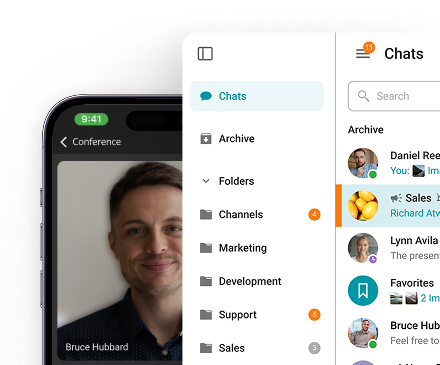
TrueConf is an on-premises video conferencing and team messaging platform built specifically around the deployment model that government and defense buyers tend to require: software installed inside the agency’s own network, with no mandatory dependency on public cloud infrastructure.
Deployment and data control. TrueConf Server runs on the customer’s own hardware or private cloud, meaning video, audio, chat, and file data never has to leave the agency’s network perimeter unless the agency chooses to allow it. This directly addresses the data sovereignty requirement that drives much of government procurement policy.
Encryption and certified compliance. TrueConf secures media with AES-256, SRTP, or H.235 encryption and protects connections via TLS. The platform holds ISO 27001 certification, is GDPR compliant, and is built to be HIPAA-ready for health-adjacent government use cases such as telemedicine or veterans’ services.
Operation without continuous internet access. Because TrueConf Server is deployed locally, it can function inside a secured LAN without an active internet connection, which matters for military units, naval operations, intelligence facilities, and any continuity-of-government scenario where external connectivity cannot be assumed or trusted.
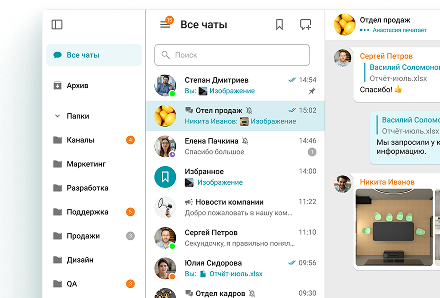
Administrative and identity control. TrueConf integrates with Active Directory and LDAP for single sign-on, supports multi-factor authentication, and gives administrators a centralized web panel to manage user accounts, group policies, recording, scheduling, and monitoring, all without involving an external vendor.
Interoperability with existing government infrastructure. Many agencies already operate SIP/H.323 hardware endpoints, legacy PBX systems, or courtroom video equipment. TrueConf includes a built-in SIP/H.323 gateway and supports phone call invitations, so new deployments do not require ripping out existing equipment.
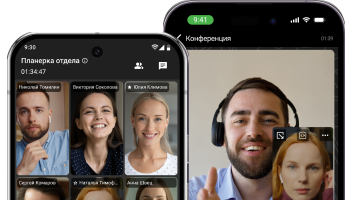
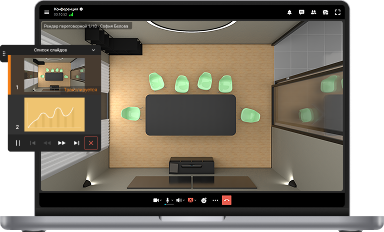
Scale for large institutions. A single conference can host up to 1,000 participants on TrueConf Server, with up to 49 visible simultaneously on screen, which supports large interagency briefings, legislative sessions, and emergency response coordination. For organizations needing higher capacity or multi-site federation across hundreds of thousands of users, TrueConf Enterprise extends the same architecture with redundancy, load balancing, and fault tolerance.
Where Government Agencies Actually Use Secure Communication Platforms
- Interagency and committee meetings: Conducting virtual city council sessions, cross-ministry briefings, and policy coordination without travel.
- Defense and military coordination: Running secure meetings between distributed units, including offline-capable sessions where internet access is restricted for operational security.
- Courts and corrections: Holding remote hearings, arraignments, and preliminary procedures to reduce physical transport of detainees and court backlog.
- Emergency response coordination: Managing real-time, inter-departmental communication during disasters or security incidents.
- National security and intelligence functions: Operating a communications platform that is deployed, managed, and contained entirely within agency-controlled infrastructure.
- Public-facing government services: Powering remote consultations, video kiosks, and virtual service windows for citizens who cannot visit an office in person.
Strengths, Limitations, and Selection Criteria

Strengths of an On-Premises Approach (as exemplified by TrueConf)
- Full control over where data physically resides
- No mandatory reliance on a third-party cloud provider’s security posture
- Works without continuous internet access, supporting high-security and field environments
- Integrates with existing identity infrastructure (AD/LDAP) and legacy hardware (SIP/H.323)
- Predictable, license-based cost structure rather than open-ended subscription scaling
Limitations to Plan For
- Requires internal IT resources to deploy, patch, and maintain the server
- Initial setup takes longer than signing up for a cloud SaaS account
- Agencies must own the responsibility for infrastructure uptime and backups, rather than outsourcing it to a vendor’s SLA
Insight 3: The real total cost of ownership comparison is rarely about license price, it is about who bears operational risk.
Cloud subscriptions appear cheaper on a monthly basis, but they shift uptime, breach response, and data-handling liability onto a third party that the agency does not fully control and, in a serious incident, cannot fully audit in real time. On-premises platforms shift more day-to-day maintenance work onto internal IT staff, but they keep risk ownership, incident response, and forensic access entirely inside the agency.
For government buyers, this tradeoff is often the deciding factor more than the line-item price difference between deployment models.
Selection Criteria for Government IT Decision-Makers
|
Criterion |
Questions to Ask |
|---|---|
|
Data residency |
Where physically does data live, and who can access the servers? |
|
Offline capability |
Does the platform function without internet access, even temporarily? |
|
Compliance |
Does the vendor hold ISO 27001, GDPR, or relevant national certifications? |
|
Identity integration |
Does it support existing AD/LDAP, SSO, and MFA infrastructure? |
|
Legacy compatibility |
Can it interoperate with current SIP/H.323 hardware and PBX systems? |
|
Administrative transparency |
Can your own IT team fully audit and control the deployment? |
|
Scalability path |
Can the platform grow from a pilot to enterprise-wide deployment without a re-architecture? |
Empower your video conferencing experience with TrueConf!
FAQ
What makes government cybersecurity requirements different from standard enterprise IT?
Government agencies face nation-state threat actors, stricter data residency laws, and a need to prove auditable compliance, not just claim it. Tools like TrueConf address this by giving agencies full architectural control over where data is processed and stored, rather than relying entirely on a vendor’s cloud infrastructure.
Is on-premises video conferencing actually more secure than cloud-based platforms?
On-premises deployment removes a structural risk: dependency on a third party’s infrastructure, jurisdiction, and access policies. TrueConf’s on-premises model means agencies control the encryption keys, the server location, and the administrative access, which cloud SaaS platforms generally cannot offer to the same degree.
Can government communication platforms work without an internet connection?
Yes, if they are designed for it. TrueConf Server can operate inside a secured local area network without continuous internet access, which is essential for military, intelligence, and continuity-of-government use cases where external connectivity cannot be guaranteed or trusted.
What compliance certifications should a government communications vendor have?
At minimum, look for ISO 27001 for information security management and GDPR compliance for personal data handling. HIPAA readiness matters for health-adjacent agencies. TrueConf holds ISO 27001 certification, is GDPR compliant, and is HIPAA-ready, which covers the most commonly required frameworks in public sector procurement.
How does TrueConf compare to mainstream cloud platforms like Zoom or Microsoft Teams for government use?
The core difference is deployment architecture. Mainstream cloud platforms route data through the vendor’s public cloud infrastructure by default. TrueConf is built for on-premises or private cloud deployment, giving agencies direct control over data location, offline operation, and administrative access, which is typically a harder requirement to meet on a pure SaaS platform.
Can legacy government video conferencing hardware work with a modern platform like TrueConf?
Yes. TrueConf includes a built-in SIP/H.323 gateway, allowing it to interoperate with existing conference room hardware, courtroom video systems, and PBX telephony already deployed across many government facilities, avoiding a costly hardware replacement cycle.
Is there a free way for agencies to evaluate a secure communications platform before procurement?
Yes. TrueConf Server Free supports up to 1,000 users with unlimited accounts, 4K video, and team messaging, making it a practical way for an agency’s IT team to pilot the platform’s security model and administration tools before committing to a full enterprise license.
About the Author
Diana Shtapova is a product specialist and technology writer with three years of experience in the unified communications industry. At TrueConf, she leverages her deep product expertise to create clear and practical content on video conferencing platforms, collaboration tools, and enterprise communication solutions. With a strong background in product research and user-focused content development, Diana helps professionals and businesses understand core product features, adopt new technologies, and unlock the full potential of modern collaboration software.


Follow us on social networks