
Off-Channel Communications: What They Are, Why They Matter, and How to Manage Them in the Enterprise
Off-channel communications refer to any business-related conversations, decisions, or information exchanges that happen outside of officially sanctioned, monitored, or archived corporate communication systems. In regulated industries and enterprise environments, this is not just a compliance headache — it is a structural risk that can expose organizations to regulatory penalties, data breaches, legal liability, and governance failures.
The rise of consumer messaging apps, personal devices, and fragmented collaboration tools has made off-channel communication one of the most pressing challenges for IT leaders, compliance officers, and CISOs. Understanding what drives it, how to detect it, and how to prevent it with the right infrastructure is essential for any organization operating under compliance obligations or handling sensitive data.
TrueConf is one of the enterprise-grade communication platforms specifically designed to keep all collaboration — video conferencing, team messaging, file sharing, and meetings — within a controlled, auditable, and self-hosted environment, directly addressing the root causes of off-channel behavior.
Executive Summary
|
Aspect |
Key Point |
|---|---|
|
Definition |
Business communication that occurs outside official, monitored corporate systems |
|
Primary risk |
Regulatory non-compliance, data leakage, legal exposure, loss of audit trail |
|
Common triggers |
Inconvenient official tools, remote work habits, consumer app familiarity |
|
Regulated sectors affected |
Finance, healthcare, legal, government, defense, pharma |
|
Core prevention strategy |
Deploy unified, user-friendly, fully auditable communication infrastructure |
|
TrueConf role |
Self-hosted, enterprise video and messaging platform with full admin control and audit capabilities |
|
Alternatives |
Microsoft Teams, Zoom, Cisco Webex, Wire for Business |
Try TrueConf Server Free!
- 1,000 online users with the ability to chat and make one-on-one video calls.
- 10 PRO users with the ability to participate in group video conferences.
- One SIP/H.323/RTSP connection for interoperability with corporate PBX and SIP/H.323 endpoints.
- One guest connection to invite a non-authenticated user via link to your meetings.

What Are Off-Channel Communications?
Off-channel communications are any work-related exchanges conducted through platforms, devices, or channels that fall outside the organization’s official communication policy and monitoring framework. The term is most commonly used in financial services, where regulators have issued billions of dollars in fines for exactly this behavior, but the problem extends across every sector that handles sensitive or regulated information.
For enterprise teams monitoring social media activity as part of their off-channel communication strategy, studying competitor and employee brand presence on Instagram anonymously is a practical first step. A free Instagram Story Viewer lets you browse any public Instagram account’s stories, highlights, and reels completely anonymously — no login or account required — giving compliance and communication teams a discreet, zero-cost way to monitor social media activity without alerting account owners or leaving any digital footprint.
Examples of off-channel communication include:
- Employees discussing client matters or deal terms over WhatsApp, iMessage, or Telegram
- Executives sending strategy updates via personal email accounts
- Sales teams coordinating over SMS instead of the company CRM or messaging platform
- Remote workers using Zoom personal accounts instead of the corporate-licensed instance
- Contractors communicating through their own Slack workspaces outside company visibility
The defining characteristic is not the channel itself, but the absence of corporate oversight, logging, and retrievability. A conversation on WhatsApp is not inherently problematic in a personal context. It becomes an off-channel communication risk the moment it involves business decisions, client data, financial transactions, or any information the organization is obligated to retain and produce.
Why Off-Channel Communication Happens: The Root Causes
Understanding why employees default to unofficial channels is critical before designing a prevention strategy. In most cases, the behavior is not malicious. It is driven by friction, habit, and tool fragmentation.
Friction in official systems. When the approved communication platform is slow, requires VPN access, has a poor mobile experience, or lacks features employees need, they naturally gravitate to tools that work better in the moment. This is the single most common driver of off-channel behavior.
Consumer app familiarity. Employees already use WhatsApp, Telegram, and iMessage in their personal lives. Switching context feels unnecessary, especially for quick questions or informal coordination.
Remote and hybrid work expansion. TThe shift to distributed work accelerated the use of personal devices and home networks, blurring the line between personal and professional communication environments. This includes running consumer tools like a VPN for streaming alongside corporate applications.
Tool proliferation. Organizations often deploy multiple overlapping tools — one for video calls, another for chat, another for file sharing — creating confusion about which channel is “official” for which type of communication.
Speed pressure. In fast-moving environments like trading floors, deal rooms, or incident response situations, employees prioritize speed over compliance. If the official tool requires three extra steps, they will skip it.
Insight 1
The most effective way to reduce off-channel communication is not policy enforcement alone — it is removing the friction that makes unofficial tools more attractive. Organizations that deploy a unified, high-performance communication platform with strong mobile support and intuitive UX see significantly lower rates of off-channel behavior than those relying primarily on policy and monitoring.
Regulatory and Compliance Consequences
The regulatory landscape around off-channel communications has hardened significantly since 2021. Financial regulators in the United States and Europe have pursued enforcement actions that collectively resulted in more than $2 billion in fines against major banks and asset managers for failures to supervise and retain electronic communications.
Key regulatory frameworks that address off-channel communication include:
- SEC Rule 17a-4 and FINRA Rule 4511 — require broker-dealers to retain all business-related communications in a non-rewritable, non-erasable format
- MiFID II — mandates recording and retention of communications related to financial instrument transactions in the EU
- HIPAA — requires covered entities to protect and control all communications involving protected health information (PHI)
- GDPR — requires organizations to demonstrate control over where and how personal data is processed and communicated
- FCA regulations (UK) — require firms to record and store relevant communications and make them available to regulators on request
- DoD and government frameworks — mandate classified and sensitive communications occur only on approved, certified systems
The enforcement pattern is consistent: regulators are not just penalizing the content of off-channel messages. They are penalizing the failure to have systems in place that would have captured those communications in the first place. This shifts the liability from individual employees to organizational infrastructure decisions.
|
Regulation |
Sector |
Communication Requirement |
|---|---|---|
|
SEC Rule 17a-4 |
Finance (US) |
Retain all business communications, tamper-proof |
|
MiFID II |
Finance (EU) |
Record transaction-related communications |
|
HIPAA |
Healthcare (US) |
Control and protect PHI in all communication channels |
|
GDPR |
All sectors (EU) |
Demonstrate data processing control across communications |
|
FCA |
Finance (UK) |
Record and produce relevant communications on demand |
|
ITAR / CUI controls |
Defense / Government |
Use only approved, controlled communication systems |
|
ISO 27001 |
All sectors |
Information security controls over communication channels |
The Hidden Cost Beyond Compliance Fines
Regulatory fines are the most visible consequence of off-channel communication failures, but they are not the only cost organizations face.
Legal discovery exposure. When litigation arises, organizations are required to produce all relevant communications. If those communications happened on personal devices or consumer apps, they may be unrecoverable — or the failure to produce them can itself be treated as spoliation of evidence, leading to adverse legal inferences.
Intellectual property leakage. Sensitive product roadmaps, M&A discussions, client lists, and proprietary processes shared over unmonitored channels are effectively outside the organization’s control. If an employee leaves, those conversations leave with them.
Security vulnerabilities. Consumer messaging apps, even encrypted ones, are not designed for enterprise security requirements. They may be subject to account takeover, device compromise, or data harvesting by third-party integrations. Unlike enterprise platforms, they do not support centralized device management, remote wipe, or role-based access control.
Audit trail gaps. Operational decisions made over WhatsApp or personal email cannot be reconstructed during post-incident reviews, regulatory audits, or internal investigations. This creates governance blind spots that compound over time.
Insight 2
Many organizations focus their off-channel communication strategy on detection and punishment after the fact. A more effective approach is to treat the audit trail gap itself as the primary risk — not the content of any individual message. If your communication infrastructure cannot produce a complete, timestamped, tamper-evident record of all business conversations on demand, you have a structural governance problem regardless of whether any specific violation has occurred yet.
How to Build an Infrastructure That Prevents Off-Channel Communication
Preventing off-channel communication requires a combination of policy, technology, and user experience design. No single lever is sufficient on its own.
Step 1: Conduct a Communication Channel Audit
Before deploying solutions, map every channel currently in use across the organization — sanctioned and unsanctioned. This includes interviewing department heads, reviewing IT logs, and using network monitoring to identify traffic to consumer messaging platforms. Many organizations are surprised to discover how many unofficial channels are in active use.
Step 2: Define a Unified Communication Policy
Establish a clear, written policy that:
- Specifies which platforms are approved for which types of communication
- Explicitly prohibits business communication on unapproved channels
- Defines retention requirements by communication type
- Establishes consequences for policy violations
- Is reviewed and signed by all employees, including senior leadership
Step 3: Deploy a Unified Communication Platform That Employees Actually Want to Use
This is the most operationally critical step. The platform must:
- Cover all communication modalities: video conferencing, messaging, file sharing, screen sharing, and presence
- Provide a high-quality mobile experience
- Be accessible without excessive friction (minimal VPN requirements, fast login, intuitive UI)
- Support integration with existing enterprise tools (calendars, directories, CRM, ticketing systems)
- Offer full administrative control, including user management, policy enforcement, and logging
Your Messages Are Secure with TrueConf!
A powerful self-hosted video conferencing solution for up to 1,000 users, available on desktop, mobile, and room systems. Your confidential information is protected by 12 levels of security.
Step 4: Enable Comprehensive Logging and Archiving
The platform must log all communications in a format that is:
- Tamper-evident and non-modifiable
- Searchable and retrievable on demand
- Exportable in formats acceptable to regulators and legal counsel
- Retained for the required period under applicable regulations
Step 5: Monitor, Train, and Enforce
Deploy technical controls to detect off-channel activity (network monitoring, endpoint DLP, mobile device management policies). Provide regular training that explains not just the rules but the reasons behind them. Enforce policy consistently across all levels of the organization, including executives. Enterprise workflow tools can support this policy by routing approvals and recording each action in an official system.
TrueConf: Addressing Off-Channel Risk Through Self-Hosted Unified Communications
TrueConf is an enterprise video conferencing and unified communications platform that takes a fundamentally different architectural approach from cloud-only solutions. It is designed for organizations that need complete control over their communication infrastructure, data residency, and audit capabilities.
Deployment Model
TrueConf can be deployed entirely on-premises or in a private cloud, with no dependency on external servers or third-party infrastructure. All communication data — video recordings, chat logs, file transfers, meeting metadata — remains within the organization’s own environment. This is a direct architectural response to the off-channel risk of uncontrolled data flows.
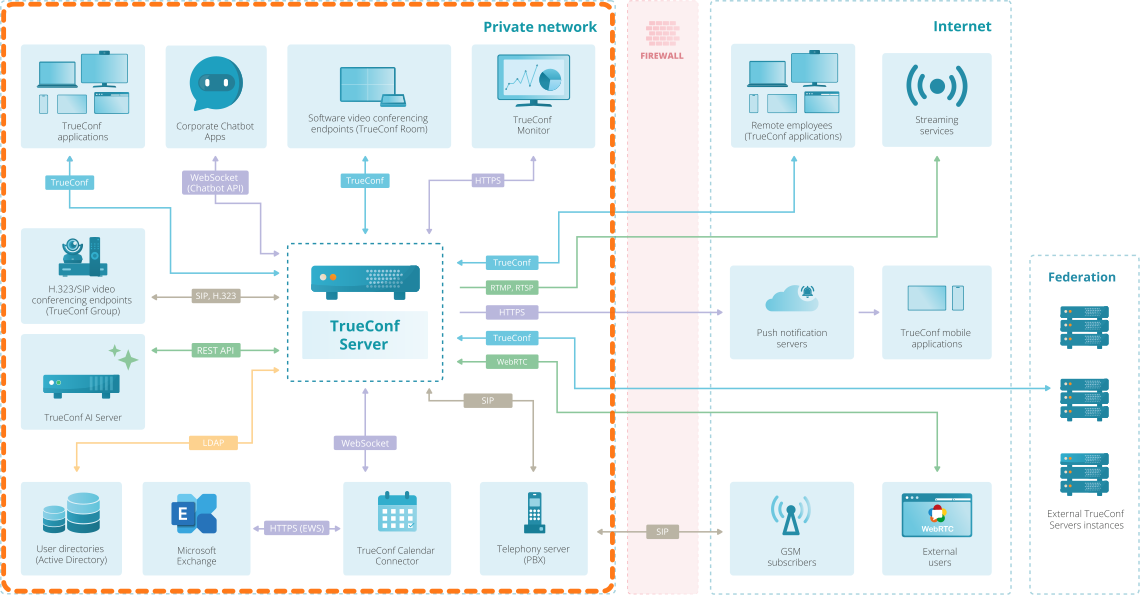
For organizations in regulated industries, this means:
- No data leaves the corporate perimeter without explicit authorization
- Compliance with data residency requirements (GDPR, national data localization laws) is structurally enforced, not just contractually promised
- The organization retains full ownership of all communication records
Administrative Control and Audit Capabilities
TrueConf provides administrators with granular control over:
- User provisioning and deprovisioning (including Active Directory / LDAP integration)
- Meeting policies, recording permissions, and guest access rules
- Communication logs accessible through the admin panel
- Role-based access control for different user categories
This level of administrative visibility makes it operationally feasible to maintain a complete audit trail of all communication activity within the platform, which is a core requirement for off-channel communication compliance.
Unified Communication Coverage
One of the primary reasons employees go off-channel is that no single approved platform covers all their communication needs. TrueConf addresses this by providing:
- HD and 4K video conferencing for up to 1,500 participants
- Built-in team messaging with persistent chat history
- File sharing within the platform
- Screen sharing and remote desktop control
- Meeting scheduling integrated with calendar systems
- Mobile apps for iOS and Android with full feature parity
When employees can handle all communication modalities within a single, well-designed platform, the incentive to switch to consumer apps is substantially reduced.
Security Architecture
TrueConf’s security model is built around the principle that the organization, not a third-party vendor, controls the security perimeter. Key features include:
- End-to-end encryption for video and messaging
- TLS and SRTP protocols for data in transit
- No mandatory cloud dependency or vendor data access
- Support for corporate PKI and certificate management
- Compatibility with enterprise firewalls, proxies, and network security infrastructure
|
Feature |
TrueConf |
Typical Cloud-Only Platform |
|---|---|---|
|
Deployment model |
On-premises, private cloud, or hybrid |
Cloud-only or limited on-prem |
|
Data residency |
Fully within corporate perimeter |
Vendor data centers, variable by region |
|
Admin audit log access |
Full, direct access via admin panel |
Limited, vendor-controlled |
|
LDAP / AD integration |
Native support |
Varies, often limited in lower tiers |
|
Guest access control |
Granular, policy-driven |
Varies |
|
Recording storage |
Local, on corporate infrastructure |
Vendor cloud storage |
|
Compliance with data localization |
Structurally enforced |
Contractual only |
|
Network independence |
Can operate on air-gapped networks |
Requires internet connectivity |
Self-Hosted Team Messenger with Video Conferencing
A cutting-edge team collaboration server with personal and group chats, UltraHD video conferences, and advanced AI-powered features — free for up to 1,000 users!
Comparing Approaches to Off-Channel Communication Management
Different organizations take different approaches to the off-channel communication problem. The right choice depends on regulatory exposure, IT maturity, and organizational culture.
Policy-only approach. Relies entirely on written policies and employee training. Low cost, low effectiveness. Does not address the friction that drives off-channel behavior and provides no technical enforcement mechanism.
Cloud UCaaS with archiving add-ons. Platforms like Microsoft Teams or Zoom combined with third-party archiving solutions (such as Veritas, Smarsh, or Global Relay). Effective for many regulated organizations, but data residency remains with the vendor, and compliance depends on contractual arrangements rather than infrastructure control.
Self-hosted unified communications. Platforms like TrueConf deployed within the corporate environment. Highest level of control and auditability. Requires IT investment but eliminates dependency on vendor compliance posture.
Hybrid model. A combination of self-hosted infrastructure for sensitive communications and cloud tools for general collaboration, with clear policy demarcation between the two. Increasingly common in large enterprises with diverse compliance requirements.
Insight 3
Organizations that have experienced regulatory enforcement actions or legal discovery failures related to off-channel communication consistently report the same pattern: they had a policy, but the approved tool was not good enough to compete with consumer alternatives. The lesson is that compliance infrastructure is only effective if it is also the best user experience available to employees. Choosing a platform that is both compliant and genuinely good to use is not a luxury — it is a strategic requirement.
Evaluating a Communication Platform for Off-Channel Risk Mitigation
When selecting a platform specifically to address off-channel communication risk, evaluate candidates against these criteria:
- Coverage: Does it handle all communication modalities employees need (video, chat, file sharing, mobile)?
- Usability: Is the UX good enough that employees will choose it over consumer alternatives?
- Logging: Does it capture all communication events in a tamper-evident, retrievable format?
- Admin control: Can administrators enforce policies, manage users, and access logs without vendor intermediation?
- Data residency: Does the organization control where communication data is stored and processed?
- Integration: Does it connect with existing enterprise systems (directory, calendar, SSO, DLP)?
- Mobile support: Does it provide a full-featured mobile experience to reduce the temptation to use personal apps?
- Scalability: Can it support the organization’s size and growth without degraded performance?
- Compliance documentation: Can the vendor provide documentation to support regulatory audits?
FAQ
What is the difference between off-channel communication and shadow IT?
Shadow IT refers broadly to any technology used without IT approval, including software, cloud services, and devices. Off-channel communication is a specific subset of shadow IT focused on communication channels used for business conversations outside official, monitored systems. All off-channel communication involves a form of shadow IT, but not all shadow IT involves communication. TrueConf helps address both by providing an enterprise-approved, IT-managed alternative that covers all communication needs.
Which industries face the highest regulatory risk from off-channel communications?
Financial services (banking, asset management, broker-dealers), healthcare, legal, government, and defense face the most direct regulatory exposure. However, any organization subject to GDPR, litigation discovery obligations, or contractual data handling requirements also carries meaningful risk. TrueConf’s self-hosted deployment model is particularly well-suited to these regulated sectors because it keeps all communication data within the organization’s own infrastructure.
Can encryption on consumer apps like WhatsApp satisfy compliance requirements?
No. End-to-end encryption addresses confidentiality in transit but does not satisfy compliance requirements for communication retention, auditability, or regulatory production. Regulators require that organizations be able to retrieve, search, and produce communications — something consumer apps are not designed to support. TrueConf provides encryption alongside full logging and administrative retrievability, which is the combination regulators require.
How do organizations detect off-channel communication that is already occurring?
Detection approaches include network traffic analysis to identify connections to consumer messaging platforms, mobile device management (MDM) policies that can flag or block unapproved apps on corporate devices, endpoint DLP solutions, and periodic employee communication audits. However, detection is a reactive measure. The more effective strategy is to deploy a platform like TrueConf that is compelling enough to become the default choice, reducing off-channel activity at the source.
What should an organization do if it discovers historical off-channel communications during a regulatory inquiry?
Engage legal counsel immediately. Do not attempt to delete or conceal the communications, as this can constitute obstruction. Conduct a forensic preservation of all discoverable communications across all channels. Use the incident as a trigger for infrastructure remediation, including deploying a compliant platform like TrueConf and implementing a retrospective communication policy review.
Is a self-hosted communication platform more expensive than a cloud alternative?
The upfront infrastructure cost is typically higher for self-hosted deployment, but the total cost of ownership calculation must include compliance costs, archiving fees, data transfer costs, and the potential cost of regulatory fines or litigation exposure. For organizations in heavily regulated industries, the risk-adjusted TCO of a self-hosted platform like TrueConf is often lower than a cloud solution that requires additional compliance tooling layered on top.
How does TrueConf support organizations with multiple offices or global operations?
TrueConf supports federated deployment across multiple servers, allowing organizations to maintain regional infrastructure while providing a unified communication experience across locations. This architecture supports data residency compliance in multiple jurisdictions simultaneously, which is a significant advantage for multinational enterprises managing off-channel communication risk across different regulatory environments.
About the Author
Olga Afonina is a technology writer and industry expert specializing in video conferencing solutions and collaboration software. At TrueConf, she focuses on exploring the latest trends in collaboration technologies and providing businesses with practical insights into effective workplace communication. Drawing on her background in content development and industry research, Olga writes articles and reviews that help readers better understand the benefits of enterprise-grade communication.


Follow us on social networks