Unified Communications

Unify business calling, messaging, and meetings in a single on-premises solution — accessible from desktops, web browsers, mobile apps, and meeting room systems.

Corporate platform with chats, video calls, and a calendar for collaboration

Address Book

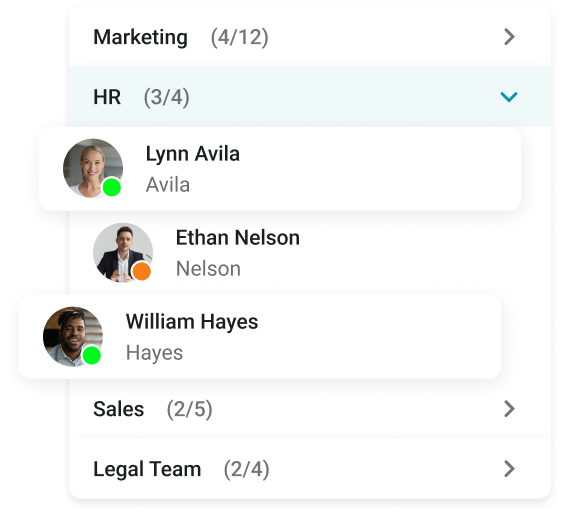
Utilize the shared address book to search for not only other TrueConf Server users, but also for connected SIP/H.323 devices. Create groups of contacts by inviting all participants with just one click!

Address Book

Team Messenger

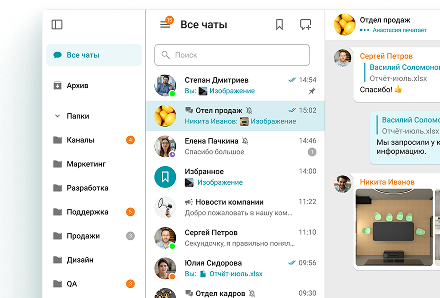
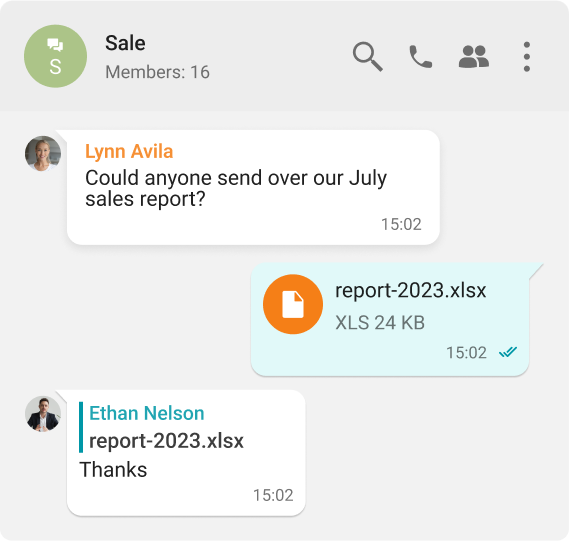
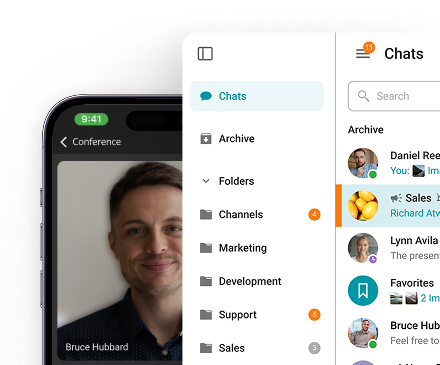
Promptly solve urgent work issues! Create personal and group chats that allow for exchanging messages not only during conferences but also outside of them.

Team Messenger

Telephony and PBX

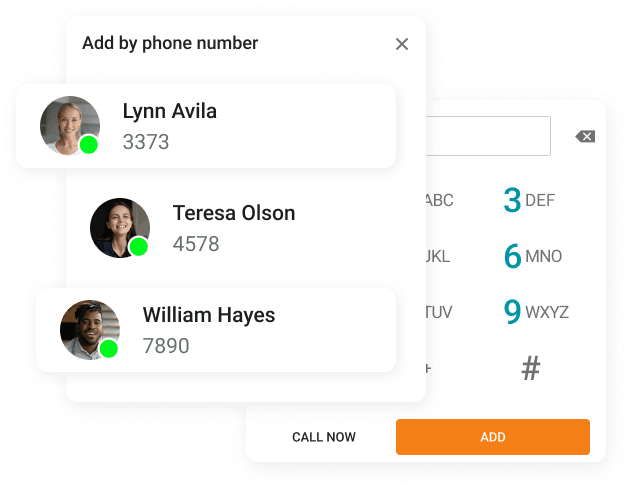
Call and invite users of your PBX, external telephone subscribers or even VoIP devices registered on TrueConf Server to a group video conference.

Telephony and PBX

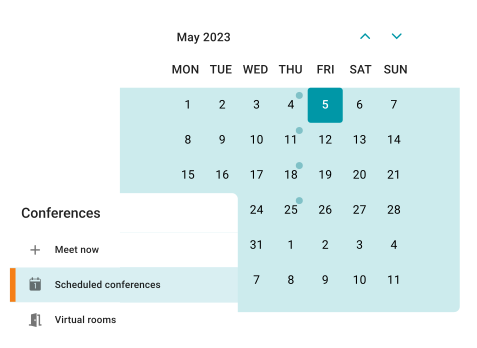
Conference Scheduler

Plan video meetings in advance! Set up the date, time and duration of conferences, as well as set a schedule of regular events.

Conference Scheduler

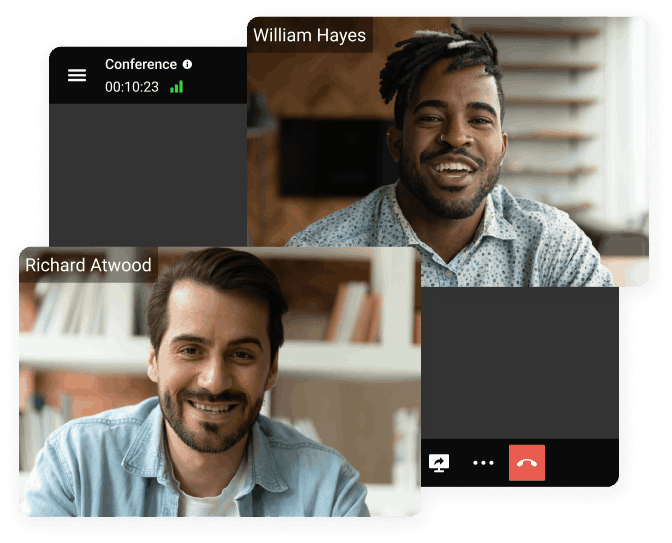
Unlimited Video Conferences

Make free audio and video calls to colleagues from any compatible device, without having to worry about time constraints.

Unlimited Video Conferences

Integration with Calendars

Add TrueConf video conferences to any events in Outlook and Thunderbird calendars! Use special plugins to easily schedule meetings with colleagues without distracting from the workflow.

Integration with Calendars

All communications — unified in one solution with TrueConf Server Free!

Download for free

FAQ

What is UCaaS, and what does UCaaS mean?

UCaaS, short for Unified Communications as a Service, represents a cloud-native delivery model for business communications that operates on a subscription basis. This approach consolidates essential workplace interaction tools, including telephony, team messaging, and video conferencing, into a single, integrated environment accessible across desktop clients, web interfaces, mobile applications, and dedicated meeting room hardware.

Unlike legacy on-premises PBX systems and fragmented standalone tools, UCaaS delivers a centrally managed communication suite that significantly simplifies deployment, enables elastic scaling to match organizational growth, and reduces the operational burden of maintaining complex infrastructure. By shifting communications to the cloud, organizations gain agility without sacrificing functionality, making UCaaS an attractive path for modernizing enterprise collaboration.

What are unified communications solutions used for?

Unified communications platforms are engineered to dissolve the boundaries between disparate communication channels, creating a cohesive digital workspace where messaging, voice, video, and collaboration tools operate in harmony. Rather than forcing employees to toggle between isolated applications for chat, calling, meetings, and file sharing, UC solutions deliver an integrated experience that accelerates workflows and enhances team responsiveness.

Organizations leverage these platforms to facilitate rapid internal coordination through instant messaging, voice calls, and ad-hoc video sessions, replacing lengthy email exchanges with real-time dialogue. They also support meetings at every scale, from impromptu team huddles to executive briefings and company-wide broadcasts, often equipped with role-based permissions and moderation capabilities for structured interactions.

External collaboration becomes seamless through controlled guest access, allowing secure engagement with clients, partners, and vendors without compromising internal systems. For distributed workforces, UC platforms provide reliable, device-agnostic access that bridges geographic divides and sustains productivity across time zones.

By centralizing administration, these solutions empower IT teams to manage user lifecycles, enforce security policies, and monitor usage through a single control plane, curbing tool sprawl and reducing operational complexity. Critically, unified communications strengthen governance by applying consistent authentication, data retention, and auditing standards across all interaction modes, making them indispensable for regulated industries where compliance and business continuity are non-negotiable.

How does unified communications support remote and hybrid teams?

Unified communications platforms serve as the connective tissue for distributed organizations, ensuring that physical distance does not impede collaboration. These systems deliver uniform access to core communication tools regardless of an employee's location or device, whether joining from a corporate desktop, personal smartphone, browser tab, or conference room system.

Persistent chat channels and team workspaces maintain conversational context across shifts and time zones, allowing asynchronous contributors to stay informed without constant real-time presence. The ability to fluidly transition between modalities, escalating a text chat to a voice call or video meeting within the same interface, mirrors natural workplace interactions and eliminates disruptive context switching.

This continuity proves especially valuable during office transitions, business travel, or unexpected disruptions, as teams retain full connectivity without reconfiguring tools or workflows. Ultimately, by unifying communication channels under a consistent experience, UC platforms enable remote and hybrid teams to function as a cohesive unit rather than a collection of isolated individuals.

How does UCaaS benefit enterprise businesses?

For large organizations, UCaaS offers a strategic pathway to modernize communications infrastructure while aligning with enterprise demands for scalability, operational efficiency, and financial predictability. The cloud-based nature of UCaaS eliminates the capital-intensive hardware investments and lengthy deployment cycles associated with traditional on-premises systems, enabling rapid rollout across global offices and remote teams.

Enterprises gain the flexibility to scale user counts, geographic coverage, and feature sets up or down in response to market dynamics, without procuring additional physical infrastructure. Centralized cloud administration streamlines user provisioning, policy enforcement, and analytics across departments and regions, reducing the burden on distributed IT teams.

From a financial perspective, the subscription model transforms communication costs from unpredictable capital expenditures into transparent operational expenses, improving budget forecasting and cash flow management. Consistent tooling across the organization fosters higher adoption rates and more effective cross-functional collaboration, as employees experience the same interface whether working from headquarters, a branch office, or home.

That said, enterprises in heavily regulated sectors, such as finance, healthcare, or government, often evaluate hybrid or on-premises alternatives alongside UCaaS to address stringent data residency, sovereignty, or compliance requirements that may necessitate greater infrastructure control.

What features should I look for in a UCaaS platform?

Selecting a UCaaS platform requires looking beyond feature checklists to evaluate how well a solution supports actual business workflows at scale. A robust platform should deliver a thoughtfully integrated suite of capabilities rather than a disjointed collection of tools.

Essential components include dynamic team messaging that supports both ephemeral conversations and persistent, searchable channels for ongoing projects; high-fidelity video conferencing with intuitive participant controls, screen sharing, and moderation features adaptable to intimate team sessions or large-scale broadcasts; and reliable telephony with native VoIP or PSTN connectivity, complete with extension management, call forwarding, and voicemail integration. Equally important is administrative depth: centralized user and role management, granular permission structures, and policy enforcement tools that simplify governance across thousands of users.

Security must be foundational, not bolted on, with end-to-end encryption, multi-factor authentication, detailed audit logs, and compliance certifications aligned to industry standards. Seamless operation across desktop, web, mobile, and room systems ensures employees can participate fluidly from any environment.

Finally, meaningful integrations with calendar systems, identity providers, and core business applications prevent UCaaS from becoming another siloed tool. The optimal platform aligns with your organization's communication rhythms, security posture, geographic footprint, and growth trajectory—delivering cohesion rather than complexity.

Is TrueConf a UCaaS platform?

Not in the conventional “as-a-service” sense. TrueConf Server is a self-managed unified communications platform, deployed either on-premises or within a private cloud environment. It delivers secure team collaboration and high-quality video conferencing while ensuring that infrastructure, data storage, and governance policies remain entirely under the organization’s control.

Who are the leading UCaaS providers, and how do I choose one?

The UCaaS landscape features several prominent players, including Microsoft Teams, Zoom Workplace, Cisco Webex, 8×8, Nextiva, Dialpad, Vonage, and Google Workspace, each offering cloud-native communication suites that bundle messaging, meetings, and telephony into subscription-based services. These platforms have gained widespread adoption thanks to their rapid deployment cycles, elastic scalability, and comprehensive feature sets that address modern workplace collaboration needs.

Yet beneath this surface similarity lies meaningful differentiation. Providers often emphasize distinct strengths: some excel at deep integration with productivity ecosystems like Microsoft 365 or Google Workspace; others prioritize global telephony reach with extensive PSTN connectivity; while certain platforms focus on intuitive interfaces for non-technical users or specialize in hosting large-scale virtual events with robust production capabilities.

Selecting the optimal UCaaS solution requires a structured evaluation across several dimensions:

Core Communication Requirements

Clarify whether your organization's primary needs center on lightweight messaging and ad-hoc meetings, full-featured business telephony with direct dialing, large-format broadcasts, or an integrated blend of all modalities.

Data Governance and Regulatory Alignment

Scrutinize where communication data resides geographically, how encryption and access controls are implemented, and whether the platform supports certifications or compliance frameworks relevant to your industry (e.g., GDPR, HIPAA, SOC 2).

Ecosystem Compatibility

Assess seamless integration with existing identity providers (such as Active Directory or Azure AD), calendar systems, room booking solutions, and legacy telephony infrastructure to avoid workflow disruption.

User Adoption Considerations

Evaluate both internal usability for employees of varying technical proficiency and the friction level for external participants, clients, partners, or candidates, who must join meetings without complex downloads or account creation.

Total Cost of Ownership and Scalability

Analyze pricing models beyond per-user fees, including costs for premium features, international calling minutes, recording storage, and how expenses scale as headcount or feature usage grows.

No universal "best" UCaaS platform exists, optimal choices depend entirely on organizational context. While cloud-delivered UCaaS suits many businesses seeking agility and reduced infrastructure overhead, organizations with stringent data sovereignty mandates, air-gapped security requirements, or regulatory obligations often explore alternatives beyond public cloud services.

In such scenarios, self-hosted platforms like TrueConf Server emerge as viable options, delivering core unified communications capabilities while granting enterprises complete control over infrastructure, data residency, and administrative governance.

How do security, reliability, and compliance factor into UC platform choice?

For enterprises, unified communications platforms transcend convenience tools, they form part of mission-critical infrastructure where failures, breaches, or compliance gaps carry significant operational, financial, and reputational risk. Consequently, security posture, service resilience, and regulatory adherence frequently outweigh feature richness when evaluating UC solutions.

Organizations typically assess platforms against four foundational pillars:

Data Protection Architecture

Robust platforms implement layered security including end-to-end or transport encryption, multi-factor authentication, granular role-based access controls, and audit trails for sensitive actions such as meeting recordings or chat exports. These measures prevent unauthorized data exposure while enabling precise incident investigation.

Service Continuity and Performance Consistency

Enterprises demand predictable uptime (often backed by SLAs), minimal latency during peak usage periods, and resilience against regional outages, particularly for executive communications, customer-facing interactions, or time-sensitive decision-making sessions.

Regulatory and Policy Alignment

Solutions must natively support data residency controls, configurable retention policies, comprehensive logging for audit purposes, and compliance certifications required by industry standards or geographic jurisdictions, not require workarounds that compromise security or legal standing.

Administrative Transparency and Control

IT teams require centralized dashboards for real-time usage analytics, rapid user provisioning/deprovisioning, policy enforcement across distributed teams, and the ability to isolate or remediate incidents without vendor dependency.

In practice, enterprises often prioritize platforms that enable them to enforce internal security policies autonomously, maintain uninterrupted service during critical operations, and demonstrate compliance through verifiable controls, sometimes accepting trade-offs in feature breadth to achieve these non-negotiable requirements.

Why are enterprise UC requirements different from SMB needs?

The communication needs of large enterprises fundamentally differ from those of small and medium-sized businesses due to three compounding factors: organizational scale, governance complexity, and risk exposure. While SMBs typically seek simplicity and rapid setup, enterprises must architect communication systems capable of supporting thousands of users across geographies, departments, and compliance regimes, without sacrificing control or reliability.

Enterprise-grade UC platforms therefore must deliver capabilities that extend far beyond basic usability:

Sophisticated Governance Frameworks

Including hierarchical permission models, meeting moderation tools (waiting rooms, participant muting, content approval), centralized policy engines, and delegated administration for regional IT teams.

Enterprise-Grade Security and Auditability

With support for single sign-on, conditional access policies, data loss prevention, encrypted media streams, and detailed audit logs that satisfy internal security teams and external auditors alike.

Predictable Performance Under Load

Platforms must handle concurrent large-scale events (hundreds or thousands of participants), sustained peak usage during business hours, and bandwidth-constrained environments without degradation in audio or video quality.

Deep Ecosystem Integration

Seamless interoperability with existing enterprise infrastructure, LDAP/Active Directory synchronization, SAML-based identity federation, legacy PBX integration, room system management, is often mandatory rather than optional.

Where SMB-focused solutions optimize for speed of adoption and minimal configuration, enterprise UC platforms balance user experience with administrative control, scalability with stability, and innovation with compliance. This divergence explains why a tool perfectly suited for a 50-person startup may prove inadequate, or even risky, for a multinational corporation operating under strict regulatory oversight.

The selection criteria, implementation complexity, and success metrics for UC platforms shift dramatically as organizational scale and risk profiles increase.

Can TrueConf Server as an all-in-one alternative to disparate communication tools?

TrueConf operates as a comprehensive collaboration ecosystem that brings together essential workplace communication channels within a single, cohesive environment. By consolidating messaging, conferencing, and team coordination tools under one roof, the platform enables organizations to significantly streamline their digital workspace while eliminating the inefficiencies caused by tool fragmentation.

At the heart of this approach lies a unified collaboration hub where instant messaging, private and group chats, and high-definition video conferencing coexist seamlessly within an intuitive interface, effectively removing the need to switch between standalone chat applications and separate meeting services. For IT departments, this consolidation translates into reduced integration complexity, as fewer third-party dependencies mean lower maintenance overhead, simplified security protocols, and more straightforward user account management.

End users benefit from a consistent experience across desktop, mobile, and tablet devices, which accelerates platform adoption and minimizes training requirements. From a governance perspective, security policies, permission settings, and compliance rules can be administered centrally rather than being scattered across multiple disconnected systems: a critical advantage for organizations operating under strict regulatory frameworks.

Including hierarchical permission models, meeting moderation tools (waiting rooms, participant muting, content approval), centralized policy engines, and delegated administration for regional IT teams.

Particularly in on-premises deployments, TrueConf Server replaces the typical patchwork of cloud-based messaging apps, external conferencing services, and niche point solutions with a single, controlled collaboration server that delivers full administrative oversight. As a result, businesses that prioritize simplicity, data sovereignty, and centralized control frequently adopt TrueConf as their foundational layer for unified communications, moving away from fragmented environments toward a more secure and manageable collaboration infrastructure.