
Sovereign Messaging Platform for Enterprise Communication
A sovereign messaging platform is an enterprise communication system designed to keep messaging infrastructure, business data and operational control within a defined organizational or jurisdictional boundary.
For governments, regulated industries and organizations reducing dependence on foreign SaaS platforms, the requirement is broader than secure chat.
The platform must answer several practical questions:
- Who operates the messaging infrastructure?
- Where is business communication stored?
- Can the organization control user identities and access?
- Can the service operate without mandatory dependence on an external messaging cloud?
- Can communication remain interoperable with other systems rather than becoming another closed ecosystem?
This is what separates sovereign messaging from an ordinary secure messenger.
What Makes a Messaging Platform Sovereign?
A sovereign messaging platform typically combines three forms of control.
Control over where the service operates
First, the organization needs control over where the service operates. This may mean customer-operated infrastructure, a sovereign cloud or another deployment model that satisfies the required jurisdiction and operational boundaries.
Control over business communication data
Second, it needs control over business communication data. Messages, files, user information and related records should remain within the agreed infrastructure and governance model.
Technological independence
Third, it needs sufficient technological independence. Core messaging should not depend entirely on an external control plane that the organization cannot operate or replace.
These principles are reflected in current sovereign messaging products. Element emphasizes self-hosted, interoperable communication based on the Matrix open standard, while Tiris positions sovereign messaging around European infrastructure, end-to-end encryption and enterprise continuity. France’s Tchap is a government-operated professional messaging service built on Matrix specifically to improve security, continuity and oversight.
Sovereign Messaging vs Secure Messaging
A secure messenger primarily focuses on protecting communication.
A sovereign messenger adds another question:
Who controls the environment in which that communication happens?
A public messaging service may use strong encryption while accounts, infrastructure and service availability remain under the provider’s control.
A sovereign enterprise messaging platform is intended to give the organization more authority over those layers.
This distinction is especially important when messaging becomes critical infrastructure rather than simply another employee application.
Data Ownership Matters More Than Server Geography
A platform hosted in Europe is not automatically sovereign.
European hosting can address an important data-residency or jurisdiction requirement, but it does not necessarily give the customer control over the service.
A stronger model considers whether the organization can control:
- its message data;
- user identities;
- retention;
- infrastructure;
- administration;
- migration or export.
Tiris, for example, explicitly combines European hosting with data ownership and E2EE as part of its sovereign positioning. Element takes a different route, emphasizing self-hosting, open standards and interoperability.
The important point is that sovereignty can be implemented through different architectures.
Encryption Is Important, but It Is Not the Whole Definition
Encryption is a core requirement for sensitive messaging, but it is only one part of sovereignty.
End-to-end encryption can reduce who is technically able to read message content.
It does not by itself determine:
- who operates the messaging servers;
- who controls identities;
- where metadata is stored;
- whether the service depends on a foreign cloud;
- whether the organization can migrate away.
This is why sovereign messaging should be evaluated across both security and control.
Current sovereign messaging products often combine the two. Tiris explicitly uses E2EE, while Element positions E2EE together with self-hosting and Matrix interoperability.
Your Messages Are Secure with TrueConf!
A powerful self-hosted video conferencing solution for up to 1,000 users, available on desktop, mobile, and room systems. Your confidential information is protected by 12 levels of security.
Interoperability Is a Major Sovereignty Requirement
One of the strongest themes in current sovereign messaging is interoperability.
A platform can be privately hosted and still create significant vendor lock-in if it depends on proprietary protocols and closed clients.
Open standards create another option.
Element, for example, bases its sovereign messaging approach on Matrix, allowing separately operated environments to communicate while retaining control over their own infrastructure. France’s Tchap and Germany’s BwMessenger are examples of public-sector messaging built around Matrix-based architectures.
This leads to an important principle:
Sovereign messaging should reduce dependency, not simply move it from a public cloud into a private data center.
Sovereign Messaging for Governments and Regulated Organizations
The demand for sovereign messaging is strongest where communication itself becomes part of critical infrastructure.
Examples include:
- government agencies;
- defense;
- financial organizations;
- critical infrastructure;
- regulated enterprises;
- large public institutions.
These organizations may need more than confidentiality.
They may also require organizational control over:
- employee accounts;
- internal communication history;
- administrative policies;
- infrastructure availability;
- external collaboration.
Tchap is a useful real-world example. France introduced the service as a government-operated messaging environment to replace fragmented communication practices and improve security, continuity and oversight. It has since scaled to hundreds of thousands of monthly active users.
Self-Hosted Sovereign Messaging
Self-hosting is one of the clearest ways to increase messaging control.
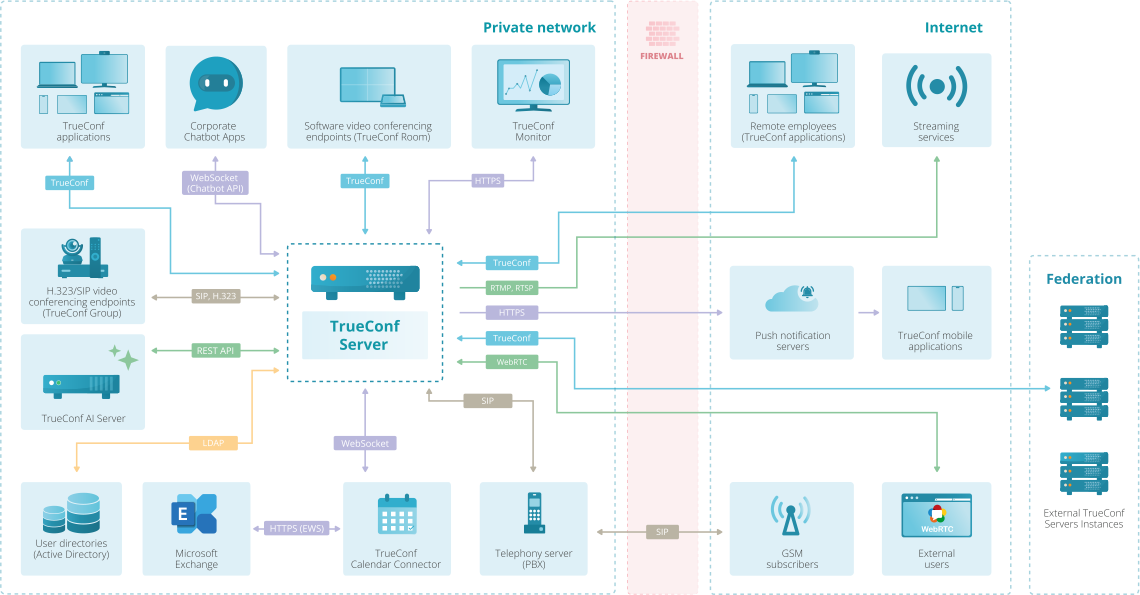
With a customer-operated deployment, the organization can decide where the platform runs and how it connects to the rest of its infrastructure.
This can be particularly useful when the organization needs messaging inside:
- private networks;
- VPN environments;
- internal data centers;
- restricted infrastructure.
But self-hosting also transfers responsibility.
The organization becomes responsible for availability, updates, backups, monitoring and recovery.
For this reason, a self-hosted platform is only useful as a sovereign solution if the organization can realistically operate it.
Business Continuity Is Part of Sovereign Messaging
Messaging is often treated as a productivity tool until the primary communication system becomes unavailable.
At that point it becomes continuity infrastructure.
This is why some sovereign messaging products are explicitly positioned as independent communication channels for outages and critical incidents. Tiris, for example, describes this as a backup communication capability independent from primary systems.
The procurement question should therefore include:
Can this platform continue to provide critical messaging when another provider or service is unavailable?
For some organizations, that requirement is more important than adding another set of collaboration features.
Where TrueConf Fits
TrueConf Server provides persistent enterprise messaging as part of a customer-operated communication environment.
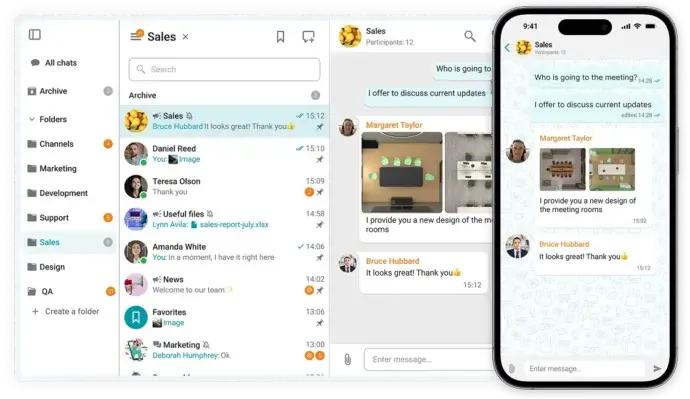
Organizations can deploy the platform on infrastructure they control and provide employees with personal chats, group chats, channels and file exchange through desktop and mobile applications.
This gives TrueConf a different architecture from public messaging services where all communication depends on a vendor-operated cloud.
For a sovereign messaging use case, the relevant characteristics are:
- customer-operated server deployment;
- persistent corporate messaging;
- centralized enterprise administration;
- integration with organizational directory infrastructure;
- operation across private LAN and VPN environments;
- messaging combined with voice and video communication when required.
The main value is not simply that TrueConf has chat.
It is that messaging can remain part of an organization-controlled communications environment rather than requiring a separate public team-messaging service.
TrueConf is therefore most relevant to organizations looking for sovereign enterprise messaging as part of broader customer-operated communications infrastructure.
See how this works in practice on the TrueConf sovereign instant messenger page.
Try TrueConf Server Free!
- 1,000 online users with the ability to chat and make one-on-one video calls.
- 10 PRO users with the ability to participate in group video conferences.
- One SIP/H.323/RTSP connection for interoperability with corporate PBX and SIP/H.323 endpoints.
- One guest connection to invite a non-authenticated user via link to your meetings.

When a Sovereign Messaging Platform Makes Sense
A sovereign messaging platform is most relevant when losing control of corporate messaging would create an unacceptable operational, legal or strategic dependency.
This can happen when an organization needs to keep internal communication inside controlled infrastructure, reduce dependence on external SaaS platforms, maintain communication across private networks or retain greater authority over business data and user administration.
For companies without those requirements, conventional SaaS messaging may remain simpler to operate.
Sovereignty should solve a real dependency problem rather than become a procurement label.
What to Check Before Selecting a Platform
A short evaluation usually reveals most of what matters.
Ask where the service is operated, who controls message data and identities, whether core messaging depends on an external cloud, how the platform handles encryption, whether it supports interoperability, and what happens if the organization needs to migrate away.
If those answers are clear, the sovereignty model is clear.
If they are not, claims such as “European”, “private”, “secure” or “self-hosted” do not tell you enough.
FAQ
What is a sovereign messaging platform?
A sovereign messaging platform is an enterprise messaging system designed to give an organization greater control over communication infrastructure, data, identities and operational dependencies.
Is sovereign messaging the same as secure messaging?
No. Secure messaging focuses primarily on protecting communication. Sovereign messaging additionally focuses on who controls the service, infrastructure and data.
Does sovereign messaging require self-hosting?
Not always. Sovereign cloud and other controlled deployment models can also address sovereignty requirements. Self-hosting provides a particularly direct form of infrastructure control.
Does a sovereign messaging platform need end-to-end encryption?
Not necessarily as part of the definition, although strong encryption may be required by the organization’s security model. Sovereignty and E2EE solve related but different problems.
Why does interoperability matter?
Interoperability can reduce vendor lock-in by allowing communication between independently operated systems and making parts of the architecture easier to replace.
Can TrueConf be used as a sovereign messaging platform?
TrueConf Server can be deployed on customer-controlled infrastructure and provides persistent enterprise messaging, user administration and private-network operation. It is relevant when messaging needs to remain part of an organization-operated communications environment.
Conclusion
A sovereign messaging platform is not simply an encrypted messenger hosted in a preferred country.
It is an enterprise messaging environment designed around control, data ownership, technological independence and continuity.
The strongest sovereign messaging architectures allow organizations to retain authority over critical communication while reducing dependence on external platforms and closed ecosystems.
For some organizations, that means European-controlled infrastructure. For others, it means self-hosting, private networks or interoperable messaging based on open standards.
TrueConf fits this category when organizations want enterprise messaging to operate as part of customer-controlled communications infrastructure rather than depend entirely on a public messaging cloud.
The decisive question is simple:
Who ultimately controls your organization’s messaging environment?
About the Author
Olga Afonina is a technology writer and industry expert specializing in video conferencing solutions and collaboration software. At TrueConf, she focuses on exploring the latest trends in collaboration technologies and providing businesses with practical insights into effective workplace communication. Drawing on her background in content development and industry research, Olga writes articles and reviews that help readers better understand the benefits of enterprise-grade communication.


Follow us on social networks